

increase. The Si-rich allophane is sometimes found in the weathered pumice layer of
the deeper part of Andisol profiles.
Imogolite gel films can be found in field-moist weathered pumice (Fig. 4.9a)
taken from the 2Bw1 horizon of the pedon shown in Fig. 4.19. After separation of
the film from soil clods and suspending it in pure water followed by ultrasonic
treatment, a thin imogolite suspension can be prepared. After spotting the suspension
on the micro grid attached copper mesh, a photograph of allophane and imogolite
can be obtained using transmission electron microscope (TEM) (Fig. 4.9b). The thin
fibrous material visible in Fig. 4.9b is imogolite, and the small distorted circles are
allophane. Similar imogolite gel film (Fig. 4.9c) was also found in the 3Bw5 horizon
(Fig. 4.19).
As shown in Fig. 4.9a and c, the imogolite gel film exists at the voids among
pumice particles, and it contains not only imogolite but also allophane, suggesting
that these films are formed through precipitation reactions. Allophanic materials
form as altermorphs of vesicle walls inside the pumice particle as shown later in
Figs. 4.26 and 4.29. Thus, two types of occurrences are possible for allophane in the
weathered pumice.
The allophane and imogolite content can be estimated by oxalate extraction as 7.1
times Si o , where Si o denotes the amount of oxalate-extractable Si (Parfitt and Henmi
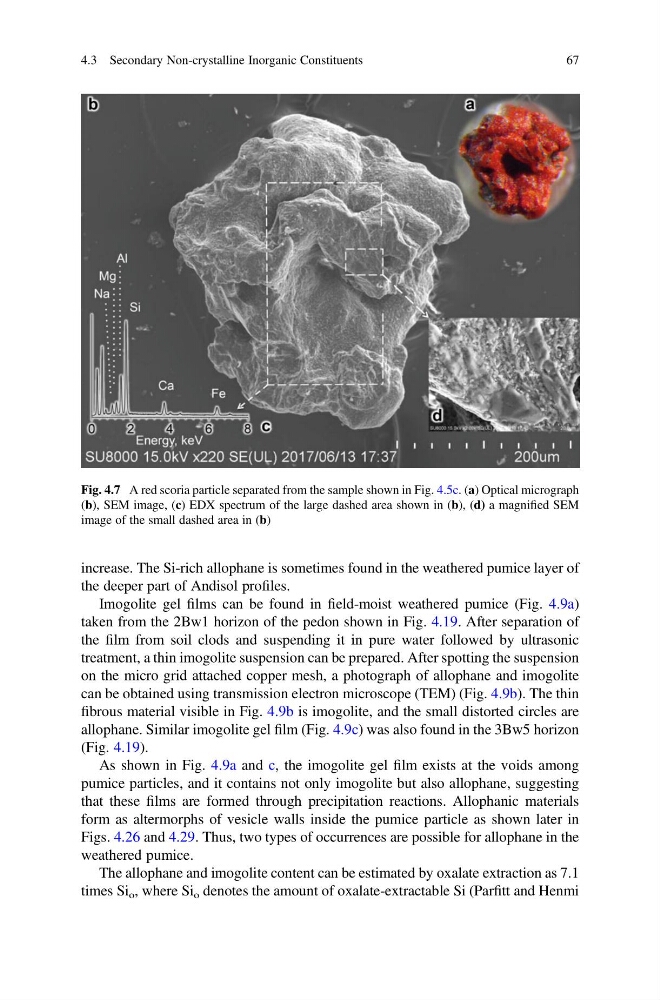
Fig. 4.7 A red scoria particle separated from the sample shown in Fig. 4.5c. (a) Optical micrograph
(b), SEM image, (c) EDX spectrum of the large dashed area shown in (b), (d) a magnified SEM
image of the small dashed area in (b)
4.3 Secondary Non-crystalline Inorganic Constituents
67
the deeper part of Andisol profiles.
Imogolite gel films can be found in field-moist weathered pumice (Fig. 4.9a)
taken from the 2Bw1 horizon of the pedon shown in Fig. 4.19. After separation of
the film from soil clods and suspending it in pure water followed by ultrasonic
treatment, a thin imogolite suspension can be prepared. After spotting the suspension
on the micro grid attached copper mesh, a photograph of allophane and imogolite
can be obtained using transmission electron microscope (TEM) (Fig. 4.9b). The thin
fibrous material visible in Fig. 4.9b is imogolite, and the small distorted circles are
allophane. Similar imogolite gel film (Fig. 4.9c) was also found in the 3Bw5 horizon
(Fig. 4.19).
As shown in Fig. 4.9a and c, the imogolite gel film exists at the voids among
pumice particles, and it contains not only imogolite but also allophane, suggesting
that these films are formed through precipitation reactions. Allophanic materials
form as altermorphs of vesicle walls inside the pumice particle as shown later in
Figs. 4.26 and 4.29. Thus, two types of occurrences are possible for allophane in the
weathered pumice.
The allophane and imogolite content can be estimated by oxalate extraction as 7.1
times Si o , where Si o denotes the amount of oxalate-extractable Si (Parfitt and Henmi
Fig. 4.7 A red scoria particle separated from the sample shown in Fig. 4.5c. (a) Optical micrograph
(b), SEM image, (c) EDX spectrum of the large dashed area shown in (b), (d) a magnified SEM
image of the small dashed area in (b)
4.3 Secondary Non-crystalline Inorganic Constituents
67