

Volcanic ash is sorted by its particle size and the specific gravity of its constituent
mineral particles during transportation in air. In the case of Tarmae-a (Ta-a) tephra
(AD1739), Hokkaido, Japan, the heavy mineral content decreased with distance
from source volcano. As the heavy mineral content decreased, the Fe and Mg content
of Ta-a tephra also decreased while the Si content increased correspondingly
(Mizuno et al. 2008).
The color of volcanic glasses is related to the rock type of the tephra. Volcanic ash
of rhyolite, dacite, and andesite rock types is dominated by non-colored volcanic
glasses including a slightly purplish one, whereas basalt and basaltic andesite rock
type is dominated by colored volcanic glasses (Shoji 1986). The chemical composition of volcanic ash is also related to rock types. The Al 2 O 3 , FeO, MgO, and CaO
content of 26 volcanic ash samples significantly, and Na 2 O, K 2 O and TiO 2 also
correlated with SiO 2 content (Shoji et al. 1975). In nine non-colored volcanic glass
samples, SiO 2 content ranged between 74.24 and 77.89%, and Al 2 O 3 content ranged
between 12.65 and 14.71%. The variation in the concentrations of SiO 2 and Al 2 O 3 of
the non-colored volcanic glasses are minor compared to that for the total SiO 2 and
Al 2 O 3 concentrations of the volcanic ashes. In contrast, in glasses present in basaltic
andesite and basalt volcanic ashes, the Al 2 O 3 , Fe 2 O 3 , MgO, and CaO contents
increase with decreasing SiO 2 content.
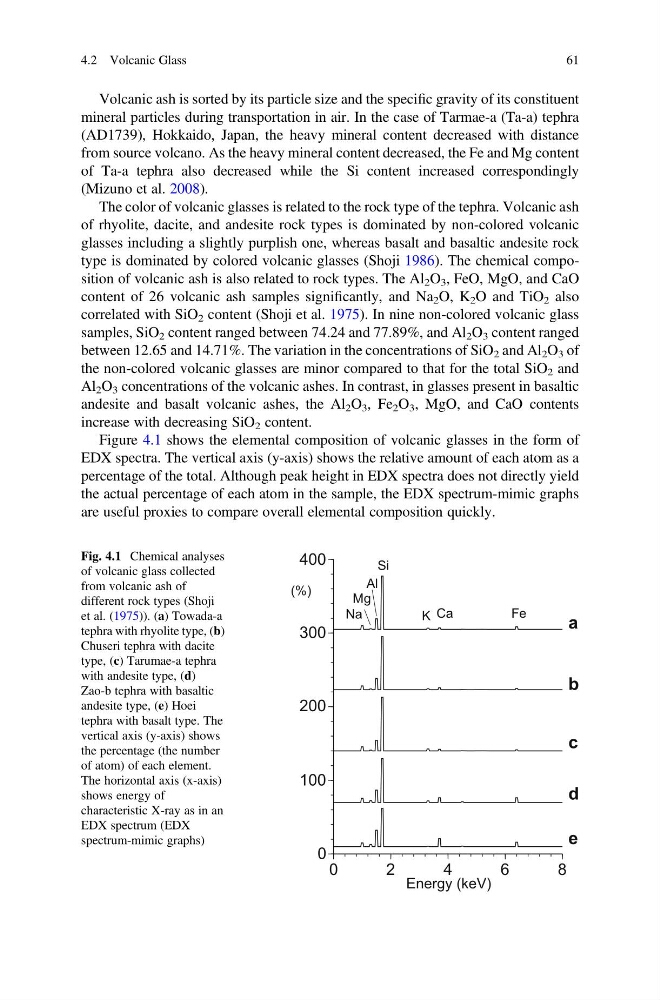
Figure 4.1 shows the elemental composition of volcanic glasses in the form of
EDX spectra. The vertical axis (y-axis) shows the relative amount of each atom as a
percentage of the total. Although peak height in EDX spectra does not directly yield
the actual percentage of each atom in the sample, the EDX spectrum-mimic graphs
are useful proxies to compare overall elemental composition quickly.
0
100
200
300
400
0
2
4
6
8
Na
Mg
Al
Si
K Ca
Fe
a
b
c
d
e
(%)
Energy (keV)
Fig. 4.1 Chemical analyses
of volcanic glass collected
from volcanic ash of
different rock types (Shoji
et al. (1975)). (a) Towada-a
tephra with rhyolite type, (b)
Chuseri tephra with dacite
type, (c) Tarumae-a tephra
with andesite type, (d)
Zao-b tephra with basaltic
andesite type, (e) Hoei
tephra with basalt type. The
vertical axis (y-axis) shows
the percentage (the number
of atom) of each element.
The horizontal axis (x-axis)
shows energy of
characteristic X-ray as in an
EDX spectrum (EDX
spectrum-mimic graphs)
4.2 Volcanic Glass
61
mineral particles during transportation in air. In the case of Tarmae-a (Ta-a) tephra
(AD1739), Hokkaido, Japan, the heavy mineral content decreased with distance
from source volcano. As the heavy mineral content decreased, the Fe and Mg content
of Ta-a tephra also decreased while the Si content increased correspondingly
(Mizuno et al. 2008).
The color of volcanic glasses is related to the rock type of the tephra. Volcanic ash
of rhyolite, dacite, and andesite rock types is dominated by non-colored volcanic
glasses including a slightly purplish one, whereas basalt and basaltic andesite rock
type is dominated by colored volcanic glasses (Shoji 1986). The chemical composition of volcanic ash is also related to rock types. The Al 2 O 3 , FeO, MgO, and CaO
content of 26 volcanic ash samples significantly, and Na 2 O, K 2 O and TiO 2 also
correlated with SiO 2 content (Shoji et al. 1975). In nine non-colored volcanic glass
samples, SiO 2 content ranged between 74.24 and 77.89%, and Al 2 O 3 content ranged
between 12.65 and 14.71%. The variation in the concentrations of SiO 2 and Al 2 O 3 of
the non-colored volcanic glasses are minor compared to that for the total SiO 2 and
Al 2 O 3 concentrations of the volcanic ashes. In contrast, in glasses present in basaltic
andesite and basalt volcanic ashes, the Al 2 O 3 , Fe 2 O 3 , MgO, and CaO contents
increase with decreasing SiO 2 content.
Figure 4.1 shows the elemental composition of volcanic glasses in the form of
EDX spectra. The vertical axis (y-axis) shows the relative amount of each atom as a
percentage of the total. Although peak height in EDX spectra does not directly yield
the actual percentage of each atom in the sample, the EDX spectrum-mimic graphs
are useful proxies to compare overall elemental composition quickly.
0
100
200
300
400
0
2
4
6
8
Na
Mg
Al
Si
K Ca
Fe
a
b
c
d
e
(%)
Energy (keV)
Fig. 4.1 Chemical analyses
of volcanic glass collected
from volcanic ash of
different rock types (Shoji
et al. (1975)). (a) Towada-a
tephra with rhyolite type, (b)
Chuseri tephra with dacite
type, (c) Tarumae-a tephra
with andesite type, (d)
Zao-b tephra with basaltic
andesite type, (e) Hoei
tephra with basalt type. The
vertical axis (y-axis) shows
the percentage (the number
of atom) of each element.
The horizontal axis (x-axis)
shows energy of
characteristic X-ray as in an
EDX spectrum (EDX
spectrum-mimic graphs)
4.2 Volcanic Glass
61