

Non-crystalline iron sulfide and iron phosphate were covered in Chap. 5, and noncrystalline aluminum phosphate were covered in Sect. 6.4. The term “volcanic ash
soils” encompasses all soils derived from volcanic ash, whereas Andisols are soils
defined by Soil Taxonomy of United States Department of Agriculutre (USDA).
4.2 Volcanic Glass
Volcanic ash, in this monograph, refers collectively to volcanic ejecta or tephra,
including pyroclastic fall and flow materials such as volcanic ash, cinders, lapilli,
scoria, and pumice (Dahlgren et al. 1993). Volcanic glass is a non-crystalline silicaalumina material and is a major constituent of the volcanic ash ejected from
volcanoes (Yamada and Shoji 1975; Heiken and Wohletz 1985). The morphological
types of volcanic glasses include sponge-like, bubble-wall type (curved platy),
fibrous, and berry-like (Shoji et al. 1993). The diameter of sponge-like and berrylike volcanic glasses can exceed 2 mm. The diameter of volcanic glass ranges below
2 μm. The color of volcanic glasses is related to the rock type of volcanic ash.
Sponge-like, bubble-wall, or fibrous glasses are non-colored. Coloured volcanic
glass is mostly berry-like with crystallites.
4.2.1 Chemical Composition of Volcanic Glasses
Shoji et al. (1975) classified volcanic ashes into five rock types based on the total
SiO 2 content. The five rock types are rhyolite, dacite, andesite, basaltic andesite, and
basalt. Their total SiO 2 content ranges are 100–70, 70–62, 62–58, 58–53.5, and
53.5–45%, respectively. Reclassification of 26 tephra reported by Shoji et al. (1975)
using the updated classification of Le Maitre (2002), known as the total alkali silica
classification (TAS diagram), yielded the same results for 22 tephra. Two of the
remaining tephra were close to the boundary between andesite and dacite, and the
other two lay between dacite and rhyolite, because the Na 2 O + K 2 O contents of all
26 tephra were below the boundaries between the four rock types (basalt, basaltic
andesite, andesite, and dacite) and the corresponding trachy-types of the TAS
diagram.
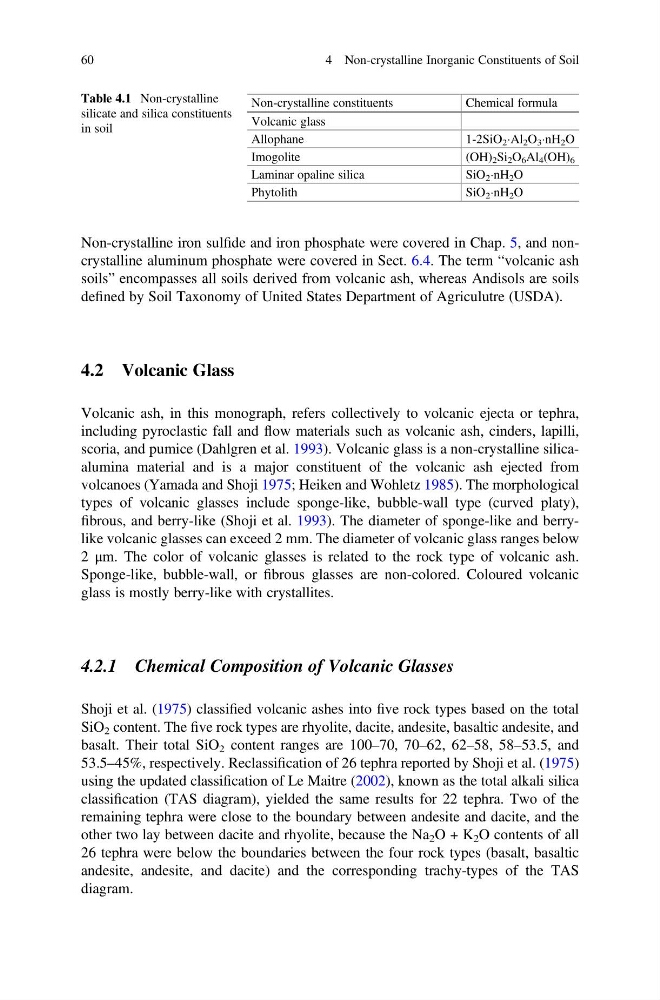
Table 4.1 Non-crystalline
silicate and silica constituents
in soil
Non-crystalline constituents
Chemical formula
Volcanic glass
Allophane
1-2SiO 2 ÁAl 2 O 3 ÁnH 2 O
Imogolite
(OH) 2 Si 2 O 6 Al 4 (OH) 6
Laminar opaline silica
SiO 2 ÁnH 2 O
Phytolith
SiO 2 ÁnH 2 O
60
4 Non-crystalline Inorganic Constituents of Soil
soils” encompasses all soils derived from volcanic ash, whereas Andisols are soils
defined by Soil Taxonomy of United States Department of Agriculutre (USDA).
4.2 Volcanic Glass
Volcanic ash, in this monograph, refers collectively to volcanic ejecta or tephra,
including pyroclastic fall and flow materials such as volcanic ash, cinders, lapilli,
scoria, and pumice (Dahlgren et al. 1993). Volcanic glass is a non-crystalline silicaalumina material and is a major constituent of the volcanic ash ejected from
volcanoes (Yamada and Shoji 1975; Heiken and Wohletz 1985). The morphological
types of volcanic glasses include sponge-like, bubble-wall type (curved platy),
fibrous, and berry-like (Shoji et al. 1993). The diameter of sponge-like and berrylike volcanic glasses can exceed 2 mm. The diameter of volcanic glass ranges below
2 μm. The color of volcanic glasses is related to the rock type of volcanic ash.
Sponge-like, bubble-wall, or fibrous glasses are non-colored. Coloured volcanic
glass is mostly berry-like with crystallites.
4.2.1 Chemical Composition of Volcanic Glasses
Shoji et al. (1975) classified volcanic ashes into five rock types based on the total
SiO 2 content. The five rock types are rhyolite, dacite, andesite, basaltic andesite, and
basalt. Their total SiO 2 content ranges are 100–70, 70–62, 62–58, 58–53.5, and
53.5–45%, respectively. Reclassification of 26 tephra reported by Shoji et al. (1975)
using the updated classification of Le Maitre (2002), known as the total alkali silica
classification (TAS diagram), yielded the same results for 22 tephra. Two of the
remaining tephra were close to the boundary between andesite and dacite, and the
other two lay between dacite and rhyolite, because the Na 2 O + K 2 O contents of all
26 tephra were below the boundaries between the four rock types (basalt, basaltic
andesite, andesite, and dacite) and the corresponding trachy-types of the TAS
diagram.
Table 4.1 Non-crystalline
silicate and silica constituents
in soil
Non-crystalline constituents
Chemical formula
Volcanic glass
Allophane
1-2SiO 2 ÁAl 2 O 3 ÁnH 2 O
Imogolite
(OH) 2 Si 2 O 6 Al 4 (OH) 6
Laminar opaline silica
SiO 2 ÁnH 2 O
Phytolith
SiO 2 ÁnH 2 O
60
4 Non-crystalline Inorganic Constituents of Soil