

From among the manganese minerals reviewed by McKenzie (1989), the examples of birnesite and lithiophorite are introduced in this section. Birnesite is a group
of manganese oxides including δ-MnO 2 , manganous manganite, and others.
According to McKenzie (1989), the birnesite group is characterized by a 0.7 nm
XRD basal reflection and its higher order. The chemical formula of lithiophorite is
(Al,Li)MnO 2 (OH) 2 . Analyses of lithiophorite and birnesite show high Mn 3 O 4 concentration (McKenzie 1989).
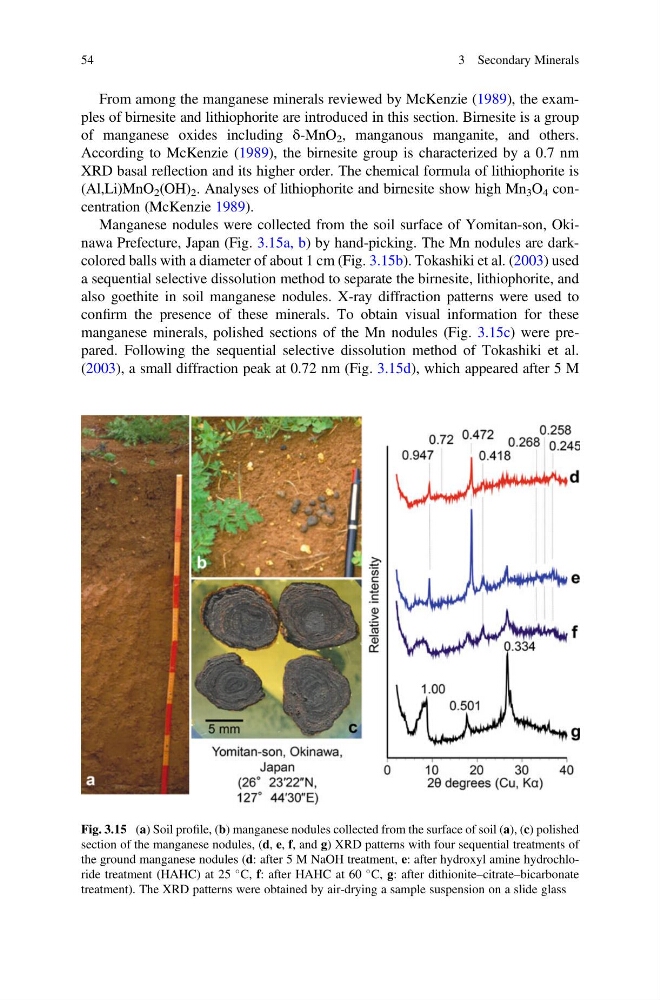
Manganese nodules were collected from the soil surface of Yomitan-son, Okinawa Prefecture, Japan (Fig. 3.15a, b) by hand-picking. The Mn nodules are darkcolored balls with a diameter of about 1 cm (Fig. 3.15b). Tokashiki et al. (2003) used
a sequential selective dissolution method to separate the birnesite, lithiophorite, and
also goethite in soil manganese nodules. X-ray diffraction patterns were used to
confirm the presence of these minerals. To obtain visual information for these
manganese minerals, polished sections of the Mn nodules (Fig. 3.15c) were prepared. Following the sequential selective dissolution method of Tokashiki et al.
(2003), a small diffraction peak at 0.72 nm (Fig. 3.15d), which appeared after 5 M
Fig. 3.15 (a) Soil profile, (b) manganese nodules collected from the surface of soil (a), (c) polished
section of the manganese nodules, (d, e, f, and g) XRD patterns with four sequential treatments of
the ground manganese nodules (d: after 5 M NaOH treatment, e: after hydroxyl amine hydrochloride treatment (HAHC) at 25
C, f: after HAHC at 60
C, g: after dithionite–citrate–bicarbonate
treatment). The XRD patterns were obtained by air-drying a sample suspension on a slide glass
54
3 Secondary Minerals
of manganese oxides including δ-MnO 2 , manganous manganite, and others.
According to McKenzie (1989), the birnesite group is characterized by a 0.7 nm
XRD basal reflection and its higher order. The chemical formula of lithiophorite is
(Al,Li)MnO 2 (OH) 2 . Analyses of lithiophorite and birnesite show high Mn 3 O 4 concentration (McKenzie 1989).
Manganese nodules were collected from the soil surface of Yomitan-son, Okinawa Prefecture, Japan (Fig. 3.15a, b) by hand-picking. The Mn nodules are darkcolored balls with a diameter of about 1 cm (Fig. 3.15b). Tokashiki et al. (2003) used
a sequential selective dissolution method to separate the birnesite, lithiophorite, and
also goethite in soil manganese nodules. X-ray diffraction patterns were used to
confirm the presence of these minerals. To obtain visual information for these
manganese minerals, polished sections of the Mn nodules (Fig. 3.15c) were prepared. Following the sequential selective dissolution method of Tokashiki et al.
(2003), a small diffraction peak at 0.72 nm (Fig. 3.15d), which appeared after 5 M
Fig. 3.15 (a) Soil profile, (b) manganese nodules collected from the surface of soil (a), (c) polished
section of the manganese nodules, (d, e, f, and g) XRD patterns with four sequential treatments of
the ground manganese nodules (d: after 5 M NaOH treatment, e: after hydroxyl amine hydrochloride treatment (HAHC) at 25
C, f: after HAHC at 60
C, g: after dithionite–citrate–bicarbonate
treatment). The XRD patterns were obtained by air-drying a sample suspension on a slide glass
54
3 Secondary Minerals