

gibbsite particles marked by the letters (a) and (b). As shown by the EDX spectra
(Fig. 3.13a, b), the cations of these particles are mostly Al. Other particles in
Fig. 3.13 are aggregates of allophanic non-crystalline materials (most abundant,
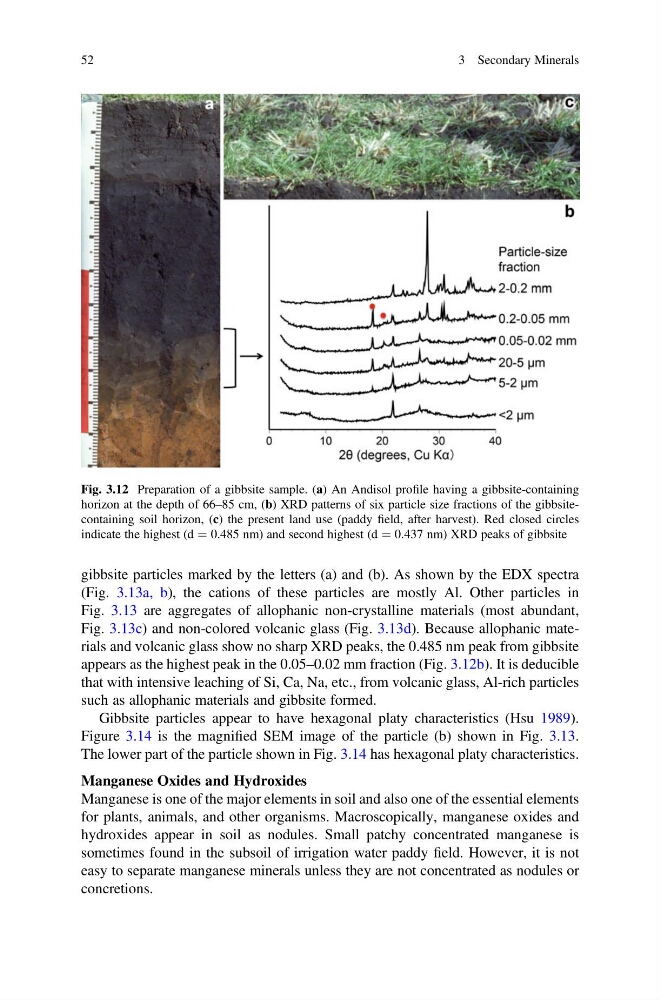
Fig. 3.13c) and non-colored volcanic glass (Fig. 3.13d). Because allophanic materials and volcanic glass show no sharp XRD peaks, the 0.485 nm peak from gibbsite
appears as the highest peak in the 0.05–0.02 mm fraction (Fig. 3.12b). It is deducible
that with intensive leaching of Si, Ca, Na, etc., from volcanic glass, Al-rich particles
such as allophanic materials and gibbsite formed.
Gibbsite particles appear to have hexagonal platy characteristics (Hsu 1989).
Figure 3.14 is the magnified SEM image of the particle (b) shown in Fig. 3.13.
The lower part of the particle shown in Fig. 3.14 has hexagonal platy characteristics.
Manganese Oxides and Hydroxides
Manganese is one of the major elements in soil and also one of the essential elements
for plants, animals, and other organisms. Macroscopically, manganese oxides and
hydroxides appear in soil as nodules. Small patchy concentrated manganese is
sometimes found in the subsoil of irrigation water paddy field. However, it is not
easy to separate manganese minerals unless they are not concentrated as nodules or
concretions.
Fig. 3.12 Preparation of a gibbsite sample. (a) An Andisol profile having a gibbsite-containing
horizon at the depth of 66–85 cm, (b) XRD patterns of six particle size fractions of the gibbsitecontaining soil horizon, (c) the present land use (paddy field, after harvest). Red closed circles
indicate the highest (d ¼ 0.485 nm) and second highest (d ¼ 0.437 nm) XRD peaks of gibbsite
52
3 Secondary Minerals
(Fig. 3.13a, b), the cations of these particles are mostly Al. Other particles in
Fig. 3.13 are aggregates of allophanic non-crystalline materials (most abundant,
Fig. 3.13c) and non-colored volcanic glass (Fig. 3.13d). Because allophanic materials and volcanic glass show no sharp XRD peaks, the 0.485 nm peak from gibbsite
appears as the highest peak in the 0.05–0.02 mm fraction (Fig. 3.12b). It is deducible
that with intensive leaching of Si, Ca, Na, etc., from volcanic glass, Al-rich particles
such as allophanic materials and gibbsite formed.
Gibbsite particles appear to have hexagonal platy characteristics (Hsu 1989).
Figure 3.14 is the magnified SEM image of the particle (b) shown in Fig. 3.13.
The lower part of the particle shown in Fig. 3.14 has hexagonal platy characteristics.
Manganese Oxides and Hydroxides
Manganese is one of the major elements in soil and also one of the essential elements
for plants, animals, and other organisms. Macroscopically, manganese oxides and
hydroxides appear in soil as nodules. Small patchy concentrated manganese is
sometimes found in the subsoil of irrigation water paddy field. However, it is not
easy to separate manganese minerals unless they are not concentrated as nodules or
concretions.
Fig. 3.12 Preparation of a gibbsite sample. (a) An Andisol profile having a gibbsite-containing
horizon at the depth of 66–85 cm, (b) XRD patterns of six particle size fractions of the gibbsitecontaining soil horizon, (c) the present land use (paddy field, after harvest). Red closed circles
indicate the highest (d ¼ 0.485 nm) and second highest (d ¼ 0.437 nm) XRD peaks of gibbsite
52
3 Secondary Minerals