

3.3 Oxides, Hydroxides, and Others
Secondary minerals in soil other than phyllosilicates include oxides, hydroxides,
carbonates, sulfates, phosphates, halides, etc., and these are summarized in
Table 3.2. Some of these are reaction products between soil inorganic constituents
and fertilizers added to farmland. In this section, gibbsite and manganese oxides are
considered. The minerals in Table 3.2 include minerals introduced in subsequent
chapters.
Gibbsite
Gibbsite is an aluminum hydroxide [Al(OH) 3 ] mineral occurring in highly weathered soils such as Oxisols (Hsu 1989). The gibbsite sheet was shown in Fig. 3.2b.
Gibbsite sheets stack in the Z direction with hydrogen bonding.
Gibbsite also occurs in Andisols (Wada and Aomine 1966). Figure 3.12a, b
shows an Andisol having a gibbsite-containing horizon at the depth of 66–85 cm
from the surface. Gibbsite exists in the 0.2–0.05, 0.05–0.02, and 0.02–0.005 mm
particle size fractions as shown by the XRD peaks at the d-spacing of 0.485 and
0.437 nm.
In the 0.05–0.02 mm particle size fraction, gibbsite particles were found using
element mapping; they appear as Al-rich particles. In Fig. 3.13, there are two
Mg, Fe
Y
X
X
Z
K +
H
H
K +
H
H
a
H
b
H
d
e
Al
Tetrahedral
sheet
Octahedral
sheet
Tetrahedral
sheet
OH
c
Repulsive
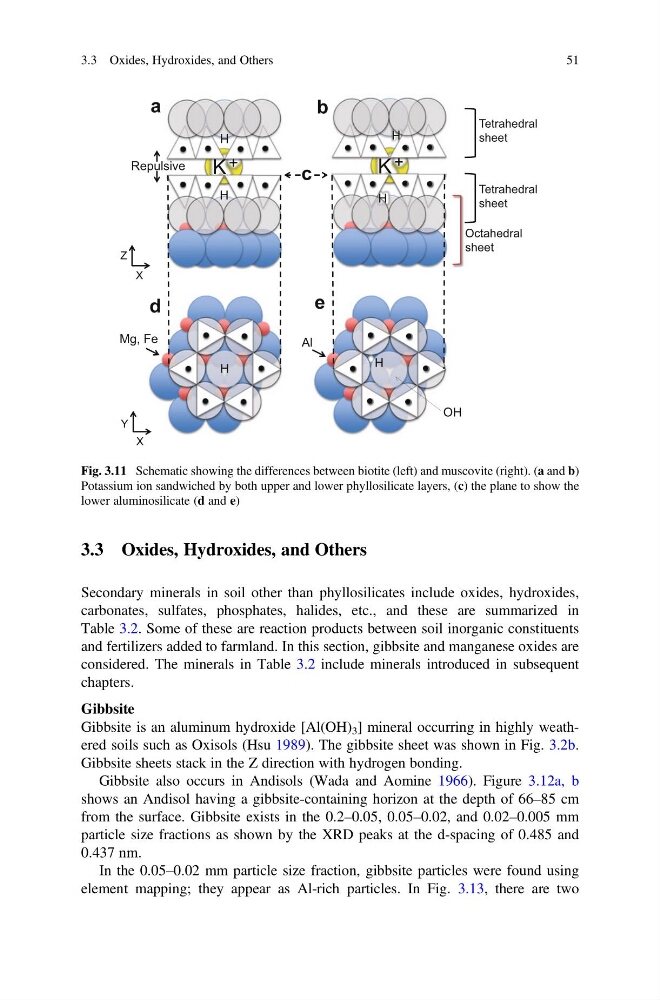
Fig. 3.11 Schematic showing the differences between biotite (left) and muscovite (right). (a and b)
Potassium ion sandwiched by both upper and lower phyllosilicate layers, (c) the plane to show the
lower aluminosilicate (d and e)
3.3 Oxides, Hydroxides, and Others
51
Secondary minerals in soil other than phyllosilicates include oxides, hydroxides,
carbonates, sulfates, phosphates, halides, etc., and these are summarized in
Table 3.2. Some of these are reaction products between soil inorganic constituents
and fertilizers added to farmland. In this section, gibbsite and manganese oxides are
considered. The minerals in Table 3.2 include minerals introduced in subsequent
chapters.
Gibbsite
Gibbsite is an aluminum hydroxide [Al(OH) 3 ] mineral occurring in highly weathered soils such as Oxisols (Hsu 1989). The gibbsite sheet was shown in Fig. 3.2b.
Gibbsite sheets stack in the Z direction with hydrogen bonding.
Gibbsite also occurs in Andisols (Wada and Aomine 1966). Figure 3.12a, b
shows an Andisol having a gibbsite-containing horizon at the depth of 66–85 cm
from the surface. Gibbsite exists in the 0.2–0.05, 0.05–0.02, and 0.02–0.005 mm
particle size fractions as shown by the XRD peaks at the d-spacing of 0.485 and
0.437 nm.
In the 0.05–0.02 mm particle size fraction, gibbsite particles were found using
element mapping; they appear as Al-rich particles. In Fig. 3.13, there are two
Mg, Fe
Y
X
X
Z
K +
H
H
K +
H
H
a
H
b
H
d
e
Al
Tetrahedral
sheet
Octahedral
sheet
Tetrahedral
sheet
OH
c
Repulsive
Fig. 3.11 Schematic showing the differences between biotite (left) and muscovite (right). (a and b)
Potassium ion sandwiched by both upper and lower phyllosilicate layers, (c) the plane to show the
lower aluminosilicate (d and e)
3.3 Oxides, Hydroxides, and Others
51