

properties of Vertisols, which occupy about 3% of the world’s soil and are distributed mainly in a portion of the Mexico Gulf region, a part of India, the upper Nile
flow region, and southeastern Australia. Without alternating wet and dry seasons,
Vertisols do not form even if smectite is abundant in the soil.
The characteristics of vermiculite are high CEC, dominance of the trioctahedral
type, and a wide range of particle size from sand to clay. The basal spacing of Mg
2+ -
saturated vermiculite is 1.4 nm. The spacing decreases to 1.0 nm with K
+ saturation,
and it does not expand with glyceration. This property is used to identify vermiculite
in soil from XRD patterns. The trioctahedral vermiculite can form from trioctahedral
micas in a tephra-deived soil (Nanzyo et al. 2001).
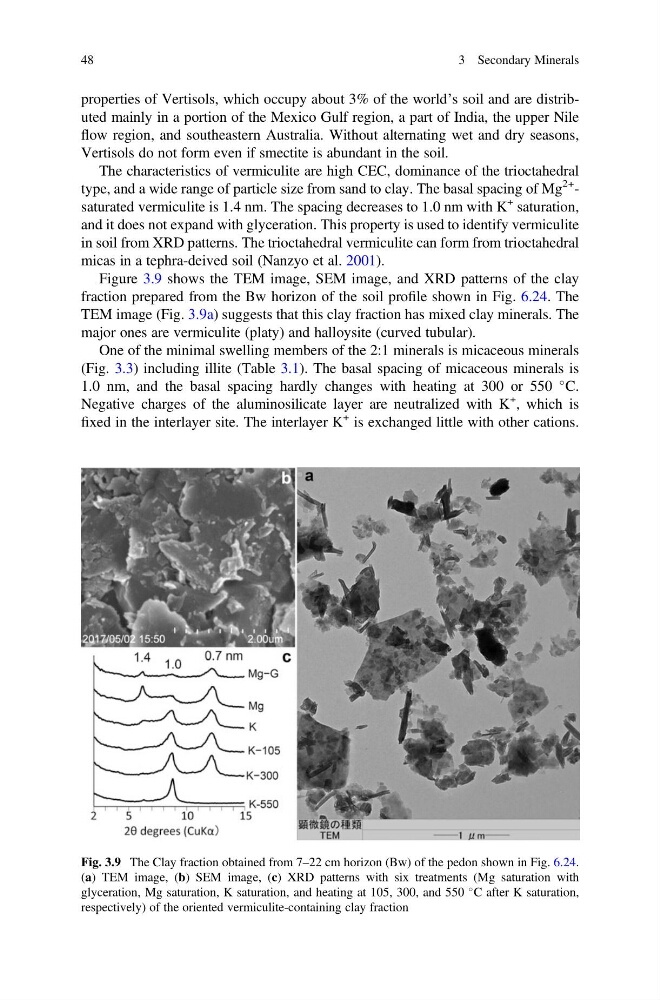
Figure 3.9 shows the TEM image, SEM image, and XRD patterns of the clay
fraction prepared from the Bw horizon of the soil profile shown in Fig. 6.24. The
TEM image (Fig. 3.9a) suggests that this clay fraction has mixed clay minerals. The
major ones are vermiculite (platy) and halloysite (curved tubular).
One of the minimal swelling members of the 2:1 minerals is micaceous minerals
(Fig. 3.3) including illite (Table 3.1). The basal spacing of micaceous minerals is
1.0 nm, and the basal spacing hardly changes with heating at 300 or 550
C.
Negative charges of the aluminosilicate layer are neutralized with K
+
, which is
fixed in the interlayer site. The interlayer K
+ is exchanged little with other cations.
Fig. 3.9 The Clay fraction obtained from 7–22 cm horizon (Bw) of the pedon shown in Fig. 6.24.
(a) TEM image, (b) SEM image, (c) XRD patterns with six treatments (Mg saturation with
glyceration, Mg saturation, K saturation, and heating at 105, 300, and 550
C after K saturation,
respectively) of the oriented vermiculite-containing clay fraction
48
3 Secondary Minerals
flow region, and southeastern Australia. Without alternating wet and dry seasons,
Vertisols do not form even if smectite is abundant in the soil.
The characteristics of vermiculite are high CEC, dominance of the trioctahedral
type, and a wide range of particle size from sand to clay. The basal spacing of Mg
2+ -
saturated vermiculite is 1.4 nm. The spacing decreases to 1.0 nm with K
+ saturation,
and it does not expand with glyceration. This property is used to identify vermiculite
in soil from XRD patterns. The trioctahedral vermiculite can form from trioctahedral
micas in a tephra-deived soil (Nanzyo et al. 2001).
Figure 3.9 shows the TEM image, SEM image, and XRD patterns of the clay
fraction prepared from the Bw horizon of the soil profile shown in Fig. 6.24. The
TEM image (Fig. 3.9a) suggests that this clay fraction has mixed clay minerals. The
major ones are vermiculite (platy) and halloysite (curved tubular).
One of the minimal swelling members of the 2:1 minerals is micaceous minerals
(Fig. 3.3) including illite (Table 3.1). The basal spacing of micaceous minerals is
1.0 nm, and the basal spacing hardly changes with heating at 300 or 550
C.
Negative charges of the aluminosilicate layer are neutralized with K
+
, which is
fixed in the interlayer site. The interlayer K
+ is exchanged little with other cations.
Fig. 3.9 The Clay fraction obtained from 7–22 cm horizon (Bw) of the pedon shown in Fig. 6.24.
(a) TEM image, (b) SEM image, (c) XRD patterns with six treatments (Mg saturation with
glyceration, Mg saturation, K saturation, and heating at 105, 300, and 550
C after K saturation,
respectively) of the oriented vermiculite-containing clay fraction
48
3 Secondary Minerals