

The particle size of micaceous minerals ranges widely between sand Figs. 2.10 and
2.11 and clay. Micaceous minerals are also formed by diagenesis, not only from the
weathering of igneous rocks.
The final member of the 2:1 minerals is chlorite (Fig. 3.3). Chlorite has an
inorganic polymer at the interlayer site. For example, in Mg chlorite (Table 3.1),
negative charges of the aluminosilicate layer accommodate a positively charged
brucite layer in which Mg
2+ is partly replaced with Al
3+ . Chlorite can be regarded as
a 2:1:1 type mineral, in which the last layer is, for example, the brucite layer of Mg
chlorite.
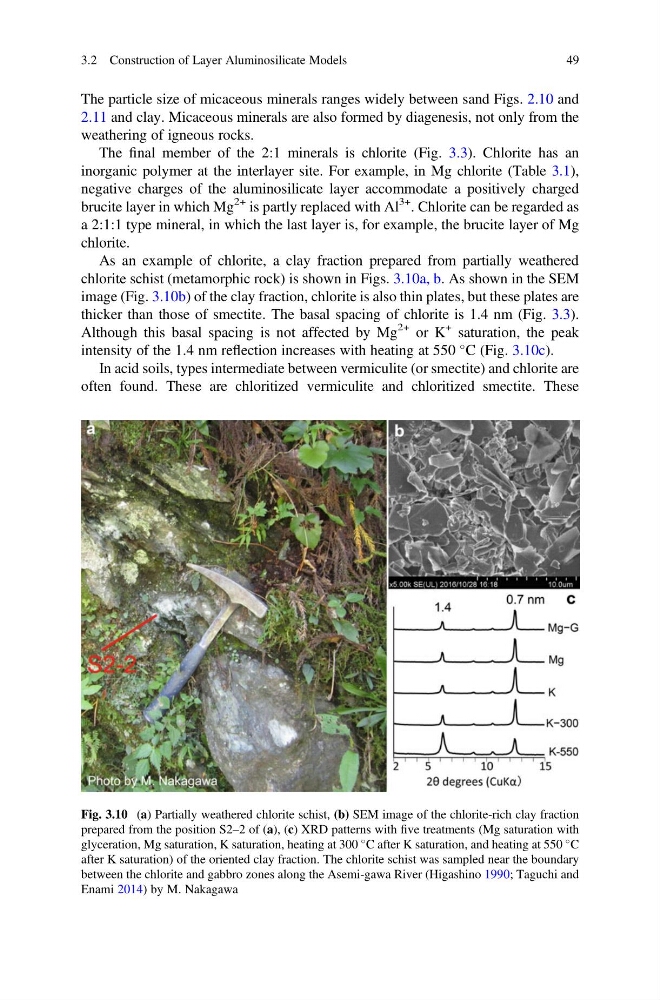
As an example of chlorite, a clay fraction prepared from partially weathered
chlorite schist (metamorphic rock) is shown in Figs. 3.10a, b. As shown in the SEM
image (Fig. 3.10b) of the clay fraction, chlorite is also thin plates, but these plates are
thicker than those of smectite. The basal spacing of chlorite is 1.4 nm (Fig. 3.3).
Although this basal spacing is not affected by Mg
2+ or K
+ saturation, the peak
intensity of the 1.4 nm reflection increases with heating at 550
C (Fig. 3.10c).
In acid soils, types intermediate between vermiculite (or smectite) and chlorite are
often found. These are chloritized vermiculite and chloritized smectite. These
Fig. 3.10 (a) Partially weathered chlorite schist, (b) SEM image of the chlorite-rich clay fraction
prepared from the position S2–2 of (a), (c) XRD patterns with five treatments (Mg saturation with
glyceration, Mg saturation, K saturation, heating at 300
C after K saturation, and heating at 550
C
after K saturation) of the oriented clay fraction. The chlorite schist was sampled near the boundary
between the chlorite and gabbro zones along the Asemi-gawa River (Higashino 1990; Taguchi and
Enami 2014) by M. Nakagawa
3.2 Construction of Layer Aluminosilicate Models
49
2.11 and clay. Micaceous minerals are also formed by diagenesis, not only from the
weathering of igneous rocks.
The final member of the 2:1 minerals is chlorite (Fig. 3.3). Chlorite has an
inorganic polymer at the interlayer site. For example, in Mg chlorite (Table 3.1),
negative charges of the aluminosilicate layer accommodate a positively charged
brucite layer in which Mg
2+ is partly replaced with Al
3+ . Chlorite can be regarded as
a 2:1:1 type mineral, in which the last layer is, for example, the brucite layer of Mg
chlorite.
As an example of chlorite, a clay fraction prepared from partially weathered
chlorite schist (metamorphic rock) is shown in Figs. 3.10a, b. As shown in the SEM
image (Fig. 3.10b) of the clay fraction, chlorite is also thin plates, but these plates are
thicker than those of smectite. The basal spacing of chlorite is 1.4 nm (Fig. 3.3).
Although this basal spacing is not affected by Mg
2+ or K
+ saturation, the peak
intensity of the 1.4 nm reflection increases with heating at 550
C (Fig. 3.10c).
In acid soils, types intermediate between vermiculite (or smectite) and chlorite are
often found. These are chloritized vermiculite and chloritized smectite. These
Fig. 3.10 (a) Partially weathered chlorite schist, (b) SEM image of the chlorite-rich clay fraction
prepared from the position S2–2 of (a), (c) XRD patterns with five treatments (Mg saturation with
glyceration, Mg saturation, K saturation, heating at 300
C after K saturation, and heating at 550
C
after K saturation) of the oriented clay fraction. The chlorite schist was sampled near the boundary
between the chlorite and gabbro zones along the Asemi-gawa River (Higashino 1990; Taguchi and
Enami 2014) by M. Nakagawa
3.2 Construction of Layer Aluminosilicate Models
49