

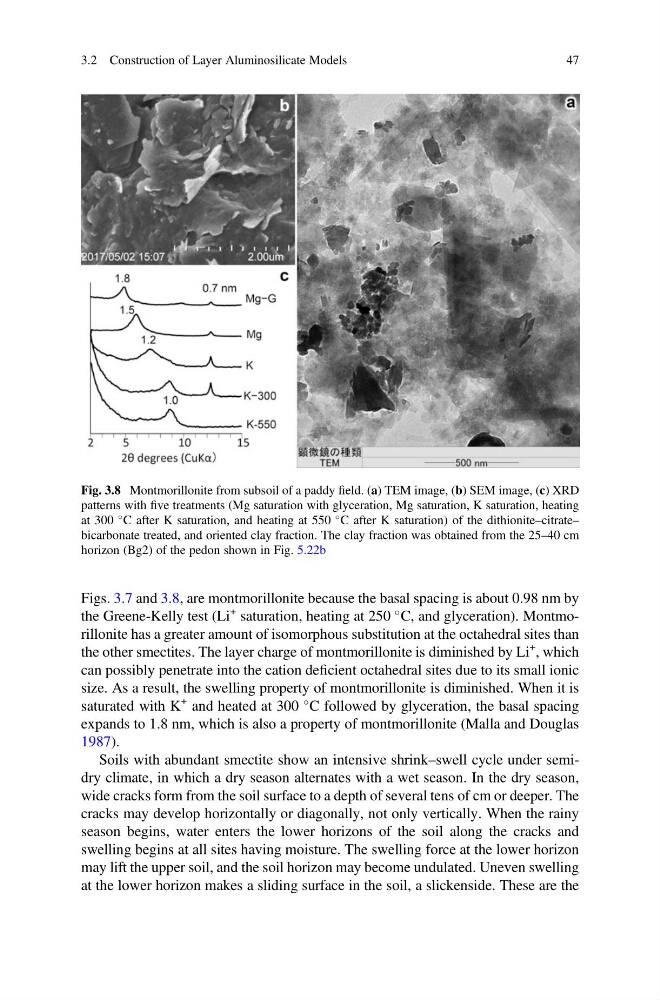
Figs. 3.7 and 3.8, are montmorillonite because the basal spacing is about 0.98 nm by
the Greene-Kelly test (Li
+ saturation, heating at 250
C, and glyceration). Montmorillonite has a greater amount of isomorphous substitution at the octahedral sites than
the other smectites. The layer charge of montmorillonite is diminished by Li
+
, which
can possibly penetrate into the cation deficient octahedral sites due to its small ionic
size. As a result, the swelling property of montmorillonite is diminished. When it is
saturated with K
+ and heated at 300
C followed by glyceration, the basal spacing
expands to 1.8 nm, which is also a property of montmorillonite (Malla and Douglas
1987).
Soils with abundant smectite show an intensive shrink–swell cycle under semidry climate, in which a dry season alternates with a wet season. In the dry season,
wide cracks form from the soil surface to a depth of several tens of cm or deeper. The
cracks may develop horizontally or diagonally, not only vertically. When the rainy
season begins, water enters the lower horizons of the soil along the cracks and
swelling begins at all sites having moisture. The swelling force at the lower horizon
may lift the upper soil, and the soil horizon may become undulated. Uneven swelling
at the lower horizon makes a sliding surface in the soil, a slickenside. These are the
Fig. 3.8 Montmorillonite from subsoil of a paddy field. (a) TEM image, (b) SEM image, (c) XRD
patterns with five treatments (Mg saturation with glyceration, Mg saturation, K saturation, heating
at 300
C after K saturation, and heating at 550
C after K saturation) of the dithionite–citrate–
bicarbonate treated, and oriented clay fraction. The clay fraction was obtained from the 25–40 cm
horizon (Bg2) of the pedon shown in Fig. 5.22b
3.2 Construction of Layer Aluminosilicate Models
47
the Greene-Kelly test (Li
+ saturation, heating at 250
C, and glyceration). Montmorillonite has a greater amount of isomorphous substitution at the octahedral sites than
the other smectites. The layer charge of montmorillonite is diminished by Li
+
, which
can possibly penetrate into the cation deficient octahedral sites due to its small ionic
size. As a result, the swelling property of montmorillonite is diminished. When it is
saturated with K
+ and heated at 300
C followed by glyceration, the basal spacing
expands to 1.8 nm, which is also a property of montmorillonite (Malla and Douglas
1987).
Soils with abundant smectite show an intensive shrink–swell cycle under semidry climate, in which a dry season alternates with a wet season. In the dry season,
wide cracks form from the soil surface to a depth of several tens of cm or deeper. The
cracks may develop horizontally or diagonally, not only vertically. When the rainy
season begins, water enters the lower horizons of the soil along the cracks and
swelling begins at all sites having moisture. The swelling force at the lower horizon
may lift the upper soil, and the soil horizon may become undulated. Uneven swelling
at the lower horizon makes a sliding surface in the soil, a slickenside. These are the
Fig. 3.8 Montmorillonite from subsoil of a paddy field. (a) TEM image, (b) SEM image, (c) XRD
patterns with five treatments (Mg saturation with glyceration, Mg saturation, K saturation, heating
at 300
C after K saturation, and heating at 550
C after K saturation) of the dithionite–citrate–
bicarbonate treated, and oriented clay fraction. The clay fraction was obtained from the 25–40 cm
horizon (Bg2) of the pedon shown in Fig. 5.22b
3.2 Construction of Layer Aluminosilicate Models
47