

Depending on the B-site cations, amphiboles are grouped as calcic amphibole,
sodic amphibole, sodic-calcic amphibole, and iron-magnesium-manganese amphibole. Hornblendes, commonly found amphiboles, are grouped as calcic amphibole
and are members of the magnesio-hornblendes (Mg can be replaced by Fe
2+ in a
wide range) at the lower level of grouping (Deer et al. 1997c).
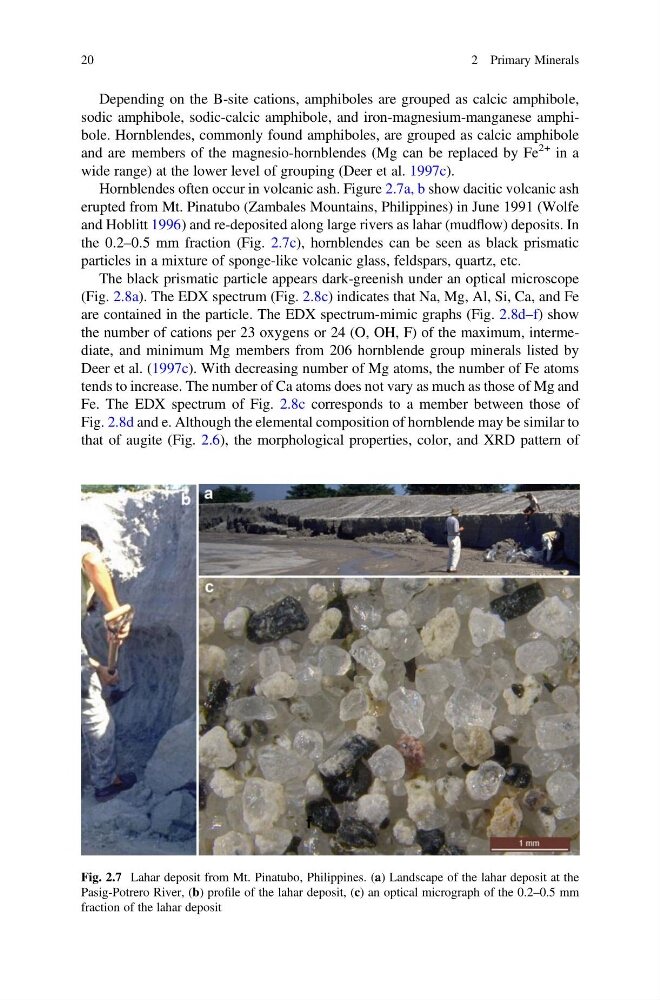
Hornblendes often occur in volcanic ash. Figure 2.7a, b show dacitic volcanic ash
erupted from Mt. Pinatubo (Zambales Mountains, Philippines) in June 1991 (Wolfe
and Hoblitt 1996) and re-deposited along large rivers as lahar (mudflow) deposits. In
the 0.2–0.5 mm fraction (Fig. 2.7c), hornblendes can be seen as black prismatic
particles in a mixture of sponge-like volcanic glass, feldspars, quartz, etc.
The black prismatic particle appears dark-greenish under an optical microscope
(Fig. 2.8a). The EDX spectrum (Fig. 2.8c) indicates that Na, Mg, Al, Si, Ca, and Fe
are contained in the particle. The EDX spectrum-mimic graphs (Fig. 2.8d–f) show
the number of cations per 23 oxygens or 24 (O, OH, F) of the maximum, intermediate, and minimum Mg members from 206 hornblende group minerals listed by
Deer et al. (1997c). With decreasing number of Mg atoms, the number of Fe atoms
tends to increase. The number of Ca atoms does not vary as much as those of Mg and
Fe. The EDX spectrum of Fig. 2.8c corresponds to a member between those of
Fig. 2.8d and e. Although the elemental composition of hornblende may be similar to
that of augite (Fig. 2.6), the morphological properties, color, and XRD pattern of
Fig. 2.7 Lahar deposit from Mt. Pinatubo, Philippines. (a) Landscape of the lahar deposit at the
Pasig-Potrero River, (b) profile of the lahar deposit, (c) an optical micrograph of the 0.2–0.5 mm
fraction of the lahar deposit
20
2 Primary Minerals
sodic amphibole, sodic-calcic amphibole, and iron-magnesium-manganese amphibole. Hornblendes, commonly found amphiboles, are grouped as calcic amphibole
and are members of the magnesio-hornblendes (Mg can be replaced by Fe
2+ in a
wide range) at the lower level of grouping (Deer et al. 1997c).
Hornblendes often occur in volcanic ash. Figure 2.7a, b show dacitic volcanic ash
erupted from Mt. Pinatubo (Zambales Mountains, Philippines) in June 1991 (Wolfe
and Hoblitt 1996) and re-deposited along large rivers as lahar (mudflow) deposits. In
the 0.2–0.5 mm fraction (Fig. 2.7c), hornblendes can be seen as black prismatic
particles in a mixture of sponge-like volcanic glass, feldspars, quartz, etc.
The black prismatic particle appears dark-greenish under an optical microscope
(Fig. 2.8a). The EDX spectrum (Fig. 2.8c) indicates that Na, Mg, Al, Si, Ca, and Fe
are contained in the particle. The EDX spectrum-mimic graphs (Fig. 2.8d–f) show
the number of cations per 23 oxygens or 24 (O, OH, F) of the maximum, intermediate, and minimum Mg members from 206 hornblende group minerals listed by
Deer et al. (1997c). With decreasing number of Mg atoms, the number of Fe atoms
tends to increase. The number of Ca atoms does not vary as much as those of Mg and
Fe. The EDX spectrum of Fig. 2.8c corresponds to a member between those of
Fig. 2.8d and e. Although the elemental composition of hornblende may be similar to
that of augite (Fig. 2.6), the morphological properties, color, and XRD pattern of
Fig. 2.7 Lahar deposit from Mt. Pinatubo, Philippines. (a) Landscape of the lahar deposit at the
Pasig-Potrero River, (b) profile of the lahar deposit, (c) an optical micrograph of the 0.2–0.5 mm
fraction of the lahar deposit
20
2 Primary Minerals