

Amphibole
Amphiboles are double chain silicates (Table 2.1). Between the double chains,
several cations link the double chain silicates. The general chemical composition
is formulated as follows:
A 0-1 B 2 C 5 T 8 O 22 (OH) 2
For example, in the Ca-rich amphiboles,
A: Na, K, or vacant
B: Ca, Na, Mn
C: Mg, Fe
2+ , Fe
3+ , Al, Ti, Mn, Cr or other
T: Si, Al
The cations at the A, B, C, and T sites play their own roles. The C site cations are
sandwiched with two double chain silicates. The sandwiched double chain silicates
are laterally linked by the B site cations. The OH group, which is bound to C site
cations, can be partially or wholly replaced by F and Cl. In the case of
oxyhornblende, the OH group is replaced by oxygen. The T site is the silicate chain.
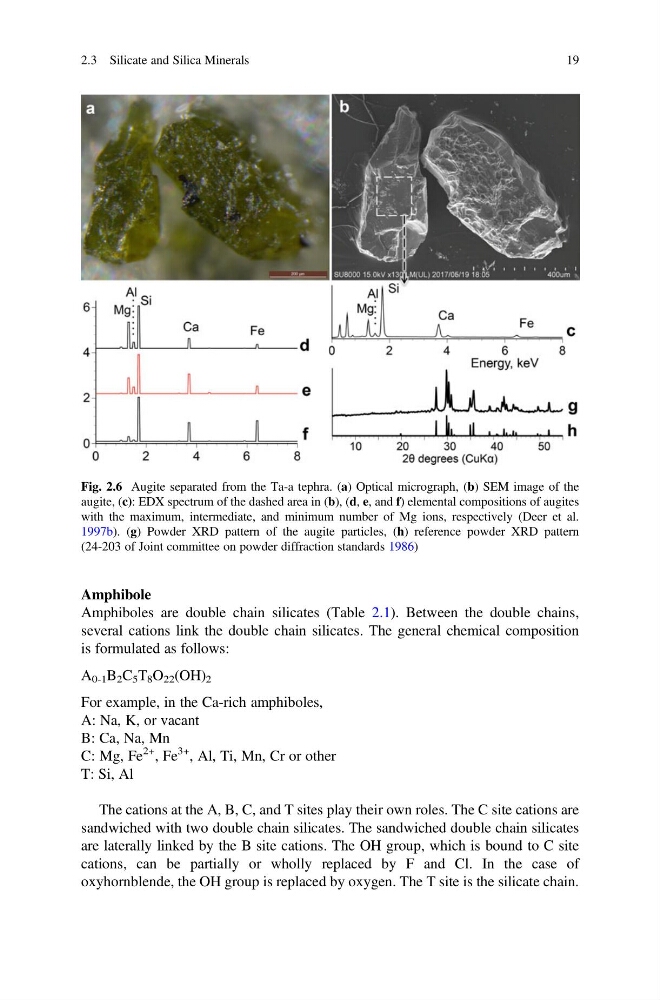
Fig. 2.6 Augite separated from the Ta-a tephra. (a) Optical micrograph, (b) SEM image of the
augite, (c): EDX spectrum of the dashed area in (b), (d, e, and f) elemental compositions of augites
with the maximum, intermediate, and minimum number of Mg ions, respectively (Deer et al.
1997b). (g) Powder XRD pattern of the augite particles, (h) reference powder XRD pattern
(24-203 of Joint committee on powder diffraction standards 1986)
2.3 Silicate and Silica Minerals
19
Amphiboles are double chain silicates (Table 2.1). Between the double chains,
several cations link the double chain silicates. The general chemical composition
is formulated as follows:
A 0-1 B 2 C 5 T 8 O 22 (OH) 2
For example, in the Ca-rich amphiboles,
A: Na, K, or vacant
B: Ca, Na, Mn
C: Mg, Fe
2+ , Fe
3+ , Al, Ti, Mn, Cr or other
T: Si, Al
The cations at the A, B, C, and T sites play their own roles. The C site cations are
sandwiched with two double chain silicates. The sandwiched double chain silicates
are laterally linked by the B site cations. The OH group, which is bound to C site
cations, can be partially or wholly replaced by F and Cl. In the case of
oxyhornblende, the OH group is replaced by oxygen. The T site is the silicate chain.
Fig. 2.6 Augite separated from the Ta-a tephra. (a) Optical micrograph, (b) SEM image of the
augite, (c): EDX spectrum of the dashed area in (b), (d, e, and f) elemental compositions of augites
with the maximum, intermediate, and minimum number of Mg ions, respectively (Deer et al.
1997b). (g) Powder XRD pattern of the augite particles, (h) reference powder XRD pattern
(24-203 of Joint committee on powder diffraction standards 1986)
2.3 Silicate and Silica Minerals
19