

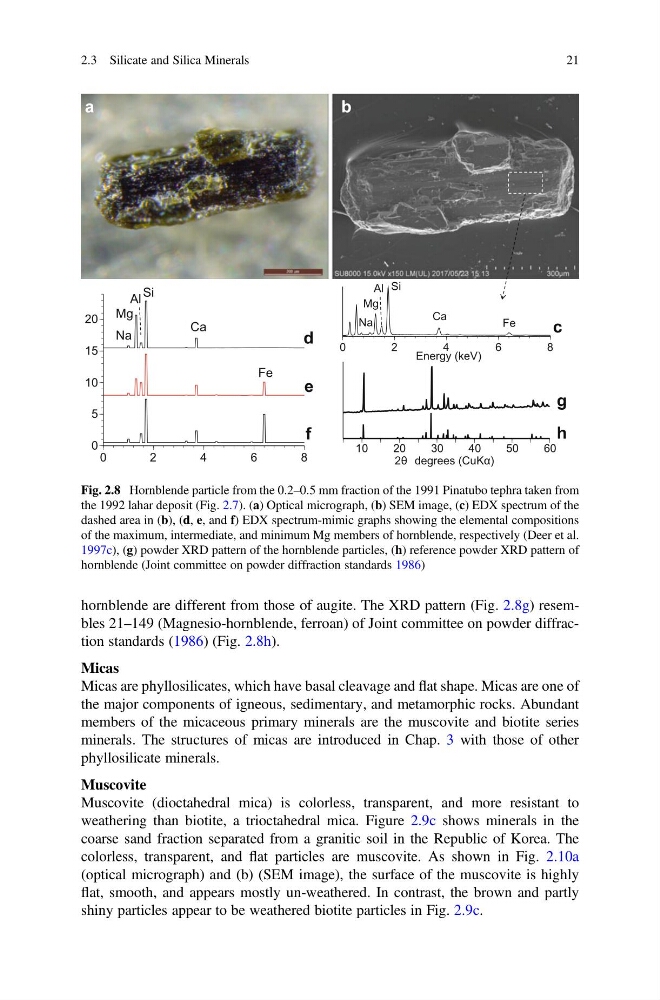
hornblende are different from those of augite. The XRD pattern (Fig. 2.8g) resembles 21–149 (Magnesio-hornblende, ferroan) of Joint committee on powder diffraction standards (1986) (Fig. 2.8h).
Micas
Micas are phyllosilicates, which have basal cleavage and flat shape. Micas are one of
the major components of igneous, sedimentary, and metamorphic rocks. Abundant
members of the micaceous primary minerals are the muscovite and biotite series
minerals. The structures of micas are introduced in Chap. 3 with those of other
phyllosilicate minerals.
Muscovite
Muscovite (dioctahedral mica) is colorless, transparent, and more resistant to
weathering than biotite, a trioctahedral mica. Figure 2.9c shows minerals in the
coarse sand fraction separated from a granitic soil in the Republic of Korea. The
colorless, transparent, and flat particles are muscovite. As shown in Fig. 2.10a
(optical micrograph) and (b) (SEM image), the surface of the muscovite is highly
flat, smooth, and appears mostly un-weathered. In contrast, the brown and partly
shiny particles appear to be weathered biotite particles in Fig. 2.9c.
0
5
10
15
20
0
2
4
6
8
0
2
4
6
8
a
b
c
d
e
f
g
h
10
20
30
40
50
60
2θ degrees (CuKα)
Energy (keV)
Na
Mg
Al
Si
Ca
Fe
Na
Mg
Al Si
Ca
Fe
Fig. 2.8 Hornblende particle from the 0.2–0.5 mm fraction of the 1991 Pinatubo tephra taken from
the 1992 lahar deposit (Fig. 2.7). (a) Optical micrograph, (b) SEM image, (c) EDX spectrum of the
dashed area in (b), (d, e, and f) EDX spectrum-mimic graphs showing the elemental compositions
of the maximum, intermediate, and minimum Mg members of hornblende, respectively (Deer et al.
1997c), (g) powder XRD pattern of the hornblende particles, (h) reference powder XRD pattern of
hornblende (Joint committee on powder diffraction standards 1986)
2.3 Silicate and Silica Minerals
21
Micas
Micas are phyllosilicates, which have basal cleavage and flat shape. Micas are one of
the major components of igneous, sedimentary, and metamorphic rocks. Abundant
members of the micaceous primary minerals are the muscovite and biotite series
minerals. The structures of micas are introduced in Chap. 3 with those of other
phyllosilicate minerals.
Muscovite
Muscovite (dioctahedral mica) is colorless, transparent, and more resistant to
weathering than biotite, a trioctahedral mica. Figure 2.9c shows minerals in the
coarse sand fraction separated from a granitic soil in the Republic of Korea. The
colorless, transparent, and flat particles are muscovite. As shown in Fig. 2.10a
(optical micrograph) and (b) (SEM image), the surface of the muscovite is highly
flat, smooth, and appears mostly un-weathered. In contrast, the brown and partly
shiny particles appear to be weathered biotite particles in Fig. 2.9c.
0
5
10
15
20
0
2
4
6
8
0
2
4
6
8
a
b
c
d
e
f
g
h
10
20
30
40
50
60
2θ degrees (CuKα)
Energy (keV)
Na
Mg
Al
Si
Ca
Fe
Na
Mg
Al Si
Ca
Fe
Fig. 2.8 Hornblende particle from the 0.2–0.5 mm fraction of the 1991 Pinatubo tephra taken from
the 1992 lahar deposit (Fig. 2.7). (a) Optical micrograph, (b) SEM image, (c) EDX spectrum of the
dashed area in (b), (d, e, and f) EDX spectrum-mimic graphs showing the elemental compositions
of the maximum, intermediate, and minimum Mg members of hornblende, respectively (Deer et al.
1997c), (g) powder XRD pattern of the hornblende particles, (h) reference powder XRD pattern of
hornblende (Joint committee on powder diffraction standards 1986)
2.3 Silicate and Silica Minerals
21