

magmas with less than about 2 g P 2 O 5 kg
À1 . On the other hand, apatite crystallizes
over a larger SiO 2 range in magmas with a higher P content than this level (Green
and Watson 1982). As the total P content of the basaltic andesite and basaltic tephras
used in the present study was 2.8 g P 2 O 5 kg
À1 or less, crystallization of apatite could
not occur and P was considered to be distributed to other minerals.
Dissolution of apatite is dependent on pH (Fig. 6.31d). Two apatite samples of
sedimentary origin (Florida and Makatea) were treated with 10 mmol L
À1 of citrate
or dilute HCl. The amount of P dissolved from the two apatite samples increased
with decreasing final pH values and was larger in the citrate treatment than in the
dilute HCl treatment, especially in the pH range of 5–6. This is possibly due to
chelation of Ca and donation of H
+ by citrate.
0
2
4
6
8
a
b
c
b
c
d
e
Ca
P
Energy (keV)
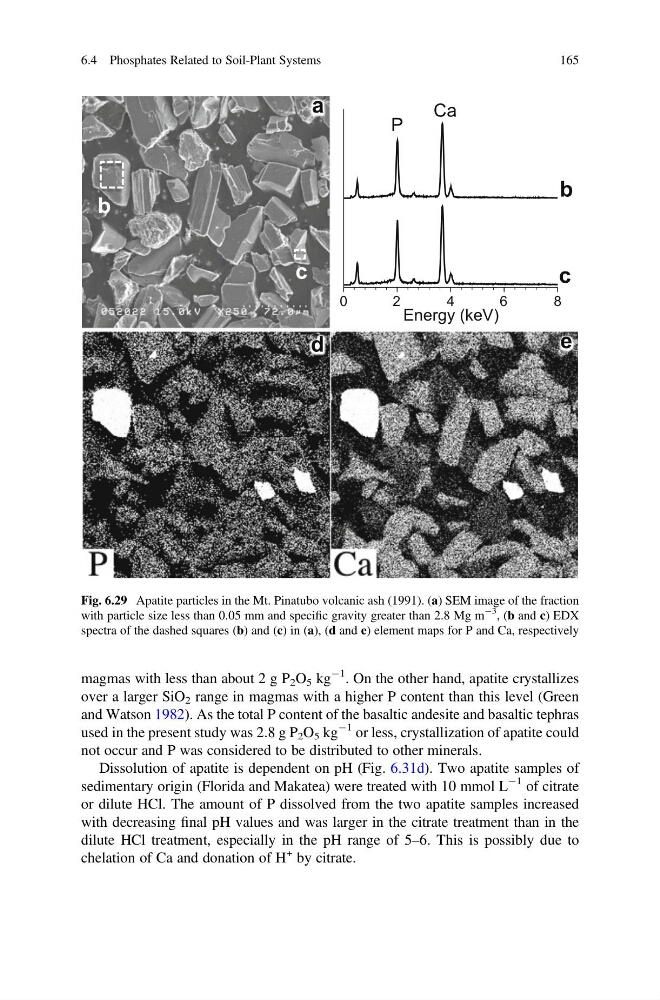
Fig. 6.29 Apatite particles in the Mt. Pinatubo volcanic ash (1991). (a) SEM image of the fraction
with particle size less than 0.05 mm and specific gravity greater than 2.8 Mg m
À3
, (b and c) EDX
spectra of the dashed squares (b) and (c) in (a), (d and e) element maps for P and Ca, respectively
6.4 Phosphates Related to Soil-Plant Systems
165
À1 . On the other hand, apatite crystallizes
over a larger SiO 2 range in magmas with a higher P content than this level (Green
and Watson 1982). As the total P content of the basaltic andesite and basaltic tephras
used in the present study was 2.8 g P 2 O 5 kg
À1 or less, crystallization of apatite could
not occur and P was considered to be distributed to other minerals.
Dissolution of apatite is dependent on pH (Fig. 6.31d). Two apatite samples of
sedimentary origin (Florida and Makatea) were treated with 10 mmol L
À1 of citrate
or dilute HCl. The amount of P dissolved from the two apatite samples increased
with decreasing final pH values and was larger in the citrate treatment than in the
dilute HCl treatment, especially in the pH range of 5–6. This is possibly due to
chelation of Ca and donation of H
+ by citrate.
0
2
4
6
8
a
b
c
b
c
d
e
Ca
P
Energy (keV)
Fig. 6.29 Apatite particles in the Mt. Pinatubo volcanic ash (1991). (a) SEM image of the fraction
with particle size less than 0.05 mm and specific gravity greater than 2.8 Mg m
À3
, (b and c) EDX
spectra of the dashed squares (b) and (c) in (a), (d and e) element maps for P and Ca, respectively
6.4 Phosphates Related to Soil-Plant Systems
165