

Acid solutions are used for the evaluation of plant-available P in soil. For
example, in the Truog method, a solution containing 1 mmol L
À1 H 2 SO 4 and 3 g L
À1
of ammonium sulfate is used to extract P from soil. Although apatite is not highly
available for many crop plants, apatite is soluble in the Truog extracting solution
(Fig. 6.30). Figure 6.30a shows a magnified composite particle of apatite and a Ti–Fe
mineral. After obtaining the SEM image (Fig. 6.30a), the sample was treated with the
Truog extracting solution, and a part of apatite apparently dissolved (Fig. 6.30b). The
thin transparent film around the dissolved apatite particle in Fig. 6.30b corresponds to
vacuum-evaporated carbon. Although the apatite particle was dissolved significantly
by this treatment, the chemical composition of the remaining part represented by a
dashed square of Fig. 6.30d in Fig. 6.30b was still the same as before the treatment
(Fig. 6.29c). The Fe-Ti oxide in contact with the apatite was not affected by this
treatment.
The Truog P levels of tephra depend on the rock type (Fig. 6.30e). The fresh
rhyolitic to andesitic tephra showed Truog P levels higher than 100 mg P 2 O 5 kg
À1 ,
whereas the basaltic and basaltic-andesitic tephra showed only low Truog P values.
These results are consistent with those obtained by Green and Watson (1982), who
reported that apatite or P 2 O 5 solubility in silicate melts increases with decreasing
SiO 2 content and that crystallization of apatite cannot occur in mafic and low-P
Ca
P
F
Energy (keV)
5
1 5
2 5
3 5
4 5
5 5
2θ (degrees, Cu Kα)
a
b
c
d
e
Q
2 μm
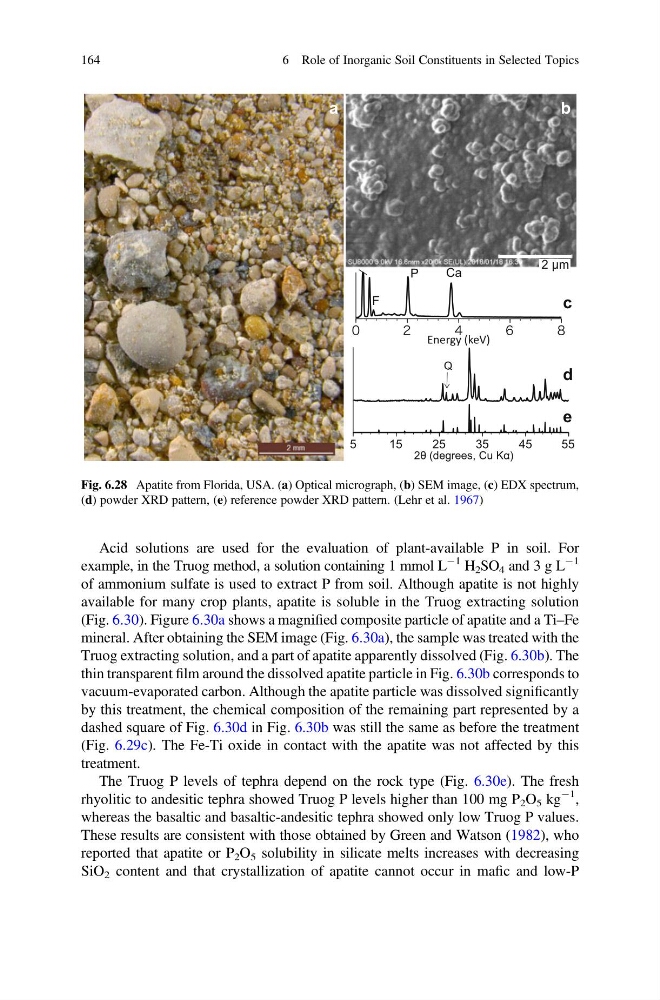
Fig. 6.28 Apatite from Florida, USA. (a) Optical micrograph, (b) SEM image, (c) EDX spectrum,
(d) powder XRD pattern, (e) reference powder XRD pattern. (Lehr et al. 1967)
164
6 Role of Inorganic Soil Constituents in Selected Topics
example, in the Truog method, a solution containing 1 mmol L
À1 H 2 SO 4 and 3 g L
À1
of ammonium sulfate is used to extract P from soil. Although apatite is not highly
available for many crop plants, apatite is soluble in the Truog extracting solution
(Fig. 6.30). Figure 6.30a shows a magnified composite particle of apatite and a Ti–Fe
mineral. After obtaining the SEM image (Fig. 6.30a), the sample was treated with the
Truog extracting solution, and a part of apatite apparently dissolved (Fig. 6.30b). The
thin transparent film around the dissolved apatite particle in Fig. 6.30b corresponds to
vacuum-evaporated carbon. Although the apatite particle was dissolved significantly
by this treatment, the chemical composition of the remaining part represented by a
dashed square of Fig. 6.30d in Fig. 6.30b was still the same as before the treatment
(Fig. 6.29c). The Fe-Ti oxide in contact with the apatite was not affected by this
treatment.
The Truog P levels of tephra depend on the rock type (Fig. 6.30e). The fresh
rhyolitic to andesitic tephra showed Truog P levels higher than 100 mg P 2 O 5 kg
À1 ,
whereas the basaltic and basaltic-andesitic tephra showed only low Truog P values.
These results are consistent with those obtained by Green and Watson (1982), who
reported that apatite or P 2 O 5 solubility in silicate melts increases with decreasing
SiO 2 content and that crystallization of apatite cannot occur in mafic and low-P
Ca
P
F
Energy (keV)
5
1 5
2 5
3 5
4 5
5 5
2θ (degrees, Cu Kα)
a
b
c
d
e
Q
2 μm
Fig. 6.28 Apatite from Florida, USA. (a) Optical micrograph, (b) SEM image, (c) EDX spectrum,
(d) powder XRD pattern, (e) reference powder XRD pattern. (Lehr et al. 1967)
164
6 Role of Inorganic Soil Constituents in Selected Topics