

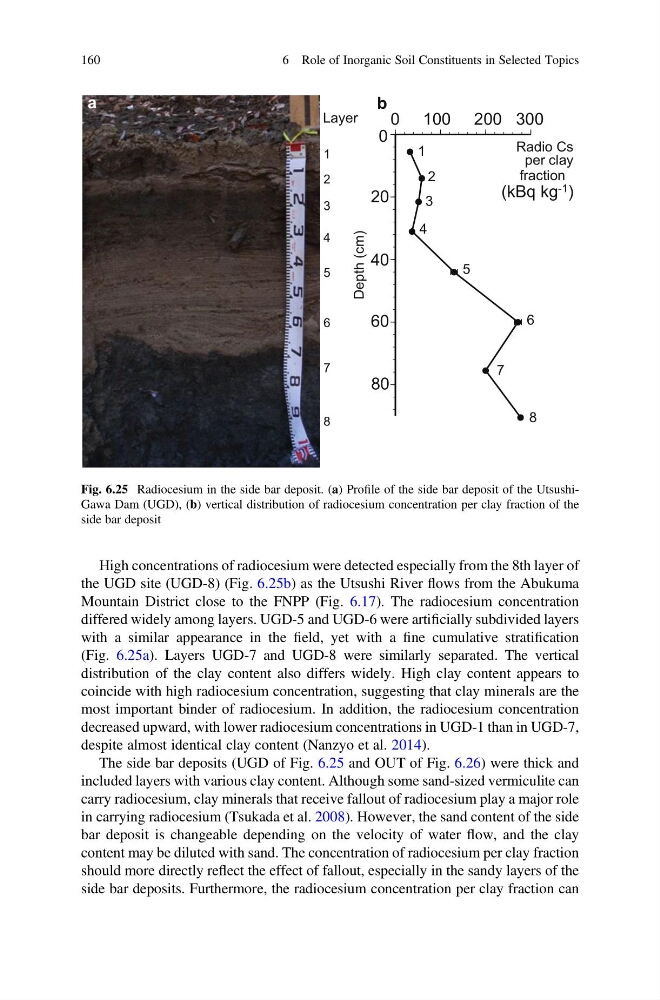
High concentrations of radiocesium were detected especially from the 8th layer of
the UGD site (UGD-8) (Fig. 6.25b) as the Utsushi River flows from the Abukuma
Mountain District close to the FNPP (Fig. 6.17). The radiocesium concentration
differed widely among layers. UGD-5 and UGD-6 were artificially subdivided layers
with a similar appearance in the field, yet with a fine cumulative stratification
(Fig. 6.25a). Layers UGD-7 and UGD-8 were similarly separated. The vertical
distribution of the clay content also differs widely. High clay content appears to
coincide with high radiocesium concentration, suggesting that clay minerals are the
most important binder of radiocesium. In addition, the radiocesium concentration
decreased upward, with lower radiocesium concentrations in UGD-1 than in UGD-7,
despite almost identical clay content (Nanzyo et al. 2014).
The side bar deposits (UGD of Fig. 6.25 and OUT of Fig. 6.26) were thick and
included layers with various clay content. Although some sand-sized vermiculite can
carry radiocesium, clay minerals that receive fallout of radiocesium play a major role
in carrying radiocesium (Tsukada et al. 2008). However, the sand content of the side
bar deposit is changeable depending on the velocity of water flow, and the clay
content may be diluted with sand. The concentration of radiocesium per clay fraction
should more directly reflect the effect of fallout, especially in the sandy layers of the
side bar deposits. Furthermore, the radiocesium concentration per clay fraction can
Radio Cs
per clay
fraction
(kBq kg -1 )
Depth (cm)
0
20
40
60
80
0 100 200 300
1
2
3
4
5
6
7
8
Layer
1
2
3
4
5
6
7
8
b
a
Fig. 6.25 Radiocesium in the side bar deposit. (a) Profile of the side bar deposit of the UtsushiGawa Dam (UGD), (b) vertical distribution of radiocesium concentration per clay fraction of the
side bar deposit
160
6 Role of Inorganic Soil Constituents in Selected Topics
the UGD site (UGD-8) (Fig. 6.25b) as the Utsushi River flows from the Abukuma
Mountain District close to the FNPP (Fig. 6.17). The radiocesium concentration
differed widely among layers. UGD-5 and UGD-6 were artificially subdivided layers
with a similar appearance in the field, yet with a fine cumulative stratification
(Fig. 6.25a). Layers UGD-7 and UGD-8 were similarly separated. The vertical
distribution of the clay content also differs widely. High clay content appears to
coincide with high radiocesium concentration, suggesting that clay minerals are the
most important binder of radiocesium. In addition, the radiocesium concentration
decreased upward, with lower radiocesium concentrations in UGD-1 than in UGD-7,
despite almost identical clay content (Nanzyo et al. 2014).
The side bar deposits (UGD of Fig. 6.25 and OUT of Fig. 6.26) were thick and
included layers with various clay content. Although some sand-sized vermiculite can
carry radiocesium, clay minerals that receive fallout of radiocesium play a major role
in carrying radiocesium (Tsukada et al. 2008). However, the sand content of the side
bar deposit is changeable depending on the velocity of water flow, and the clay
content may be diluted with sand. The concentration of radiocesium per clay fraction
should more directly reflect the effect of fallout, especially in the sandy layers of the
side bar deposits. Furthermore, the radiocesium concentration per clay fraction can
Radio Cs
per clay
fraction
(kBq kg -1 )
Depth (cm)
0
20
40
60
80
0 100 200 300
1
2
3
4
5
6
7
8
Layer
1
2
3
4
5
6
7
8
b
a
Fig. 6.25 Radiocesium in the side bar deposit. (a) Profile of the side bar deposit of the UtsushiGawa Dam (UGD), (b) vertical distribution of radiocesium concentration per clay fraction of the
side bar deposit
160
6 Role of Inorganic Soil Constituents in Selected Topics