

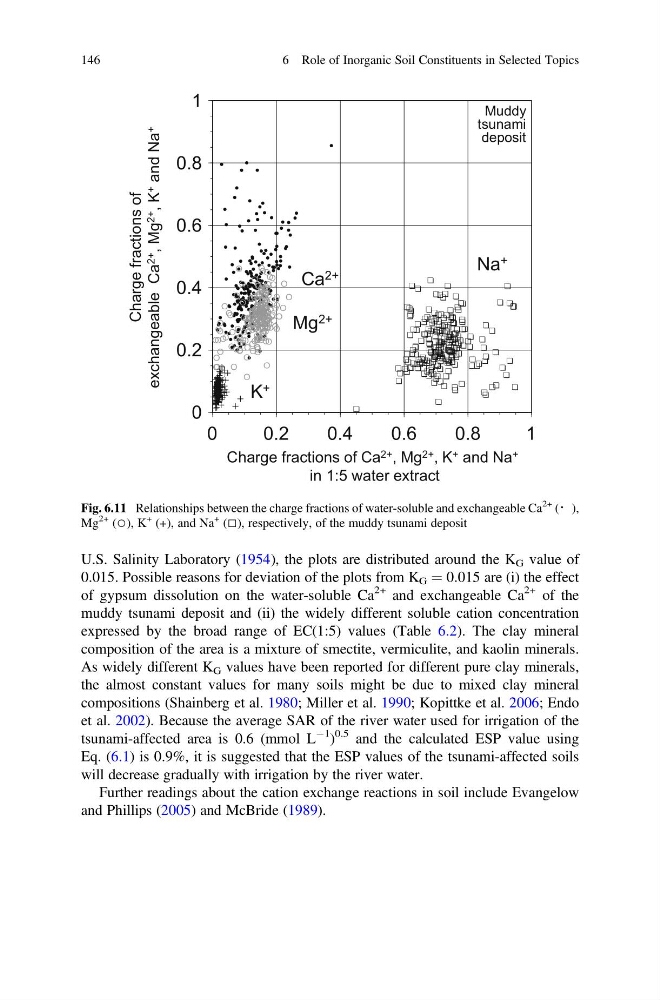
U.S. Salinity Laboratory (1954), the plots are distributed around the K G value of
0.015. Possible reasons for deviation of the plots from K G ¼ 0.015 are (i) the effect
of gypsum dissolution on the water-soluble Ca
2+ and exchangeable Ca
2+ of the
muddy tsunami deposit and (ii) the widely different soluble cation concentration
expressed by the broad range of EC(1:5) values (Table 6.2). The clay mineral
composition of the area is a mixture of smectite, vermiculite, and kaolin minerals.
As widely different K G values have been reported for different pure clay minerals,
the almost constant values for many soils might be due to mixed clay mineral
compositions (Shainberg et al. 1980; Miller et al. 1990; Kopittke et al. 2006; Endo
et al. 2002). Because the average SAR of the river water used for irrigation of the
tsunami-affected area is 0.6 (mmol L
À1 )
0.5 and the calculated ESP value using
Eq. (6.1) is 0.9%, it is suggested that the ESP values of the tsunami-affected soils
will decrease gradually with irrigation by the river water.
Further readings about the cation exchange reactions in soil include Evangelow
and Phillips (2005) and McBride (1989).
Charge fractions of Ca 2+ , Mg 2+ , K + and Na +
in 1:5 water extract
Charge fractions of
exchangeable Ca 2+
, Mg 2+
, K +
and Na +
Na +
Ca 2+
Mg 2+
K +
Muddy
tsunami
deposit
Fig. 6.11 Relationships between the charge fractions of water-soluble and exchangeable Ca
2+ (・),
Mg
2+ (○), K
+ (+), and Na
+ (□), respectively, of the muddy tsunami deposit
146
6 Role of Inorganic Soil Constituents in Selected Topics
0.015. Possible reasons for deviation of the plots from K G ¼ 0.015 are (i) the effect
of gypsum dissolution on the water-soluble Ca
2+ and exchangeable Ca
2+ of the
muddy tsunami deposit and (ii) the widely different soluble cation concentration
expressed by the broad range of EC(1:5) values (Table 6.2). The clay mineral
composition of the area is a mixture of smectite, vermiculite, and kaolin minerals.
As widely different K G values have been reported for different pure clay minerals,
the almost constant values for many soils might be due to mixed clay mineral
compositions (Shainberg et al. 1980; Miller et al. 1990; Kopittke et al. 2006; Endo
et al. 2002). Because the average SAR of the river water used for irrigation of the
tsunami-affected area is 0.6 (mmol L
À1 )
0.5 and the calculated ESP value using
Eq. (6.1) is 0.9%, it is suggested that the ESP values of the tsunami-affected soils
will decrease gradually with irrigation by the river water.
Further readings about the cation exchange reactions in soil include Evangelow
and Phillips (2005) and McBride (1989).
Charge fractions of Ca 2+ , Mg 2+ , K + and Na +
in 1:5 water extract
Charge fractions of
exchangeable Ca 2+
, Mg 2+
, K +
and Na +
Na +
Ca 2+
Mg 2+
K +
Muddy
tsunami
deposit
Fig. 6.11 Relationships between the charge fractions of water-soluble and exchangeable Ca
2+ (・),
Mg
2+ (○), K
+ (+), and Na
+ (□), respectively, of the muddy tsunami deposit
146
6 Role of Inorganic Soil Constituents in Selected Topics