

appears to be the major constituent in this sample (Fig. 6.7f). This result is due to the
lower solubility of gypsum than halite. At the sampled site, a considerable portion of
the halite had been removed by rainwater, leaving the gypsum as the major evaporite. Gypsum can precipitate from seawater during drying. In addition, Ca
2+ , released
from the Ap horizon soil by an ion exchange reaction with Na
+
, could take part in the
gypsum precipitation because SO 4
2À is relatively abundant in seawater.
Further study for evaporates is Doner and Lynn (1989).
6.2.5 Salinization and Sodification
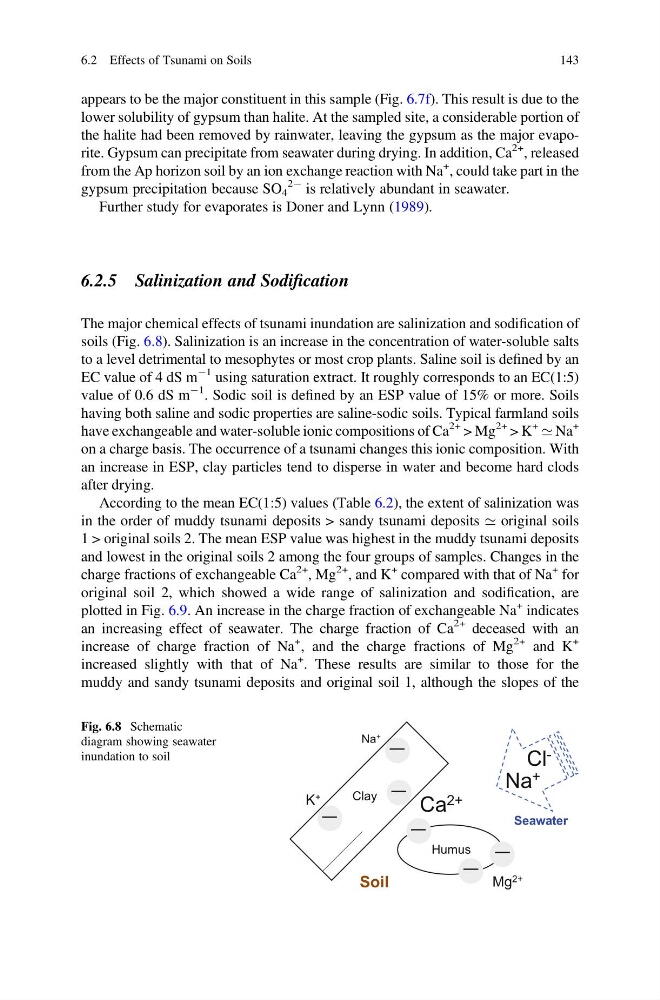
The major chemical effects of tsunami inundation are salinization and sodification of
soils (Fig. 6.8). Salinization is an increase in the concentration of water-soluble salts
to a level detrimental to mesophytes or most crop plants. Saline soil is defined by an
EC value of 4 dS m
À1 using saturation extract. It roughly corresponds to an EC(1:5)
value of 0.6 dS m
À1 . Sodic soil is defined by an ESP value of 15% or more. Soils
having both saline and sodic properties are saline-sodic soils. Typical farmland soils
have exchangeable and water-soluble ionic compositions of Ca
2+ > Mg
2+ > K
+
’ Na
+
on a charge basis. The occurrence of a tsunami changes this ionic composition. With
an increase in ESP, clay particles tend to disperse in water and become hard clods
after drying.
According to the mean EC(1:5) values (Table 6.2), the extent of salinization was
in the order of muddy tsunami deposits > sandy tsunami deposits ’ original soils
1 > original soils 2. The mean ESP value was highest in the muddy tsunami deposits
and lowest in the original soils 2 among the four groups of samples. Changes in the
charge fractions of exchangeable Ca
2+ , Mg
2+ , and K
+ compared with that of Na
+ for
original soil 2, which showed a wide range of salinization and sodification, are
plotted in Fig. 6.9. An increase in the charge fraction of exchangeable Na
+ indicates
an increasing effect of seawater. The charge fraction of Ca
2+ deceased with an
increase of charge fraction of Na
+
, and the charge fractions of Mg
2+ and K
+
increased slightly with that of Na
+
. These results are similar to those for the
muddy and sandy tsunami deposits and original soil 1, although the slopes of the
Humus
Clay
Ca 2+
K +
Mg 2+
Na +
Cl -
Soil
Seawater
Na +
Fig. 6.8 Schematic
diagram showing seawater
inundation to soil
6.2 Effects of Tsunami on Soils
143
lower solubility of gypsum than halite. At the sampled site, a considerable portion of
the halite had been removed by rainwater, leaving the gypsum as the major evaporite. Gypsum can precipitate from seawater during drying. In addition, Ca
2+ , released
from the Ap horizon soil by an ion exchange reaction with Na
+
, could take part in the
gypsum precipitation because SO 4
2À is relatively abundant in seawater.
Further study for evaporates is Doner and Lynn (1989).
6.2.5 Salinization and Sodification
The major chemical effects of tsunami inundation are salinization and sodification of
soils (Fig. 6.8). Salinization is an increase in the concentration of water-soluble salts
to a level detrimental to mesophytes or most crop plants. Saline soil is defined by an
EC value of 4 dS m
À1 using saturation extract. It roughly corresponds to an EC(1:5)
value of 0.6 dS m
À1 . Sodic soil is defined by an ESP value of 15% or more. Soils
having both saline and sodic properties are saline-sodic soils. Typical farmland soils
have exchangeable and water-soluble ionic compositions of Ca
2+ > Mg
2+ > K
+
’ Na
+
on a charge basis. The occurrence of a tsunami changes this ionic composition. With
an increase in ESP, clay particles tend to disperse in water and become hard clods
after drying.
According to the mean EC(1:5) values (Table 6.2), the extent of salinization was
in the order of muddy tsunami deposits > sandy tsunami deposits ’ original soils
1 > original soils 2. The mean ESP value was highest in the muddy tsunami deposits
and lowest in the original soils 2 among the four groups of samples. Changes in the
charge fractions of exchangeable Ca
2+ , Mg
2+ , and K
+ compared with that of Na
+ for
original soil 2, which showed a wide range of salinization and sodification, are
plotted in Fig. 6.9. An increase in the charge fraction of exchangeable Na
+ indicates
an increasing effect of seawater. The charge fraction of Ca
2+ deceased with an
increase of charge fraction of Na
+
, and the charge fractions of Mg
2+ and K
+
increased slightly with that of Na
+
. These results are similar to those for the
muddy and sandy tsunami deposits and original soil 1, although the slopes of the
Humus
Clay
Ca 2+
K +
Mg 2+
Na +
Cl -
Soil
Seawater
Na +
Fig. 6.8 Schematic
diagram showing seawater
inundation to soil
6.2 Effects of Tsunami on Soils
143