

(Erickson 2009). In contrast, the TS content of the muddy tsunami deposit was larger
than the content of original soil 2 by various amounts. Because the TS content of the
muddy tsunami deposit does not correlate with TOC, the added TS (beyond that of
original soil 2) appears to be in inorganic form. The four samples from TS-rich
muddy tsunami deposits all included framboidal pyrite, as shown in Figs. 5.26 and
5.27.
6.2.4 Evaporites on the Tsunami Deposits
White powdery materials, possibly evaporites, formed on the surface of the muddy
tsunami deposits, as shown in Fig. 6.3b. A sample was taken from one muddy
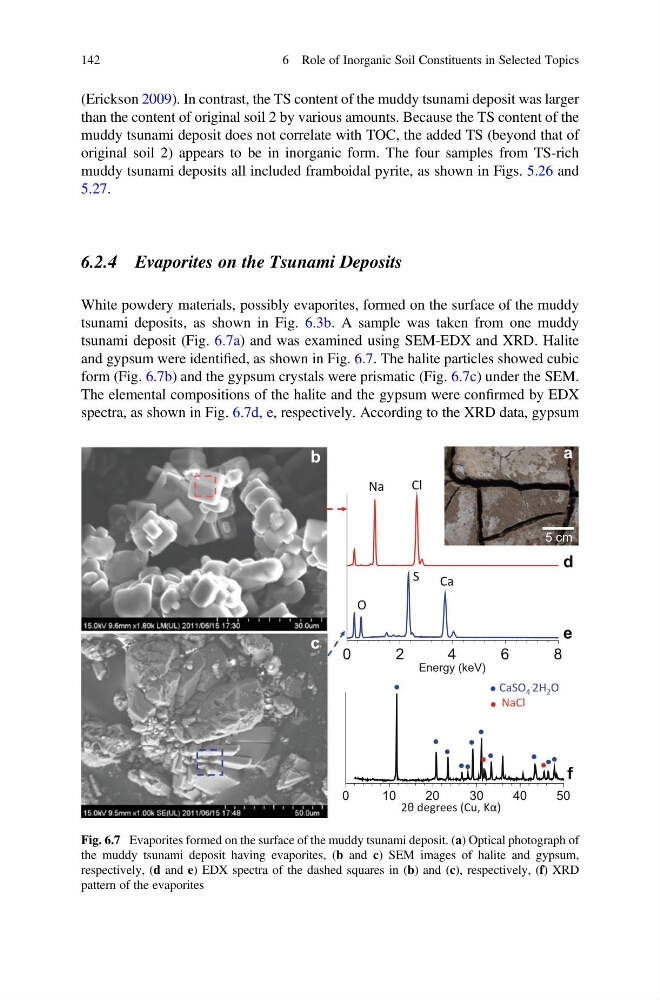
tsunami deposit (Fig. 6.7a) and was examined using SEM-EDX and XRD. Halite
and gypsum were identified, as shown in Fig. 6.7. The halite particles showed cubic
form (Fig. 6.7b) and the gypsum crystals were prismatic (Fig. 6.7c) under the SEM.
The elemental compositions of the halite and the gypsum were confirmed by EDX
spectra, as shown in Fig. 6.7d, e, respectively. According to the XRD data, gypsum
0
2
4
6
8
Energy (keV)
Na
Cl
S Ca
O
0
1 0
2 0
3 0
4 0
5 0
2θ degrees (Cu, Kα)
b
c
d
e
f
CaSO 4
. 2H 2 O
NaCl
a
5 cm
Fig. 6.7 Evaporites formed on the surface of the muddy tsunami deposit. (a) Optical photograph of
the muddy tsunami deposit having evaporites, (b and c) SEM images of halite and gypsum,
respectively, (d and e) EDX spectra of the dashed squares in (b) and (c), respectively, (f) XRD
pattern of the evaporites
142
6 Role of Inorganic Soil Constituents in Selected Topics
than the content of original soil 2 by various amounts. Because the TS content of the
muddy tsunami deposit does not correlate with TOC, the added TS (beyond that of
original soil 2) appears to be in inorganic form. The four samples from TS-rich
muddy tsunami deposits all included framboidal pyrite, as shown in Figs. 5.26 and
5.27.
6.2.4 Evaporites on the Tsunami Deposits
White powdery materials, possibly evaporites, formed on the surface of the muddy
tsunami deposits, as shown in Fig. 6.3b. A sample was taken from one muddy
tsunami deposit (Fig. 6.7a) and was examined using SEM-EDX and XRD. Halite
and gypsum were identified, as shown in Fig. 6.7. The halite particles showed cubic
form (Fig. 6.7b) and the gypsum crystals were prismatic (Fig. 6.7c) under the SEM.
The elemental compositions of the halite and the gypsum were confirmed by EDX
spectra, as shown in Fig. 6.7d, e, respectively. According to the XRD data, gypsum
0
2
4
6
8
Energy (keV)
Na
Cl
S Ca
O
0
1 0
2 0
3 0
4 0
5 0
2θ degrees (Cu, Kα)
b
c
d
e
f
CaSO 4
. 2H 2 O
NaCl
a
5 cm
Fig. 6.7 Evaporites formed on the surface of the muddy tsunami deposit. (a) Optical photograph of
the muddy tsunami deposit having evaporites, (b and c) SEM images of halite and gypsum,
respectively, (d and e) EDX spectra of the dashed squares in (b) and (c), respectively, (f) XRD
pattern of the evaporites
142
6 Role of Inorganic Soil Constituents in Selected Topics