

distributed within the region (shaded areas in Fig. 6.5c). Hence, the TOC-rich areas
of the muddy tsunami deposits are nearly identical to those of the original soil 1 and
the soil map made before tsunami inundation. Considering these results, it is highly
probable that the muddy tsunami deposits originated from the surface soil of the
tsunami affected areas. This estimation is supported by the fact that the Truog P
values of the muddy tsunami deposits are distinctively higher than those of the sandy
tsunami deposit and original soils 1 and 2 (Table 6.2). The high Truog P values are
due to the accumulation of P fertilizer in the plow layer soil. The plow layer soil of
the farmland eroded by the tsunami was deposited with sorting as the tsunami
retreated. Szczuciński et al. (2012) reported that marine sediments are present in
only low abundance in the present muddy tsunami deposit on the Sendai Plain.
6.2.3 Relationships Between TOC, TN, and TS
of the Tsunami Deposits and the Original Soils
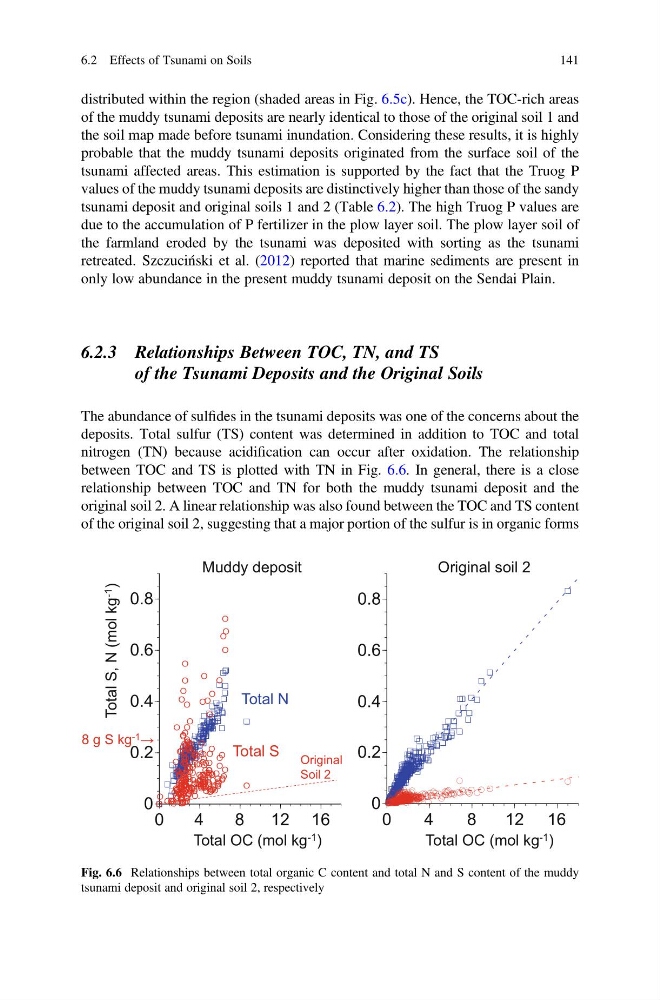
The abundance of sulfides in the tsunami deposits was one of the concerns about the
deposits. Total sulfur (TS) content was determined in addition to TOC and total
nitrogen (TN) because acidification can occur after oxidation. The relationship
between TOC and TS is plotted with TN in Fig. 6.6. In general, there is a close
relationship between TOC and TN for both the muddy tsunami deposit and the
original soil 2. A linear relationship was also found between the TOC and TS content
of the original soil 2, suggesting that a major portion of the sulfur is in organic forms
Original soil 2
Muddy deposit
Original
Soil 2
Total N
Total S
Total OC (mol kg -1 )
(
N
,
S
l
a
t
o
T
m o lk g -1
)
8 g S kg -1 →
Total OC (mol kg -1 )
Fig. 6.6 Relationships between total organic C content and total N and S content of the muddy
tsunami deposit and original soil 2, respectively
6.2 Effects of Tsunami on Soils
141
of the muddy tsunami deposits are nearly identical to those of the original soil 1 and
the soil map made before tsunami inundation. Considering these results, it is highly
probable that the muddy tsunami deposits originated from the surface soil of the
tsunami affected areas. This estimation is supported by the fact that the Truog P
values of the muddy tsunami deposits are distinctively higher than those of the sandy
tsunami deposit and original soils 1 and 2 (Table 6.2). The high Truog P values are
due to the accumulation of P fertilizer in the plow layer soil. The plow layer soil of
the farmland eroded by the tsunami was deposited with sorting as the tsunami
retreated. Szczuciński et al. (2012) reported that marine sediments are present in
only low abundance in the present muddy tsunami deposit on the Sendai Plain.
6.2.3 Relationships Between TOC, TN, and TS
of the Tsunami Deposits and the Original Soils
The abundance of sulfides in the tsunami deposits was one of the concerns about the
deposits. Total sulfur (TS) content was determined in addition to TOC and total
nitrogen (TN) because acidification can occur after oxidation. The relationship
between TOC and TS is plotted with TN in Fig. 6.6. In general, there is a close
relationship between TOC and TN for both the muddy tsunami deposit and the
original soil 2. A linear relationship was also found between the TOC and TS content
of the original soil 2, suggesting that a major portion of the sulfur is in organic forms
Original soil 2
Muddy deposit
Original
Soil 2
Total N
Total S
Total OC (mol kg -1 )
(
N
,
S
l
a
t
o
T
m o lk g -1
)
8 g S kg -1 →
Total OC (mol kg -1 )
Fig. 6.6 Relationships between total organic C content and total N and S content of the muddy
tsunami deposit and original soil 2, respectively
6.2 Effects of Tsunami on Soils
141