

6.2.2 Origin of the Muddy Tsunami Deposit
In general, erosion by the tsunami occurred in the nearshore zone (Fig. 6.3 ①).
(Srisutam and Wagner 2010). The color of a tsunami may change from place to place
depending on the properties of the sediments on the seafloor. As shown in Fig. 6.1b,
the tsunami that struck the Sendai Plain had a whitish color, suggesting that its mud
content was low. The color of the tsunami became black when the tsunami crossed
over the ridges and flowed down to the paddy fields (Figs. 6.1c and 6.3b). Eroded
sites were also found along roads, where the tsunami crossed over the roads and
flowed down to the paddy fields (Fig. 6.3a).
The distribution of the total thickness of the tsunami deposit is shown in Fig. 6.4.
The sandy tsunami deposit was thicker near the shore, suggesting that most of the
sandy tsunami deposit originated in the nearshore zone (Fig. 6.3c ①). However, the
muddy tsunami deposit was thick in the intermediate area of tsunami inundation, so
the origin of the muddy tsunami deposit was uncertain. From the distribution of total
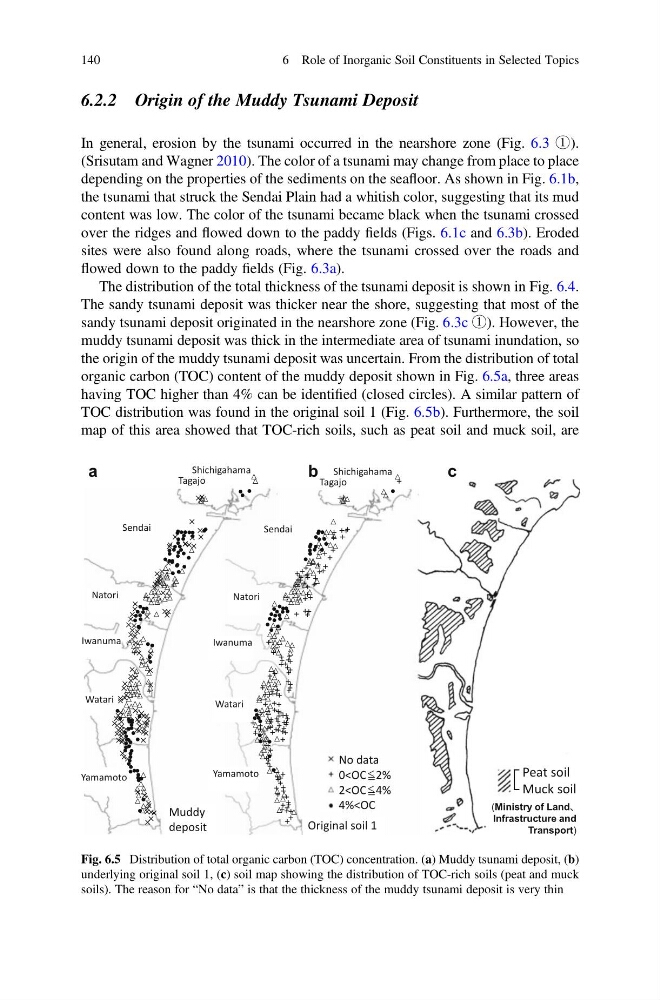
organic carbon (TOC) content of the muddy deposit shown in Fig. 6.5a, three areas
having TOC higher than 4% can be identified (closed circles). A similar pattern of
TOC distribution was found in the original soil 1 (Fig. 6.5b). Furthermore, the soil
map of this area showed that TOC-rich soils, such as peat soil and muck soil, are
(Ministry of Land
Infrastructure and
Transport)
No data
0
Muck soil
Tagajo
Shichigahama
Sendai
Natori
Iwanuma
Watari
Yamamoto
Tagajo
Shichigahama
Sendai
Natori
Iwanuma
Yamamoto
Watari
Muddy
deposit
Original soil 1
a
b
c
=
< =
Fig. 6.5 Distribution of total organic carbon (TOC) concentration. (a) Muddy tsunami deposit, (b)
underlying original soil 1, (c) soil map showing the distribution of TOC-rich soils (peat and muck
soils). The reason for “No data” is that the thickness of the muddy tsunami deposit is very thin
140
6 Role of Inorganic Soil Constituents in Selected Topics
In general, erosion by the tsunami occurred in the nearshore zone (Fig. 6.3 ①).
(Srisutam and Wagner 2010). The color of a tsunami may change from place to place
depending on the properties of the sediments on the seafloor. As shown in Fig. 6.1b,
the tsunami that struck the Sendai Plain had a whitish color, suggesting that its mud
content was low. The color of the tsunami became black when the tsunami crossed
over the ridges and flowed down to the paddy fields (Figs. 6.1c and 6.3b). Eroded
sites were also found along roads, where the tsunami crossed over the roads and
flowed down to the paddy fields (Fig. 6.3a).
The distribution of the total thickness of the tsunami deposit is shown in Fig. 6.4.
The sandy tsunami deposit was thicker near the shore, suggesting that most of the
sandy tsunami deposit originated in the nearshore zone (Fig. 6.3c ①). However, the
muddy tsunami deposit was thick in the intermediate area of tsunami inundation, so
the origin of the muddy tsunami deposit was uncertain. From the distribution of total
organic carbon (TOC) content of the muddy deposit shown in Fig. 6.5a, three areas
having TOC higher than 4% can be identified (closed circles). A similar pattern of
TOC distribution was found in the original soil 1 (Fig. 6.5b). Furthermore, the soil
map of this area showed that TOC-rich soils, such as peat soil and muck soil, are
(Ministry of Land
Infrastructure and
Transport)
No data
0
Muck soil
Tagajo
Shichigahama
Sendai
Natori
Iwanuma
Watari
Yamamoto
Tagajo
Shichigahama
Sendai
Natori
Iwanuma
Yamamoto
Watari
Muddy
deposit
Original soil 1
a
b
c
=
< =
Fig. 6.5 Distribution of total organic carbon (TOC) concentration. (a) Muddy tsunami deposit, (b)
underlying original soil 1, (c) soil map showing the distribution of TOC-rich soils (peat and muck
soils). The reason for “No data” is that the thickness of the muddy tsunami deposit is very thin
140
6 Role of Inorganic Soil Constituents in Selected Topics