

Figures 5.26 and 5.27 show framboidal pyrite separated from the 2011 muddy
tsunami deposit in Miyagi Prefecture, Japan (also see Sect. 6.2). At least at
four sampling sites, muddy tsunami deposits with total S content between 8 and
23 g kg
À1 contained framboidal pyrite, which is most commonly found in soils and
sediments (Fanning et al. 2002). Figure 5.26a shows a SEM image of the framboidal
pyrite. As shown in the EDX spectrum (Fig. 5.26b) and powder XRD pattern
(Fig. 5.26c), and also in the element maps of S (Fig. 5.26d) and Fe (Fig. 5.26e),
spherical or spheroidal crystal aggregates contain S and Fe as major elements; in
addition, the powder XRD pattern includes a set of diffraction peaks from pyrite.
Some of the crystal aggregates are partly broken. The pyrite samples shown in
Figs. 5.26a and 5.27a were prepared after treatment by hot KOH digestion and
separation of heavy mineral fractions (Valentyne 1963).
The crystal aggregates of pyrites are grayish gold or gold in color, and spherical
or spheroidal in shape (Fig. 5.27a). Magnification of one of the crystal aggregates
(Fig. 5.27b) shows that it consists of different crystal forms, such as octahedral
(Fig. 5.27c) and polyhedral or sub-rounded (Fig. 5.27d) types.
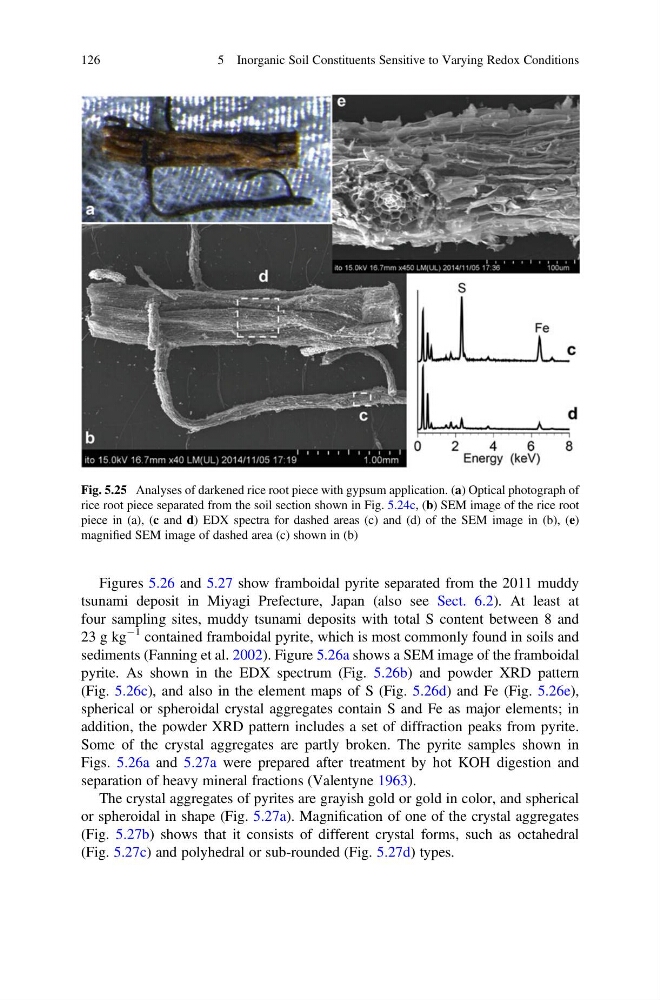
Fig. 5.25 Analyses of darkened rice root piece with gypsum application. (a) Optical photograph of
rice root piece separated from the soil section shown in Fig. 5.24c, (b) SEM image of the rice root
piece in (a), (c and d) EDX spectra for dashed areas (c) and (d) of the SEM image in (b), (e)
magnified SEM image of dashed area (c) shown in (b)
126
5 Inorganic Soil Constituents Sensitive to Varying Redox Conditions
tsunami deposit in Miyagi Prefecture, Japan (also see Sect. 6.2). At least at
four sampling sites, muddy tsunami deposits with total S content between 8 and
23 g kg
À1 contained framboidal pyrite, which is most commonly found in soils and
sediments (Fanning et al. 2002). Figure 5.26a shows a SEM image of the framboidal
pyrite. As shown in the EDX spectrum (Fig. 5.26b) and powder XRD pattern
(Fig. 5.26c), and also in the element maps of S (Fig. 5.26d) and Fe (Fig. 5.26e),
spherical or spheroidal crystal aggregates contain S and Fe as major elements; in
addition, the powder XRD pattern includes a set of diffraction peaks from pyrite.
Some of the crystal aggregates are partly broken. The pyrite samples shown in
Figs. 5.26a and 5.27a were prepared after treatment by hot KOH digestion and
separation of heavy mineral fractions (Valentyne 1963).
The crystal aggregates of pyrites are grayish gold or gold in color, and spherical
or spheroidal in shape (Fig. 5.27a). Magnification of one of the crystal aggregates
(Fig. 5.27b) shows that it consists of different crystal forms, such as octahedral
(Fig. 5.27c) and polyhedral or sub-rounded (Fig. 5.27d) types.
Fig. 5.25 Analyses of darkened rice root piece with gypsum application. (a) Optical photograph of
rice root piece separated from the soil section shown in Fig. 5.24c, (b) SEM image of the rice root
piece in (a), (c and d) EDX spectra for dashed areas (c) and (d) of the SEM image in (b), (e)
magnified SEM image of dashed area (c) shown in (b)
126
5 Inorganic Soil Constituents Sensitive to Varying Redox Conditions