

The presence of pyrite or sulfidic materials can be evaluated by pH measurement
after H 2 O 2 treatment or incubation of soil samples at field capacity for 8 weeks. If the
pH after this treatment is lower than 3 or 3.5, the soil contains a significant amount of
sulfidic materials. Sulfidic soils are converted to strongly acid soils after oxidation
(Soil Survey Staff 1999).
5.5.3 Jarosite
Jarosite is a sulfate mineral [KFe 3 (SO 4 ) 2 (OH) 6 ] formed by oxidation of pyrite. A
Na-substituted type of jarosite, natrojarosite [NaFe 3 (SO 4 ) 2 (OH) 6 ], also exists. They
are both stable under acidic conditions. One of the characteristics of acid sulfate soil
(Fanning and Burch 2000) is significant amounts of jarosite or natrojarosite. Acid
sulfate soils are distributed in coastal lowlands, which are affected by sea-level rise
and fall. Chemical problems of acid sulfate soil are low pH, lack of basic cations,
excessive toxic Al, and high phosphate fixation. Soil amendments, such as liming
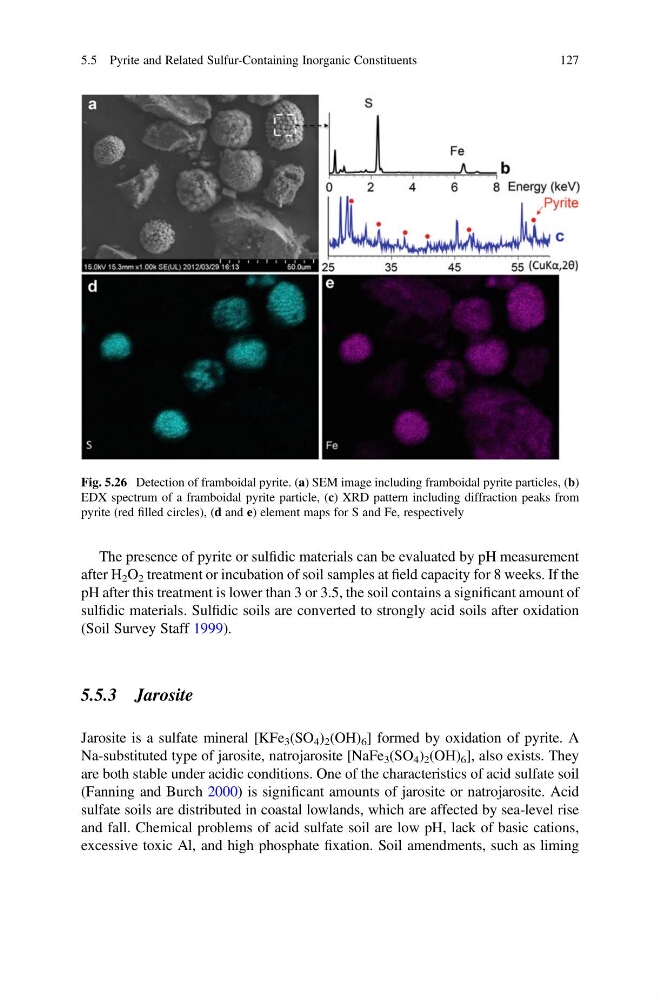
Fig. 5.26 Detection of framboidal pyrite. (a) SEM image including framboidal pyrite particles, (b)
EDX spectrum of a framboidal pyrite particle, (c) XRD pattern including diffraction peaks from
pyrite (red filled circles), (d and e) element maps for S and Fe, respectively
5.5 Pyrite and Related Sulfur-Containing Inorganic Constituents
127
after H 2 O 2 treatment or incubation of soil samples at field capacity for 8 weeks. If the
pH after this treatment is lower than 3 or 3.5, the soil contains a significant amount of
sulfidic materials. Sulfidic soils are converted to strongly acid soils after oxidation
(Soil Survey Staff 1999).
5.5.3 Jarosite
Jarosite is a sulfate mineral [KFe 3 (SO 4 ) 2 (OH) 6 ] formed by oxidation of pyrite. A
Na-substituted type of jarosite, natrojarosite [NaFe 3 (SO 4 ) 2 (OH) 6 ], also exists. They
are both stable under acidic conditions. One of the characteristics of acid sulfate soil
(Fanning and Burch 2000) is significant amounts of jarosite or natrojarosite. Acid
sulfate soils are distributed in coastal lowlands, which are affected by sea-level rise
and fall. Chemical problems of acid sulfate soil are low pH, lack of basic cations,
excessive toxic Al, and high phosphate fixation. Soil amendments, such as liming
Fig. 5.26 Detection of framboidal pyrite. (a) SEM image including framboidal pyrite particles, (b)
EDX spectrum of a framboidal pyrite particle, (c) XRD pattern including diffraction peaks from
pyrite (red filled circles), (d and e) element maps for S and Fe, respectively
5.5 Pyrite and Related Sulfur-Containing Inorganic Constituents
127