

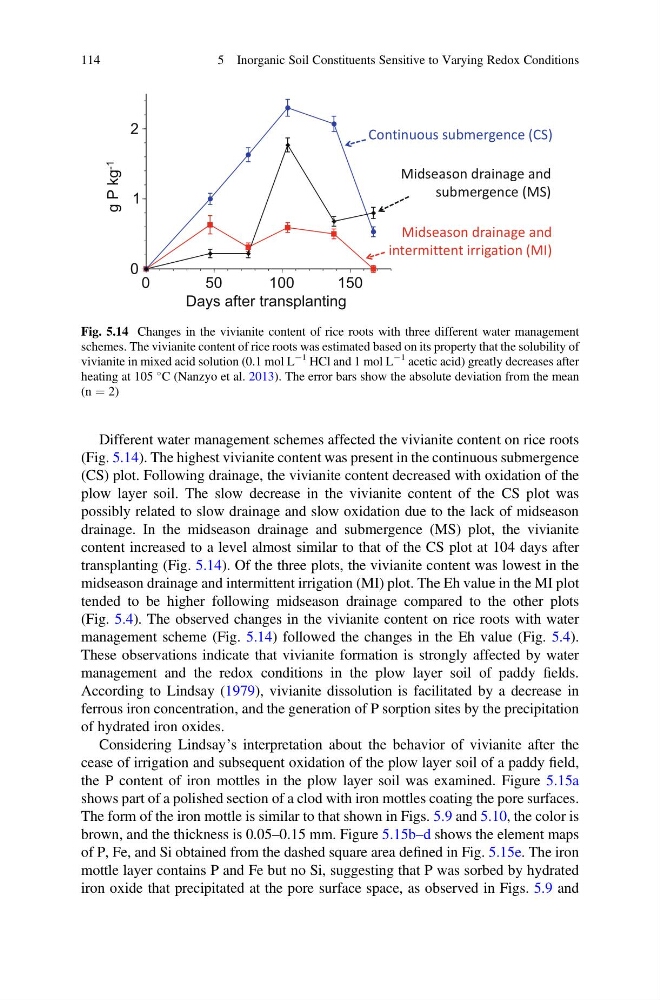
Different water management schemes affected the vivianite content on rice roots
(Fig. 5.14). The highest vivianite content was present in the continuous submergence
(CS) plot. Following drainage, the vivianite content decreased with oxidation of the
plow layer soil. The slow decrease in the vivianite content of the CS plot was
possibly related to slow drainage and slow oxidation due to the lack of midseason
drainage. In the midseason drainage and submergence (MS) plot, the vivianite
content increased to a level almost similar to that of the CS plot at 104 days after
transplanting (Fig. 5.14). Of the three plots, the vivianite content was lowest in the
midseason drainage and intermittent irrigation (MI) plot. The Eh value in the MI plot
tended to be higher following midseason drainage compared to the other plots
(Fig. 5.4). The observed changes in the vivianite content on rice roots with water
management scheme (Fig. 5.14) followed the changes in the Eh value (Fig. 5.4).
These observations indicate that vivianite formation is strongly affected by water
management and the redox conditions in the plow layer soil of paddy fields.
According to Lindsay (1979), vivianite dissolution is facilitated by a decrease in
ferrous iron concentration, and the generation of P sorption sites by the precipitation
of hydrated iron oxides.
Considering Lindsay’s interpretation about the behavior of vivianite after the
cease of irrigation and subsequent oxidation of the plow layer soil of a paddy field,
the P content of iron mottles in the plow layer soil was examined. Figure 5.15a
shows part of a polished section of a clod with iron mottles coating the pore surfaces.
The form of the iron mottle is similar to that shown in Figs. 5.9 and 5.10, the color is
brown, and the thickness is 0.05–0.15 mm. Figure 5.15b–d shows the element maps
of P, Fe, and Si obtained from the dashed square area defined in Fig. 5.15e. The iron
mottle layer contains P and Fe but no Si, suggesting that P was sorbed by hydrated
iron oxide that precipitated at the pore surface space, as observed in Figs. 5.9 and
g P kg -1
Continuous submergence (CS)
Midseason drainage and
submergence (MS)
Midseason drainage and
intermittent irrigation (MI)
Fig. 5.14 Changes in the vivianite content of rice roots with three different water management
schemes. The vivianite content of rice roots was estimated based on its property that the solubility of
vivianite in mixed acid solution (0.1 mol L
À1 HCl and 1 mol L
À1 acetic acid) greatly decreases after
heating at 105
C (Nanzyo et al. 2013). The error bars show the absolute deviation from the mean
(n ¼ 2)
114
5 Inorganic Soil Constituents Sensitive to Varying Redox Conditions
(Fig. 5.14). The highest vivianite content was present in the continuous submergence
(CS) plot. Following drainage, the vivianite content decreased with oxidation of the
plow layer soil. The slow decrease in the vivianite content of the CS plot was
possibly related to slow drainage and slow oxidation due to the lack of midseason
drainage. In the midseason drainage and submergence (MS) plot, the vivianite
content increased to a level almost similar to that of the CS plot at 104 days after
transplanting (Fig. 5.14). Of the three plots, the vivianite content was lowest in the
midseason drainage and intermittent irrigation (MI) plot. The Eh value in the MI plot
tended to be higher following midseason drainage compared to the other plots
(Fig. 5.4). The observed changes in the vivianite content on rice roots with water
management scheme (Fig. 5.14) followed the changes in the Eh value (Fig. 5.4).
These observations indicate that vivianite formation is strongly affected by water
management and the redox conditions in the plow layer soil of paddy fields.
According to Lindsay (1979), vivianite dissolution is facilitated by a decrease in
ferrous iron concentration, and the generation of P sorption sites by the precipitation
of hydrated iron oxides.
Considering Lindsay’s interpretation about the behavior of vivianite after the
cease of irrigation and subsequent oxidation of the plow layer soil of a paddy field,
the P content of iron mottles in the plow layer soil was examined. Figure 5.15a
shows part of a polished section of a clod with iron mottles coating the pore surfaces.
The form of the iron mottle is similar to that shown in Figs. 5.9 and 5.10, the color is
brown, and the thickness is 0.05–0.15 mm. Figure 5.15b–d shows the element maps
of P, Fe, and Si obtained from the dashed square area defined in Fig. 5.15e. The iron
mottle layer contains P and Fe but no Si, suggesting that P was sorbed by hydrated
iron oxide that precipitated at the pore surface space, as observed in Figs. 5.9 and
g P kg -1
Continuous submergence (CS)
Midseason drainage and
submergence (MS)
Midseason drainage and
intermittent irrigation (MI)
Fig. 5.14 Changes in the vivianite content of rice roots with three different water management
schemes. The vivianite content of rice roots was estimated based on its property that the solubility of
vivianite in mixed acid solution (0.1 mol L
À1 HCl and 1 mol L
À1 acetic acid) greatly decreases after
heating at 105
C (Nanzyo et al. 2013). The error bars show the absolute deviation from the mean
(n ¼ 2)
114
5 Inorganic Soil Constituents Sensitive to Varying Redox Conditions