

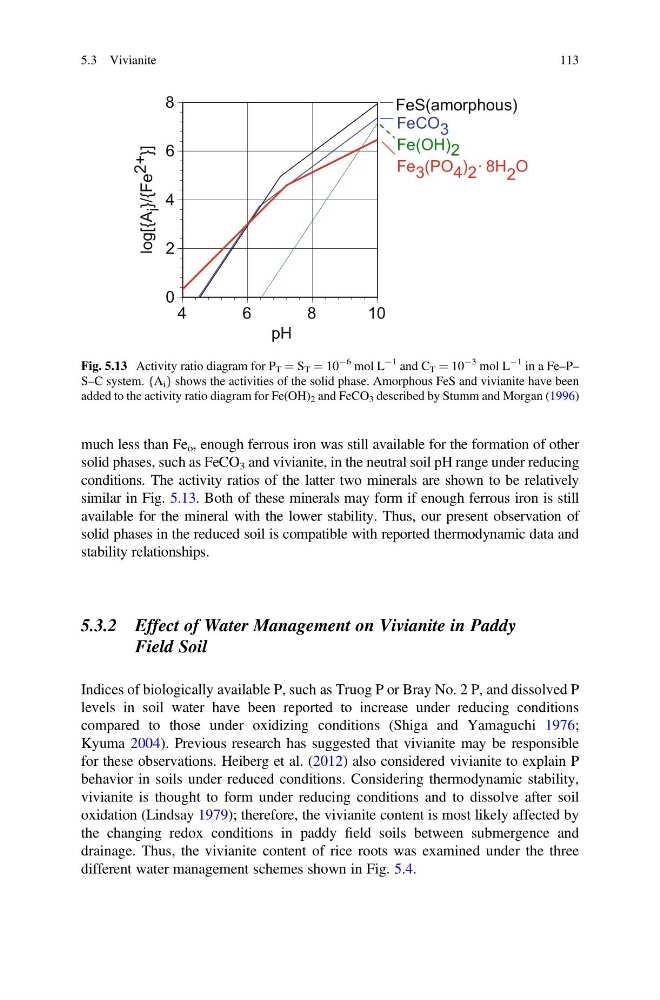
much less than Fe o , enough ferrous iron was still available for the formation of other
solid phases, such as FeCO 3 and vivianite, in the neutral soil pH range under reducing
conditions. The activity ratios of the latter two minerals are shown to be relatively
similar in Fig. 5.13. Both of these minerals may form if enough ferrous iron is still
available for the mineral with the lower stability. Thus, our present observation of
solid phases in the reduced soil is compatible with reported thermodynamic data and
stability relationships.
5.3.2 Effect of Water Management on Vivianite in Paddy
Field Soil
Indices of biologically available P, such as Truog P or Bray No. 2 P, and dissolved P
levels in soil water have been reported to increase under reducing conditions
compared to those under oxidizing conditions (Shiga and Yamaguchi 1976;
Kyuma 2004). Previous research has suggested that vivianite may be responsible
for these observations. Heiberg et al. (2012) also considered vivianite to explain P
behavior in soils under reduced conditions. Considering thermodynamic stability,
vivianite is thought to form under reducing conditions and to dissolve after soil
oxidation (Lindsay 1979); therefore, the vivianite content is most likely affected by
the changing redox conditions in paddy field soils between submergence and
drainage. Thus, the vivianite content of rice roots was examined under the three
different water management schemes shown in Fig. 5.4.
0
2
4
6
8
4
6
8
1 0
pH
log[{A
i }/{Fe 2+
}]
FeS(amorphous)
FeCO 3
Fe(OH) 2
Fe 3 (PO 4 ) 2 8H 2 O
.
Fig. 5.13 Activity ratio diagram for P T ¼ S T ¼ 10
À6 mol L
À1 and C T ¼ 10
À3 mol L
À1 in a Fe–P–
S–C system. {A i } shows the activities of the solid phase. Amorphous FeS and vivianite have been
added to the activity ratio diagram for Fe(OH) 2 and FeCO 3 described by Stumm and Morgan (1996)
5.3 Vivianite
113
solid phases, such as FeCO 3 and vivianite, in the neutral soil pH range under reducing
conditions. The activity ratios of the latter two minerals are shown to be relatively
similar in Fig. 5.13. Both of these minerals may form if enough ferrous iron is still
available for the mineral with the lower stability. Thus, our present observation of
solid phases in the reduced soil is compatible with reported thermodynamic data and
stability relationships.
5.3.2 Effect of Water Management on Vivianite in Paddy
Field Soil
Indices of biologically available P, such as Truog P or Bray No. 2 P, and dissolved P
levels in soil water have been reported to increase under reducing conditions
compared to those under oxidizing conditions (Shiga and Yamaguchi 1976;
Kyuma 2004). Previous research has suggested that vivianite may be responsible
for these observations. Heiberg et al. (2012) also considered vivianite to explain P
behavior in soils under reduced conditions. Considering thermodynamic stability,
vivianite is thought to form under reducing conditions and to dissolve after soil
oxidation (Lindsay 1979); therefore, the vivianite content is most likely affected by
the changing redox conditions in paddy field soils between submergence and
drainage. Thus, the vivianite content of rice roots was examined under the three
different water management schemes shown in Fig. 5.4.
0
2
4
6
8
4
6
8
1 0
pH
log[{A
i }/{Fe 2+
}]
FeS(amorphous)
FeCO 3
Fe(OH) 2
Fe 3 (PO 4 ) 2 8H 2 O
.
Fig. 5.13 Activity ratio diagram for P T ¼ S T ¼ 10
À6 mol L
À1 and C T ¼ 10
À3 mol L
À1 in a Fe–P–
S–C system. {A i } shows the activities of the solid phase. Amorphous FeS and vivianite have been
added to the activity ratio diagram for Fe(OH) 2 and FeCO 3 described by Stumm and Morgan (1996)
5.3 Vivianite
113