

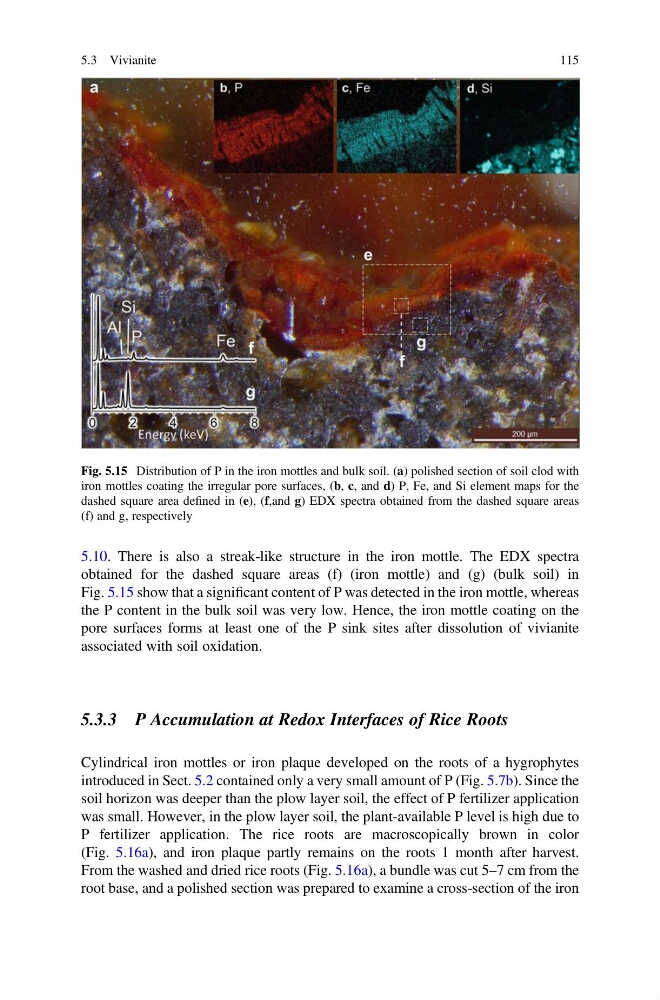
5.10. There is also a streak-like structure in the iron mottle. The EDX spectra
obtained for the dashed square areas (f) (iron mottle) and (g) (bulk soil) in
Fig. 5.15 show that a significant content of P was detected in the iron mottle, whereas
the P content in the bulk soil was very low. Hence, the iron mottle coating on the
pore surfaces forms at least one of the P sink sites after dissolution of vivianite
associated with soil oxidation.
5.3.3 P Accumulation at Redox Interfaces of Rice Roots
Cylindrical iron mottles or iron plaque developed on the roots of a hygrophytes
introduced in Sect. 5.2 contained only a very small amount of P (Fig. 5.7b). Since the
soil horizon was deeper than the plow layer soil, the effect of P fertilizer application
was small. However, in the plow layer soil, the plant-available P level is high due to
P fertilizer application. The rice roots are macroscopically brown in color
(Fig. 5.16a), and iron plaque partly remains on the roots 1 month after harvest.
From the washed and dried rice roots (Fig. 5.16a), a bundle was cut 5–7 cm from the
root base, and a polished section was prepared to examine a cross-section of the iron
Fig. 5.15 Distribution of P in the iron mottles and bulk soil. (a) polished section of soil clod with
iron mottles coating the irregular pore surfaces, (b, c, and d) P, Fe, and Si element maps for the
dashed square area defined in (e), (f,and g) EDX spectra obtained from the dashed square areas
(f) and g, respectively
5.3 Vivianite
115
obtained for the dashed square areas (f) (iron mottle) and (g) (bulk soil) in
Fig. 5.15 show that a significant content of P was detected in the iron mottle, whereas
the P content in the bulk soil was very low. Hence, the iron mottle coating on the
pore surfaces forms at least one of the P sink sites after dissolution of vivianite
associated with soil oxidation.
5.3.3 P Accumulation at Redox Interfaces of Rice Roots
Cylindrical iron mottles or iron plaque developed on the roots of a hygrophytes
introduced in Sect. 5.2 contained only a very small amount of P (Fig. 5.7b). Since the
soil horizon was deeper than the plow layer soil, the effect of P fertilizer application
was small. However, in the plow layer soil, the plant-available P level is high due to
P fertilizer application. The rice roots are macroscopically brown in color
(Fig. 5.16a), and iron plaque partly remains on the roots 1 month after harvest.
From the washed and dried rice roots (Fig. 5.16a), a bundle was cut 5–7 cm from the
root base, and a polished section was prepared to examine a cross-section of the iron
Fig. 5.15 Distribution of P in the iron mottles and bulk soil. (a) polished section of soil clod with
iron mottles coating the irregular pore surfaces, (b, c, and d) P, Fe, and Si element maps for the
dashed square area defined in (e), (f,and g) EDX spectra obtained from the dashed square areas
(f) and g, respectively
5.3 Vivianite
115