

oxides) surround montmorillonite platy particles. In contrast, Fig. 5.8b shows that
platy montmorillonite particles in the bulk soil lack these very fine spherical
particles.
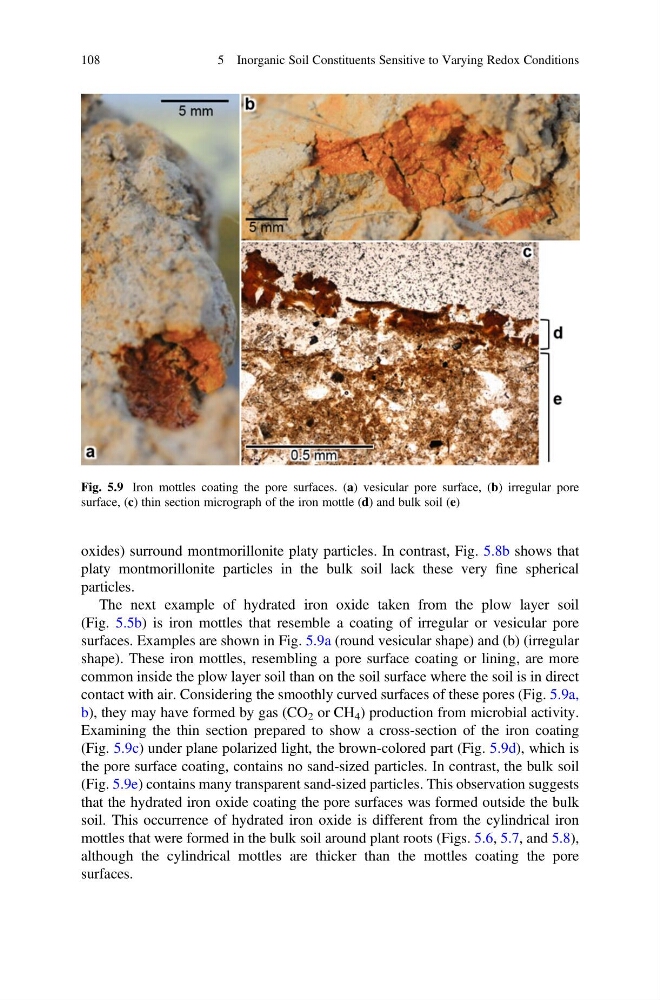
The next example of hydrated iron oxide taken from the plow layer soil
(Fig. 5.5b) is iron mottles that resemble a coating of irregular or vesicular pore
surfaces. Examples are shown in Fig. 5.9a (round vesicular shape) and (b) (irregular
shape). These iron mottles, resembling a pore surface coating or lining, are more
common inside the plow layer soil than on the soil surface where the soil is in direct
contact with air. Considering the smoothly curved surfaces of these pores (Fig. 5.9a,
b), they may have formed by gas (CO 2 or CH 4 ) production from microbial activity.
Examining the thin section prepared to show a cross-section of the iron coating
(Fig. 5.9c) under plane polarized light, the brown-colored part (Fig. 5.9d), which is
the pore surface coating, contains no sand-sized particles. In contrast, the bulk soil
(Fig. 5.9e) contains many transparent sand-sized particles. This observation suggests
that the hydrated iron oxide coating the pore surfaces was formed outside the bulk
soil. This occurrence of hydrated iron oxide is different from the cylindrical iron
mottles that were formed in the bulk soil around plant roots (Figs. 5.6, 5.7, and 5.8),
although the cylindrical mottles are thicker than the mottles coating the pore
surfaces.
Fig. 5.9 Iron mottles coating the pore surfaces. (a) vesicular pore surface, (b) irregular pore
surface, (c) thin section micrograph of the iron mottle (d) and bulk soil (e)
108
5 Inorganic Soil Constituents Sensitive to Varying Redox Conditions
platy montmorillonite particles in the bulk soil lack these very fine spherical
particles.
The next example of hydrated iron oxide taken from the plow layer soil
(Fig. 5.5b) is iron mottles that resemble a coating of irregular or vesicular pore
surfaces. Examples are shown in Fig. 5.9a (round vesicular shape) and (b) (irregular
shape). These iron mottles, resembling a pore surface coating or lining, are more
common inside the plow layer soil than on the soil surface where the soil is in direct
contact with air. Considering the smoothly curved surfaces of these pores (Fig. 5.9a,
b), they may have formed by gas (CO 2 or CH 4 ) production from microbial activity.
Examining the thin section prepared to show a cross-section of the iron coating
(Fig. 5.9c) under plane polarized light, the brown-colored part (Fig. 5.9d), which is
the pore surface coating, contains no sand-sized particles. In contrast, the bulk soil
(Fig. 5.9e) contains many transparent sand-sized particles. This observation suggests
that the hydrated iron oxide coating the pore surfaces was formed outside the bulk
soil. This occurrence of hydrated iron oxide is different from the cylindrical iron
mottles that were formed in the bulk soil around plant roots (Figs. 5.6, 5.7, and 5.8),
although the cylindrical mottles are thicker than the mottles coating the pore
surfaces.
Fig. 5.9 Iron mottles coating the pore surfaces. (a) vesicular pore surface, (b) irregular pore
surface, (c) thin section micrograph of the iron mottle (d) and bulk soil (e)
108
5 Inorganic Soil Constituents Sensitive to Varying Redox Conditions