

586
10 Particle Physics – II
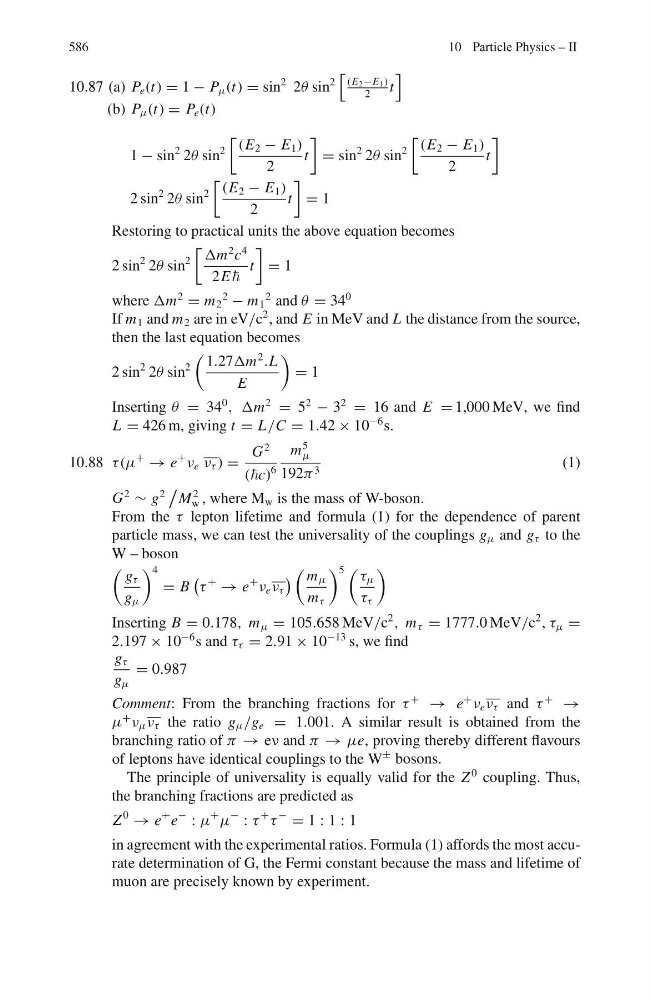
10.87 (a) P e (t) = 1 − P μ (t) = sin
2 2θ sin
2
(E2−E1)
2
t
(b) P μ (t) = P e (t)
1 − sin
2 2θ sin
2
(E 2 − E 1 )
2
t
= sin
2 2θ sin
2
(E 2 − E 1 )
2
t
2 sin
2 2θ sin
2
(E 2 − E 1 )
2
t
= 1
Restoring to practical units the above equation becomes
2 sin
2 2θ sin
2
Δm
2 c
4
2E
t
= 1
where Δm
2
= m 2
2
− m 1
2 and θ = 34
0
If m 1 and m 2 are in eV/c
2 , and E in MeV and L the distance from the source,
then the last equation becomes
2 sin
2 2θ sin
2
1.27Δm
2
.L
E
= 1
Inserting θ = 34
0
, Δm
2
= 5
2
− 3
2
= 16 and E = 1,000 MeV, we find
L = 426 m, giving t = L/C = 1.42 × 10
−6 s.
10.88 τ (μ
+
→ e
+
ν e ν τ ) =
G
2
(c)
6
m
5
μ
192π 3
(1)
G
2
∼ g
2
M
2
w , where M w is the mass of W-boson.
From the τ lepton lifetime and formula (1) for the dependence of parent
particle mass, we can test the universality of the couplings g μ and g τ to the
W – boson
g τ
g μ
4
= B
τ
+
→ e
+
ν e ν τ
m μ
m τ
5 τ μ
τ τ
Inserting B = 0.178, m μ = 105.658 MeV/c
2
, m τ = 1777.0 MeV/c
2 , τ μ =
2.197 × 10
−6 s and τ τ = 2.91 × 10
−13 s, we find
g τ
g μ
= 0.987
Comment: From the branching fractions for τ
+
→ e
+
ν e ν τ and τ
+
→
μ
+
ν μ ν τ the ratio g μ /g e = 1.001. A similar result is obtained from the
branching ratio of π → eν and π → μe, proving thereby different flavours
of leptons have identical couplings to the W
± bosons.
The principle of universality is equally valid for the Z
0 coupling. Thus,
the branching fractions are predicted as
Z
0
→ e
+ e
− : μ
+
μ
− : τ
+
τ
−
= 1 : 1 : 1
in agreement with the experimental ratios. Formula (1) affords the most accurate determination of G, the Fermi constant because the mass and lifetime of
muon are precisely known by experiment.