

10.3 Solutions
585
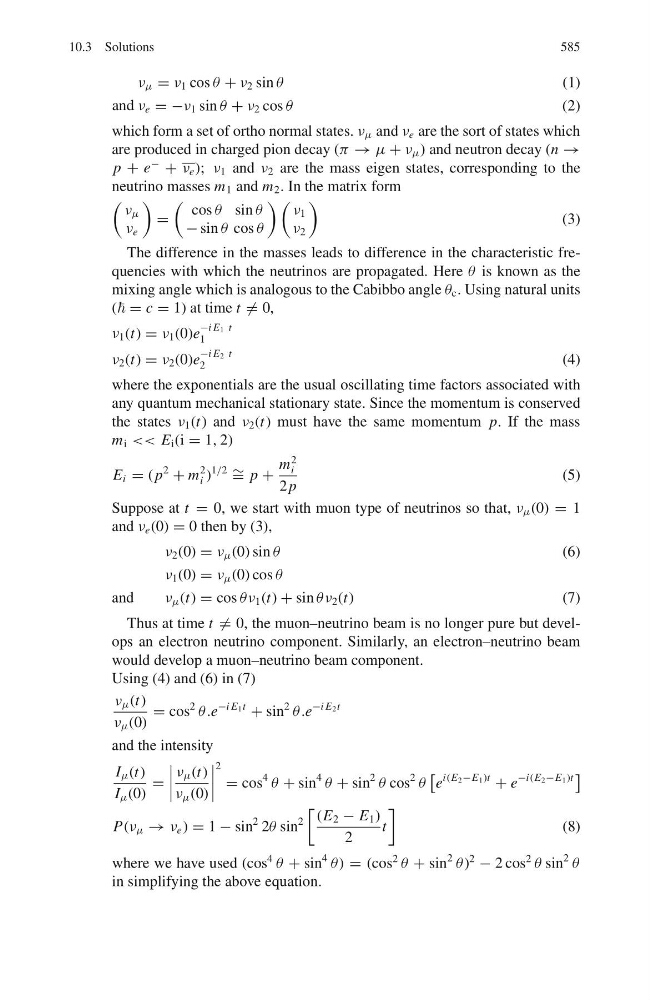
ν μ = ν 1 cos θ + ν 2 sin θ
(1)
and ν e = −ν 1 sin θ + ν 2 cos θ
(2)
which form a set of ortho normal states. ν μ and ν e are the sort of states which
are produced in charged pion decay (π → μ + ν μ ) and neutron decay (n →
p + e
−
+ ν e ); ν 1 and ν 2 are the mass eigen states, corresponding to the
neutrino masses m 1 and m 2 . In the matrix form
ν μ
ν e
=
cos θ sin θ
− sin θ cos θ
ν 1
ν 2
(3)
The difference in the masses leads to difference in the characteristic frequencies with which the neutrinos are propagated. Here θ is known as the
mixing angle which is analogous to the Cabibbo angle θ c . Using natural units
( = c = 1) at time t = 0,
ν 1 (t) = ν 1 (0)e
−i E1 t
1
ν 2 (t) = ν 2 (0)e
−i E 2 t
2
(4)
where the exponentials are the usual oscillating time factors associated with
any quantum mechanical stationary state. Since the momentum is conserved
the states ν 1 (t) and ν 2 (t) must have the same momentum p. If the mass
m i << E i (i = 1, 2)
E i = ( p
2
+ m
2
i )
1/2 ∼ = p +
m
2
i
2 p
(5)
Suppose at t = 0, we start with muon type of neutrinos so that, ν μ (0) = 1
and ν e (0) = 0 then by (3),
ν 2 (0) = ν μ (0) sin θ
(6)
ν 1 (0) = ν μ (0) cos θ
and
ν μ (t) = cos θν 1 (t) + sin θν 2 (t)
( 7 )
Thus at time t = 0, the muon–neutrino beam is no longer pure but develops an electron neutrino component. Similarly, an electron–neutrino beam
would develop a muon–neutrino beam component.
Using (4) and (6) in (7)
ν μ (t)
ν μ (0)
= cos
2
θ.e
−i E 1 t
+ sin
2
θ.e
−i E 2 t
and the intensity
I μ (t)
I μ (0)
=
ν μ (t)
ν μ (0)
2
= cos
4
θ + sin
4
θ + sin
2
θ cos
2
θ
e
i(E 2 −E 1 )t
+ e
−i(E 2 −E 1 )t
P(ν μ → ν e ) = 1 − sin
2 2θ sin
2
(E 2 − E 1 )
2
t
(8)
where we have used (cos
4
θ + sin
4
θ) = (cos
2
θ + sin
2
θ )
2
− 2 cos
2
θ sin
2
θ
in simplifying the above equation.