

584
10 Particle Physics – II
Meson Quark wave function |Σa i Q i |
2
ρ
0
(uu − dd)/
√
2
1
√
2
2
3
−
−
1
3
2 =
1
2
ω
0
(uu + dd)/
√
2
1
√
2
2
3
−
1
3
2 =
1
18
Φ
0
ss
1
3
2 =
1
9
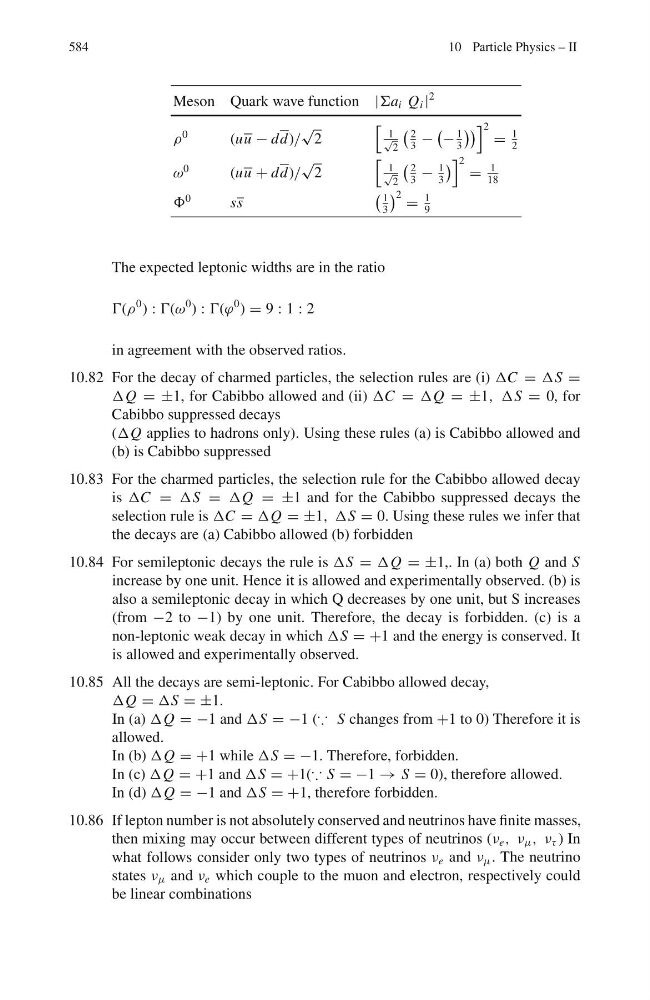
The expected leptonic widths are in the ratio
Γ(ρ
0 ) : Γ(ω
0 ) : Γ(ϕ
0 ) = 9 : 1 : 2
in agreement with the observed ratios.
10.82 For the decay of charmed particles, the selection rules are (i) ΔC = ΔS =
ΔQ = ±1, for Cabibbo allowed and (ii) ΔC = ΔQ = ±1, ΔS = 0, for
Cabibbo suppressed decays
(ΔQ applies to hadrons only). Using these rules (a) is Cabibbo allowed and
(b) is Cabibbo suppressed
10.83 For the charmed particles, the selection rule for the Cabibbo allowed decay
is ΔC = ΔS = ΔQ = ±1 and for the Cabibbo suppressed decays the
selection rule is ΔC = ΔQ = ±1, ΔS = 0. Using these rules we infer that
the decays are (a) Cabibbo allowed (b) forbidden
10.84 For semileptonic decays the rule is ΔS = ΔQ = ±1,. In (a) both Q and S
increase by one unit. Hence it is allowed and experimentally observed. (b) is
also a semileptonic decay in which Q decreases by one unit, but S increases
(from −2 to −1) by one unit. Therefore, the decay is forbidden. (c) is a
non-leptonic weak decay in which ΔS = +1 and the energy is conserved. It
is allowed and experimentally observed.
10.85 All the decays are semi-leptonic. For Cabibbo allowed decay,
ΔQ = ΔS = ±1.
In (a) ΔQ = −1 and ΔS = −1 (∵ S changes from +1 to 0) Therefore it is
allowed.
In (b) ΔQ = +1 while ΔS = −1. Therefore, forbidden.
In (c) ΔQ = +1 and ΔS = +1(∵ S = −1 → S = 0), therefore allowed.
In (d) ΔQ = −1 and ΔS = +1, therefore forbidden.
10.86 If lepton number is not absolutely conserved and neutrinos have finite masses,
then mixing may occur between different types of neutrinos (ν e , ν μ , ν τ ) In
what follows consider only two types of neutrinos ν e and ν μ . The neutrino
states ν μ and ν e which couple to the muon and electron, respectively could
be linear combinations