

10.3 Solutions
583
(h) Mass m x ≥
m π + m μ + m υ
/c
2
= (135 + 106 + 0) /c
2
= 241 MeV/c
2
(i) X is identified as K
+ -meson.
10.77 The initial state
16 O
∗ has odd parity, while the parity of
12 C is even and so
also that of α. If α is emitted with l = 0 the parity of the final state is even.
Clearly the decay goes through a weak interaction because parity is violated
and the observed width is consistent with a weak decay. On the other hand
the width of the electro-magnetic decay
16 O
∗
→
16 O + γ , is 3 × 10
−3 eV.
10.78 τ τ = B×τ μ
mμ
mτ
5 =
17.7
100
×2.197×10
−6
×
105.658
1784
5 = 0.28×10
−12 s a value
which is in excellent agreement with the experimental value of 0.3 × 10
−12 s
10.79 Pions have T = 1. A system of two pions can exist in the isospin state I = 0,
1, and 2 state. Therefore, isospin is conserved in all the three cases.
Now pions obey Bose statistics and so Ψ total is symmetrical. As J = 0
for pions, the spatial part of pions system must be symmetrical. The intrinsic
parity of each pion being negative, does not contribute to the parity of the
state. The parity of the state is mainly determined by the L-value; p = (−1)
l .
Therefore, allowed states correspond to L = 0, 2, 4, . . . It follows that particles with J
p
= 0
+
, 2
+
. . . can decay to two pions, so that only possible
decay is f
0
→ π
+
+ π
− ; the other two particles ω
0 and η
0 actually decay
into three pions.
10.80 The mass of η – meson is 549 Mev/c
2 while the mass of four pions is
558 MeV/c
2 if all the four pions are charged and 540 MeV/c
2 if uncharged.
In the first state the decay cannot occur because of energy conservation and
in the second case the decay will be heavily suppressed because of a small
phase space on account of small Q-value. Apart from this the only possible
pionic decay is the 3-body mode, the strong decay into two pions or four
pions being forbidden by parity conservation.
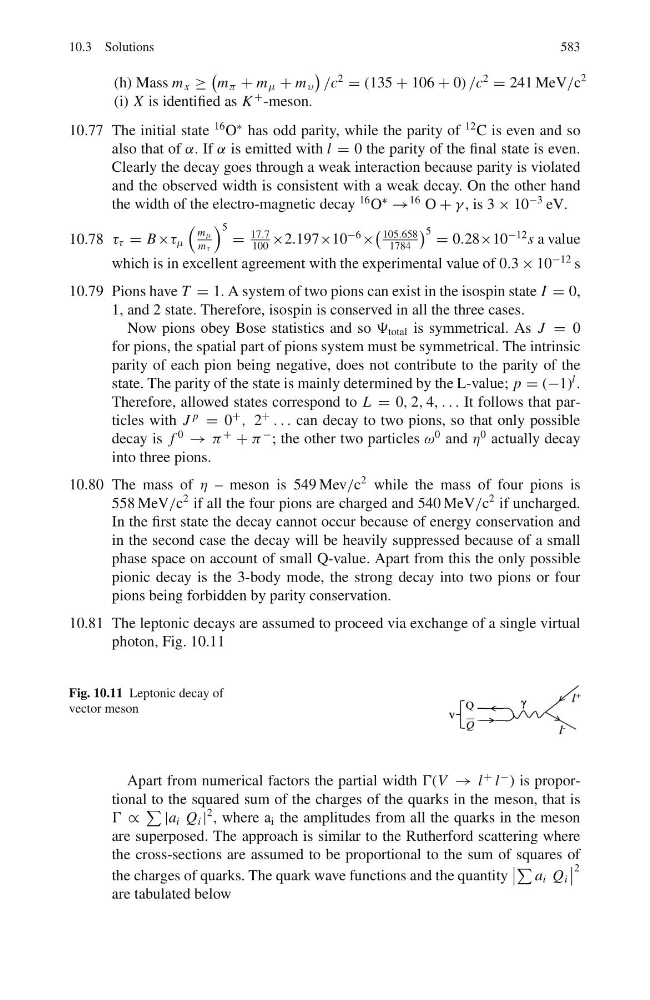
10.81 The leptonic decays are assumed to proceed via exchange of a single virtual
photon, Fig. 10.11
Fig. 10.11 Leptonic decay of
vector meson
Apart from numerical factors the partial width Γ(V → l
+ l
− ) is proportional to the squared sum of the charges of the quarks in the meson, that is
Γ ∝
|a i Q i |
2 , where a i the amplitudes from all the quarks in the meson
are superposed. The approach is similar to the Rutherford scattering where
the cross-sections are assumed to be proportional to the sum of squares of
the charges of quarks. The quark wave functions and the quantity
a i Q i
2
are tabulated below