

10.3 Solutions
587
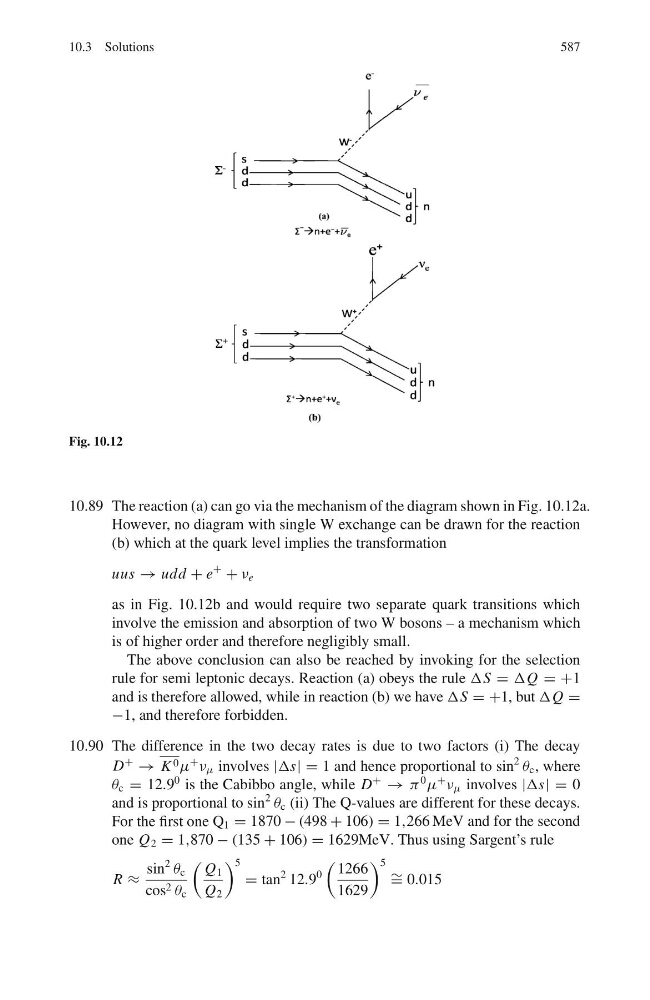
Fig. 10.12
10.89 The reaction (a) can go via the mechanism of the diagram shown in Fig. 10.12a.
However, no diagram with single W exchange can be drawn for the reaction
(b) which at the quark level implies the transformation
uus → udd + e
+
+ ν e
as in Fig. 10.12b and would require two separate quark transitions which
involve the emission and absorption of two W bosons – a mechanism which
is of higher order and therefore negligibly small.
The above conclusion can also be reached by invoking for the selection
rule for semi leptonic decays. Reaction (a) obeys the rule ΔS = ΔQ = +1
and is therefore allowed, while in reaction (b) we have ΔS = +1, but ΔQ =
−1, and therefore forbidden.
10.90 The difference in the two decay rates is due to two factors (i) The decay
D
+
→ K 0 μ
+
ν μ involves |Δs| = 1 and hence proportional to sin
2
θ c , where
θ c = 12.9
0 is the Cabibbo angle, while D
+
→ π
0
μ
+
ν μ involves |Δs| = 0
and is proportional to sin
2
θ c (ii) The Q-values are different for these decays.
For the first one Q 1 = 1870 − (498 + 106) = 1,266 MeV and for the second
one Q 2 = 1,870 − (135 + 106) = 1629MeV. Thus using Sargent’s rule
R ≈
sin
2
θ c
cos 2 θ c
Q 1
Q 2
5
= tan
2 12.9
0
1266
1629
5 ∼ = 0.015