

40
1 Mathematical Physics
1.18 The given function is of the square form. As f (x) is defined in the interval
(−π, π), the Fourier expansion is given by
f (x) =
1
2
a 0 +
∞
n=1
(a n cos nx + b n sin nx)
( 1 )
where a n = (1/π )
π
−π
f (x) cos nx dx
(2)
a 0 = (1/π )
π
−π
f (x) dx
(3)
b n =
1
π
π
−π
f (x) sin nx dx
(4)
By (3)
a 0 = (1/π )
0
−π
0dx +
π
0
πdx
= π
(5)
By (2)
a n = (1/π )
π
0
cos nx dx = 0, n ≥ 1
( 6 )
By (4)
b n = (1/π )
π
0
π sin nx dx =
1
n
(1 − cos nπ )
( 7 )
Using (5), (6) and (7) in (1)
f (x) =
π
2
+ 2
sin(x) +
1
3
sin 3x +
1
5
sin 5x + · · ·
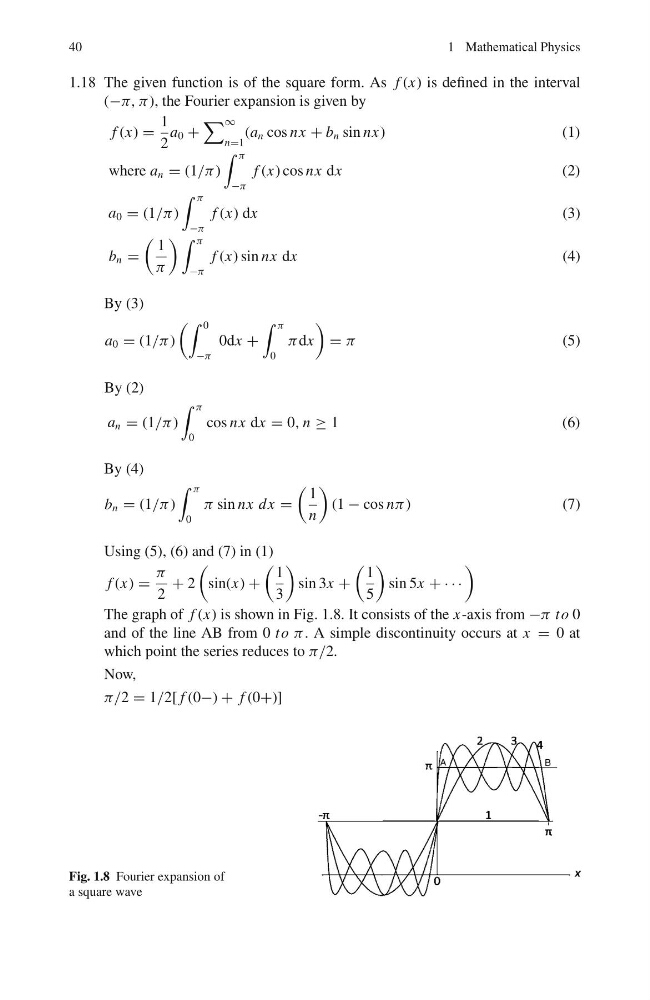
The graph of f (x) is shown in Fig. 1.8. It consists of the x-axis from −π to 0
and of the line AB from 0 to π . A simple discontinuity occurs at x = 0 at
which point the series reduces to π/2.
Now,
π/2 = 1/2[ f (0−) + f (0+)]
Fig. 1.8 Fourier expansion of
a square wave
1 Mathematical Physics
1.18 The given function is of the square form. As f (x) is defined in the interval
(−π, π), the Fourier expansion is given by
f (x) =
1
2
a 0 +
∞
n=1
(a n cos nx + b n sin nx)
( 1 )
where a n = (1/π )
π
−π
f (x) cos nx dx
(2)
a 0 = (1/π )
π
−π
f (x) dx
(3)
b n =
1
π
π
−π
f (x) sin nx dx
(4)
By (3)
a 0 = (1/π )
0
−π
0dx +
π
0
πdx
= π
(5)
By (2)
a n = (1/π )
π
0
cos nx dx = 0, n ≥ 1
( 6 )
By (4)
b n = (1/π )
π
0
π sin nx dx =
1
n
(1 − cos nπ )
( 7 )
Using (5), (6) and (7) in (1)
f (x) =
π
2
+ 2
sin(x) +
1
3
sin 3x +
1
5
sin 5x + · · ·
The graph of f (x) is shown in Fig. 1.8. It consists of the x-axis from −π to 0
and of the line AB from 0 to π . A simple discontinuity occurs at x = 0 at
which point the series reduces to π/2.
Now,
π/2 = 1/2[ f (0−) + f (0+)]
Fig. 1.8 Fourier expansion of
a square wave