

1.3 Solutions
41
which is consistent with Dirichlet’s theorem. Similar behavior is exhibited at
x = π, ±2π . . . Figure 1.8 shows first four partial sums with equations
y = π/2
y = π/2 + 2 sin x
y = π/2 + 2(sin x + (1/3) sin 3x)
y = π/2 + 2(sin x + (1/3) sin 3x + (1/5) sin 5x)
1.19 By Problem 1.18,
y =
π
2
+ 2
sin x +
1
3
sin 3x +
1
5
sin 5x +
1
7
sin 7x + · · ·
Put x = π/2 in the above series
y = π =
π
2
+ 2
1 −
1
3
+
1
5
−
1
7
+ · · ·
Hence
π
4
= 1 −
1
3
+
1
5
−
1
7
+ · · ·
1.20 The Fourier transform of f (x) is
T (u) =
1
√
2π
a
−a
e
iux f (x)dx
=
1
√
2π
a
−a
1.e
iux dx =
1
√
2π
e
iux
iu
a
−a
=
1
√
2π
e
iua
− e
−iua
iu
=
2
π
sin ua
u
, u = 0
For u = 0, T (u) =
2
π
u.
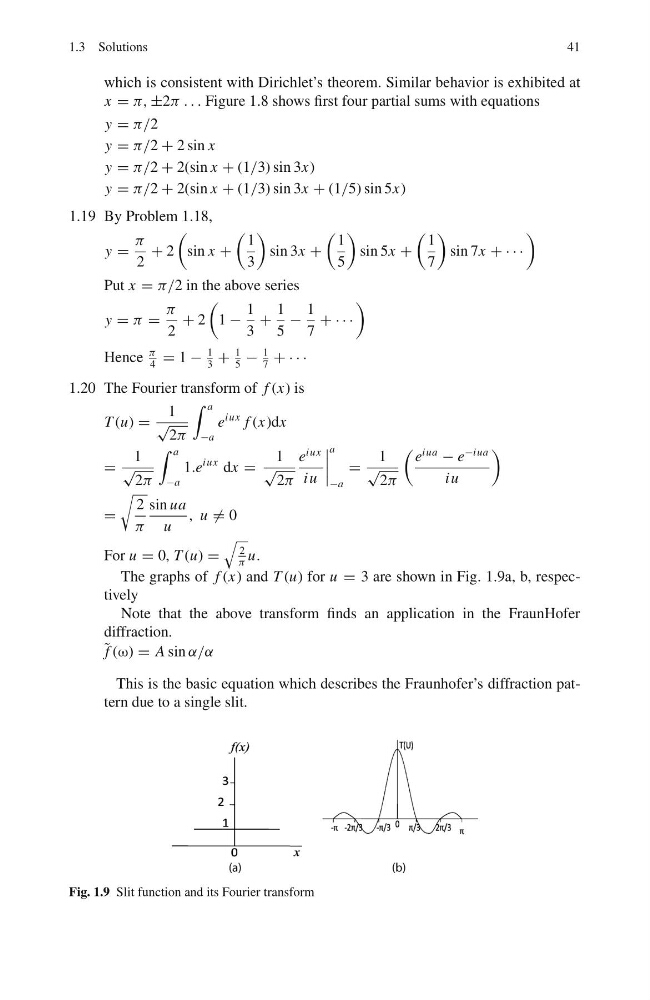
The graphs of f (x) and T (u) for u = 3 are shown in Fig. 1.9a, b, respectively
Note that the above transform finds an application in the FraunHofer
diffraction.
˜ f (ω) = A sin α/α
This is the basic equation which describes the Fraunhofer’s diffraction pattern due to a single slit.
Fig. 1.9 Slit function and its Fourier transform
41
which is consistent with Dirichlet’s theorem. Similar behavior is exhibited at
x = π, ±2π . . . Figure 1.8 shows first four partial sums with equations
y = π/2
y = π/2 + 2 sin x
y = π/2 + 2(sin x + (1/3) sin 3x)
y = π/2 + 2(sin x + (1/3) sin 3x + (1/5) sin 5x)
1.19 By Problem 1.18,
y =
π
2
+ 2
sin x +
1
3
sin 3x +
1
5
sin 5x +
1
7
sin 7x + · · ·
Put x = π/2 in the above series
y = π =
π
2
+ 2
1 −
1
3
+
1
5
−
1
7
+ · · ·
Hence
π
4
= 1 −
1
3
+
1
5
−
1
7
+ · · ·
1.20 The Fourier transform of f (x) is
T (u) =
1
√
2π
a
−a
e
iux f (x)dx
=
1
√
2π
a
−a
1.e
iux dx =
1
√
2π
e
iux
iu
a
−a
=
1
√
2π
e
iua
− e
−iua
iu
=
2
π
sin ua
u
, u = 0
For u = 0, T (u) =
2
π
u.
The graphs of f (x) and T (u) for u = 3 are shown in Fig. 1.9a, b, respectively
Note that the above transform finds an application in the FraunHofer
diffraction.
˜ f (ω) = A sin α/α
This is the basic equation which describes the Fraunhofer’s diffraction pattern due to a single slit.
Fig. 1.9 Slit function and its Fourier transform