

1.3 Solutions
39
1.3.2 Fourier Series and Fourier Transforms
1.17 f (x) =
1
2
a 0 +
∞
n=1
a n cos
nπ x
L
+ b n sin
nπ x
L
(1)
a n = (1/L)
L
−L
f (x) cos
nπ x
L
dx
(2)
b n = (1/L)
L
−L
f (x) sin
nπ x
L
dx
(3)
As f (x) is an odd function, a n = 0 for all n.
b n = (1/L)
L
−L
f (x) sin
nπ x
L
dx
= (2/L)
L
0
x sin
nπ x
L
dx
= −
2
nπ
cos nπ = −
2
nπ
(−1)
n
=
2
nπ
(−1)
n+1
Therefore,
f (x) = (2/π )
∞
1
(−1)
n+1
n
sin
nπ x
L
= (2/π )[sin
π x
L
−
1
2
sin
2π x
L
+
1
3
sin
3π x
L
− · · · ]
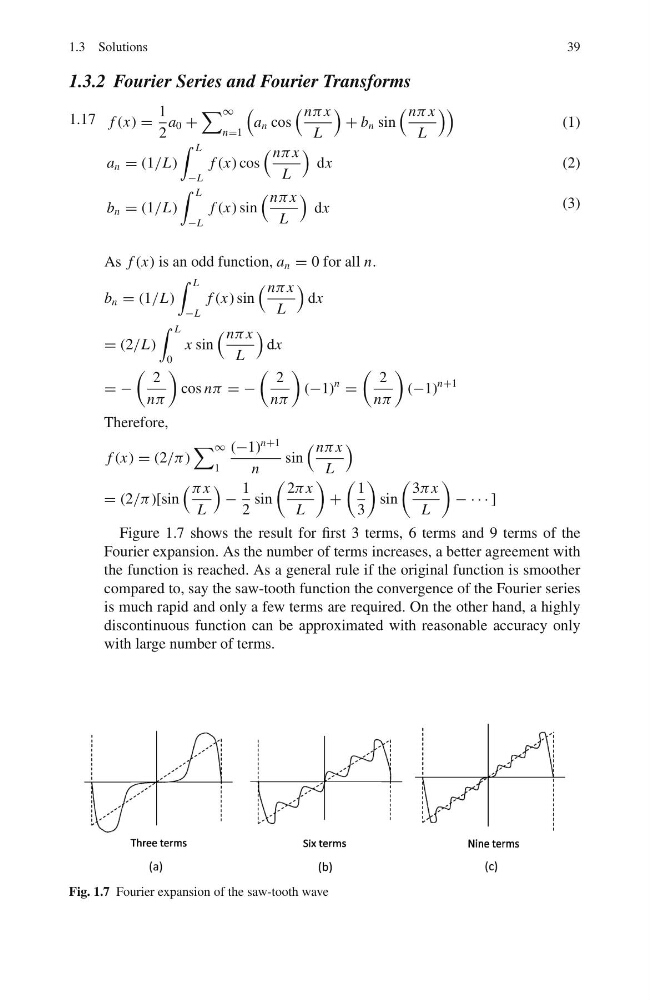
Figure 1.7 shows the result for first 3 terms, 6 terms and 9 terms of the
Fourier expansion. As the number of terms increases, a better agreement with
the function is reached. As a general rule if the original function is smoother
compared to, say the saw-tooth function the convergence of the Fourier series
is much rapid and only a few terms are required. On the other hand, a highly
discontinuous function can be approximated with reasonable accuracy only
with large number of terms.
Fig. 1.7 Fourier expansion of the saw-tooth wave
39
1.3.2 Fourier Series and Fourier Transforms
1.17 f (x) =
1
2
a 0 +
∞
n=1
a n cos
nπ x
L
+ b n sin
nπ x
L
(1)
a n = (1/L)
L
−L
f (x) cos
nπ x
L
dx
(2)
b n = (1/L)
L
−L
f (x) sin
nπ x
L
dx
(3)
As f (x) is an odd function, a n = 0 for all n.
b n = (1/L)
L
−L
f (x) sin
nπ x
L
dx
= (2/L)
L
0
x sin
nπ x
L
dx
= −
2
nπ
cos nπ = −
2
nπ
(−1)
n
=
2
nπ
(−1)
n+1
Therefore,
f (x) = (2/π )
∞
1
(−1)
n+1
n
sin
nπ x
L
= (2/π )[sin
π x
L
−
1
2
sin
2π x
L
+
1
3
sin
3π x
L
− · · · ]
Figure 1.7 shows the result for first 3 terms, 6 terms and 9 terms of the
Fourier expansion. As the number of terms increases, a better agreement with
the function is reached. As a general rule if the original function is smoother
compared to, say the saw-tooth function the convergence of the Fourier series
is much rapid and only a few terms are required. On the other hand, a highly
discontinuous function can be approximated with reasonable accuracy only
with large number of terms.
Fig. 1.7 Fourier expansion of the saw-tooth wave