

478
8 Nuclear Physics – II
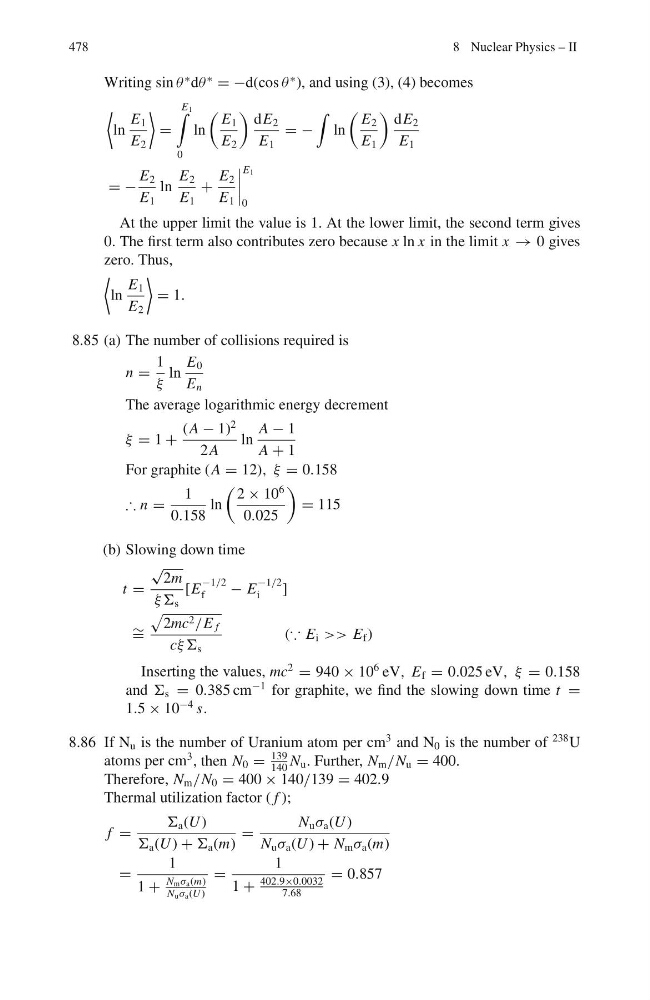
Writing sin θ
∗ dθ
∗
= −d(cos θ
∗ ), and using (3), (4) becomes
ln
E 1
E 2
=
E1
0
ln
E 1
E 2
dE 2
E 1
= −
ln
E 2
E 1
dE 2
E 1
= −
E 2
E 1
ln
E 2
E 1
+
E 2
E 1
E1
0
At the upper limit the value is 1. At the lower limit, the second term gives
0. The first term also contributes zero because x ln x in the limit x → 0 gives
zero. Thus,
ln
E 1
E 2
= 1.
8.85 (a) The number of collisions required is
n =
1
ξ
ln
E 0
E n
The average logarithmic energy decrement
ξ = 1 +
(A − 1)
2
2A
ln
A − 1
A + 1
For graphite (A = 12), ξ = 0.158
∴ n =
1
0.158
ln
2 × 10
6
0.025
= 115
(b) Slowing down time
t =
√
2m
ξ Σ s
[E
−1/2
f
− E
−1/2
i
]
∼ =
2mc 2 /E f
cξ Σ s
(∵ E i >> E f )
Inserting the values, mc
2
= 940 × 10
6 eV, E f = 0.025 eV, ξ = 0.158
and Σ s = 0.385 cm
−1 for graphite, we find the slowing down time t =
1.5 × 10
−4 s.
8.86 If N u is the number of Uranium atom per cm
3 and N 0 is the number of
238 U
atoms per cm
3 , then N 0 =
139
140
N u . Further, N m /N u = 400.
Therefore, N m /N 0 = 400 × 140/139 = 402.9
Thermal utilization factor ( f );
f =
Σ a (U )
Σ a (U ) + Σ a (m)
=
N u σ a (U )
N u σ a (U ) + N m σ a (m)
=
1
1 +
N m σ a (m)
N u σ a (U )
=
1
1 +
402.9×0.0032
7.68
= 0.857
8 Nuclear Physics – II
Writing sin θ
∗ dθ
∗
= −d(cos θ
∗ ), and using (3), (4) becomes
ln
E 1
E 2
=
E1
0
ln
E 1
E 2
dE 2
E 1
= −
ln
E 2
E 1
dE 2
E 1
= −
E 2
E 1
ln
E 2
E 1
+
E 2
E 1
E1
0
At the upper limit the value is 1. At the lower limit, the second term gives
0. The first term also contributes zero because x ln x in the limit x → 0 gives
zero. Thus,
ln
E 1
E 2
= 1.
8.85 (a) The number of collisions required is
n =
1
ξ
ln
E 0
E n
The average logarithmic energy decrement
ξ = 1 +
(A − 1)
2
2A
ln
A − 1
A + 1
For graphite (A = 12), ξ = 0.158
∴ n =
1
0.158
ln
2 × 10
6
0.025
= 115
(b) Slowing down time
t =
√
2m
ξ Σ s
[E
−1/2
f
− E
−1/2
i
]
∼ =
2mc 2 /E f
cξ Σ s
(∵ E i >> E f )
Inserting the values, mc
2
= 940 × 10
6 eV, E f = 0.025 eV, ξ = 0.158
and Σ s = 0.385 cm
−1 for graphite, we find the slowing down time t =
1.5 × 10
−4 s.
8.86 If N u is the number of Uranium atom per cm
3 and N 0 is the number of
238 U
atoms per cm
3 , then N 0 =
139
140
N u . Further, N m /N u = 400.
Therefore, N m /N 0 = 400 × 140/139 = 402.9
Thermal utilization factor ( f );
f =
Σ a (U )
Σ a (U ) + Σ a (m)
=
N u σ a (U )
N u σ a (U ) + N m σ a (m)
=
1
1 +
N m σ a (m)
N u σ a (U )
=
1
1 +
402.9×0.0032
7.68
= 0.857