

8.3 Solutions
479
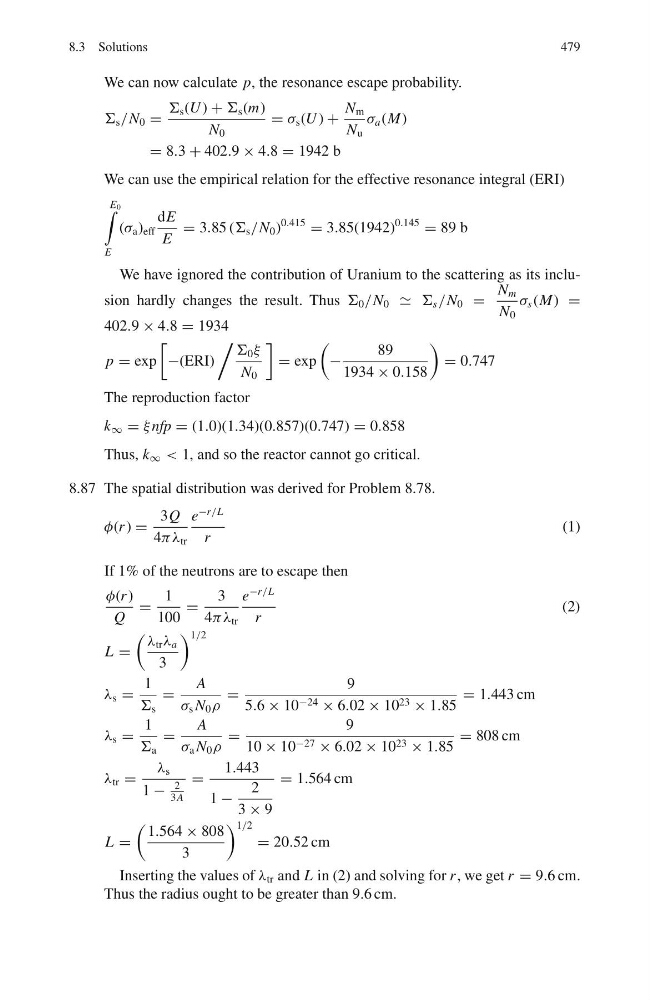
We can now calculate p, the resonance escape probability.
Σ s /N 0 =
Σ s (U ) + Σ s (m)
N 0
= σ s (U ) +
N m
N u
σ a (M)
= 8.3 + 402.9 × 4.8 = 1942 b
We can use the empirical relation for the effective resonance integral (ERI)
E0
E
(σ a ) eff
dE
E
= 3.85 (Σ s /N 0 )
0.415
= 3.85(1942)
0.145
= 89 b
We have ignored the contribution of Uranium to the scattering as its inclusion hardly changes the result. Thus Σ 0 /N 0 Σ s /N 0 =
N m
N 0
σ s (M) =
402.9 × 4.8 = 1934
p = exp
−(ERI)
Σ 0 ξ
N 0
= exp
−
89
1934 × 0.158
= 0.747
The reproduction factor
k ∞ = ξ nfp = (1.0)(1.34)(0.857)(0.747) = 0.858
Thus, k ∞ < 1, and so the reactor cannot go critical.
8.87 The spatial distribution was derived for Problem 8.78.
φ(r ) =
3Q
4πλ tr
e
−r/L
r
(1)
If 1% of the neutrons are to escape then
φ(r )
Q
=
1
100
=
3
4πλ tr
e
−r/L
r
(2)
L =
λ tr λ a
3
1/2
λ s =
1
Σ s
=
A
σ s N 0 ρ
=
9
5.6 × 10 −24 × 6.02 × 10 23 × 1.85
= 1.443 cm
λ s =
1
Σ a
=
A
σ a N 0 ρ
=
9
10 × 10 −27 × 6.02 × 10 23 × 1.85
= 808 cm
λ tr =
λ s
1 −
2
3A
=
1.443
1 −
2
3 × 9
= 1.564 cm
L =
1.564 × 808
3
1/2
= 20.52 cm
Inserting the values of λ tr and L in (2) and solving for r , we get r = 9.6 cm.
Thus the radius ought to be greater than 9.6 cm.
479
We can now calculate p, the resonance escape probability.
Σ s /N 0 =
Σ s (U ) + Σ s (m)
N 0
= σ s (U ) +
N m
N u
σ a (M)
= 8.3 + 402.9 × 4.8 = 1942 b
We can use the empirical relation for the effective resonance integral (ERI)
E0
E
(σ a ) eff
dE
E
= 3.85 (Σ s /N 0 )
0.415
= 3.85(1942)
0.145
= 89 b
We have ignored the contribution of Uranium to the scattering as its inclusion hardly changes the result. Thus Σ 0 /N 0 Σ s /N 0 =
N m
N 0
σ s (M) =
402.9 × 4.8 = 1934
p = exp
−(ERI)
Σ 0 ξ
N 0
= exp
−
89
1934 × 0.158
= 0.747
The reproduction factor
k ∞ = ξ nfp = (1.0)(1.34)(0.857)(0.747) = 0.858
Thus, k ∞ < 1, and so the reactor cannot go critical.
8.87 The spatial distribution was derived for Problem 8.78.
φ(r ) =
3Q
4πλ tr
e
−r/L
r
(1)
If 1% of the neutrons are to escape then
φ(r )
Q
=
1
100
=
3
4πλ tr
e
−r/L
r
(2)
L =
λ tr λ a
3
1/2
λ s =
1
Σ s
=
A
σ s N 0 ρ
=
9
5.6 × 10 −24 × 6.02 × 10 23 × 1.85
= 1.443 cm
λ s =
1
Σ a
=
A
σ a N 0 ρ
=
9
10 × 10 −27 × 6.02 × 10 23 × 1.85
= 808 cm
λ tr =
λ s
1 −
2
3A
=
1.443
1 −
2
3 × 9
= 1.564 cm
L =
1.564 × 808
3
1/2
= 20.52 cm
Inserting the values of λ tr and L in (2) and solving for r , we get r = 9.6 cm.
Thus the radius ought to be greater than 9.6 cm.