

8.3 Solutions
477
Number of
235 U atoms/cm
3 ,
N =
N 0 ρ
A
×
0.7
100
=
6 × 10
23
× 19
238
×
0.7
100
= 3.353 × 10
20
Σ a = σ a N = 550 × 10
−24
× 3.353 × 10
20
= 0.1844 cm
−1
If φ is the neutron flux and 200 MeV is released per fission, then energy
released in 1 cm
3
/s will be 200φΣ a MeV or 200 × 0.1844 × 1.6 × 10
−13
φ =
5.9 × 10
−12
φ = 7.648 Therefore φ = 1.3 × 10
12
/cm
2
− s
8.84 Let the Lab kinetic energy of neutron be E 1 and E 2 before and after the scattering. The neutron and proton mass is approximately identical.
The neutron velocity in the CMS, is v
∗
1 = v 1 /2 as the masses of projectile
and target are nearly identical. As the scattering is elastic, the velocity of the
neutron v
∗
2 = v
∗
1 in magnitude. Let the neutron be scattered at angle θ
∗ in
the CMS. The velocity v
∗
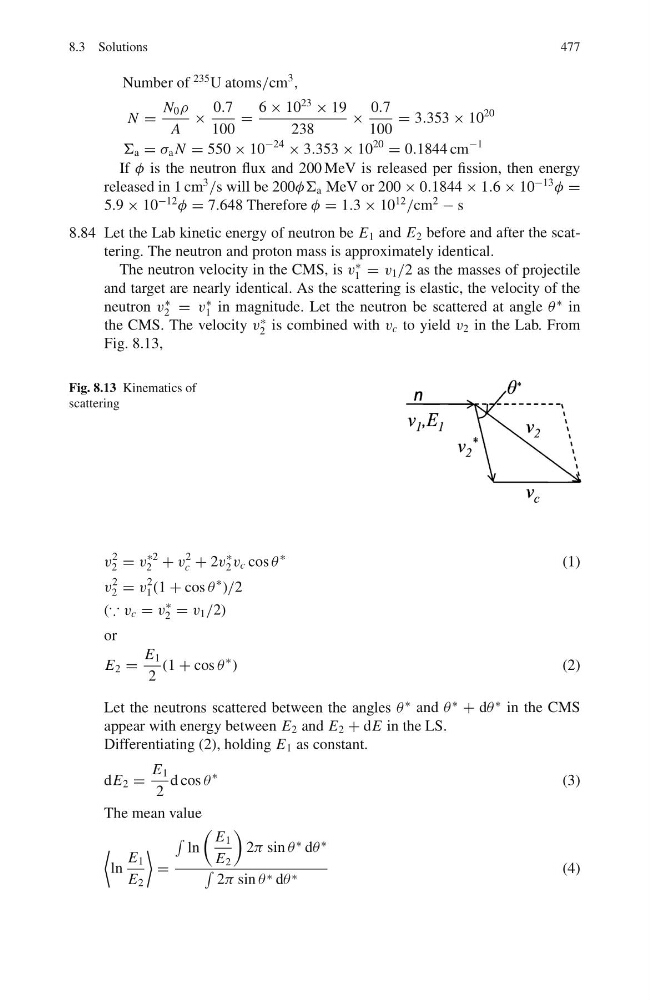
2 is combined with v c to yield v 2 in the Lab. From
Fig. 8.13,
Fig. 8.13 Kinematics of
scattering
v
2
2 = v
∗2
2 + v
2
c + 2v
∗
2 v c cos θ
∗
(1)
v
2
2 = v
2
1 (1 + cos θ
∗ )/2
(∵ v c = v
∗
2 = v 1 /2)
or
E 2 =
E 1
2
(1 + cos θ
∗ )
( 2 )
Let the neutrons scattered between the angles θ
∗ and θ
∗
+ dθ
∗ in the CMS
appear with energy between E 2 and E 2 + dE in the LS.
Differentiating (2), holding E 1 as constant.
dE 2 =
E 1
2
d cos θ
∗
(3)
The mean value
ln
E 1
E 2
=
ln
E 1
E 2
2π sin θ
∗ dθ
∗
2π sin θ ∗ dθ ∗
(4)
477
Number of
235 U atoms/cm
3 ,
N =
N 0 ρ
A
×
0.7
100
=
6 × 10
23
× 19
238
×
0.7
100
= 3.353 × 10
20
Σ a = σ a N = 550 × 10
−24
× 3.353 × 10
20
= 0.1844 cm
−1
If φ is the neutron flux and 200 MeV is released per fission, then energy
released in 1 cm
3
/s will be 200φΣ a MeV or 200 × 0.1844 × 1.6 × 10
−13
φ =
5.9 × 10
−12
φ = 7.648 Therefore φ = 1.3 × 10
12
/cm
2
− s
8.84 Let the Lab kinetic energy of neutron be E 1 and E 2 before and after the scattering. The neutron and proton mass is approximately identical.
The neutron velocity in the CMS, is v
∗
1 = v 1 /2 as the masses of projectile
and target are nearly identical. As the scattering is elastic, the velocity of the
neutron v
∗
2 = v
∗
1 in magnitude. Let the neutron be scattered at angle θ
∗ in
the CMS. The velocity v
∗
2 is combined with v c to yield v 2 in the Lab. From
Fig. 8.13,
Fig. 8.13 Kinematics of
scattering
v
2
2 = v
∗2
2 + v
2
c + 2v
∗
2 v c cos θ
∗
(1)
v
2
2 = v
2
1 (1 + cos θ
∗ )/2
(∵ v c = v
∗
2 = v 1 /2)
or
E 2 =
E 1
2
(1 + cos θ
∗ )
( 2 )
Let the neutrons scattered between the angles θ
∗ and θ
∗
+ dθ
∗ in the CMS
appear with energy between E 2 and E 2 + dE in the LS.
Differentiating (2), holding E 1 as constant.
dE 2 =
E 1
2
d cos θ
∗
(3)
The mean value
ln
E 1
E 2
=
ln
E 1
E 2
2π sin θ
∗ dθ
∗
2π sin θ ∗ dθ ∗
(4)