

472
8 Nuclear Physics – II
where the first term on the right hand side denotes the absorption rate of neutrons in
23 Na, and if it is assumed that each neutron thus absorbed produces a
24 Na atom, then this also represents the production rate of
24 Na. The second
term represents the decay rate, so that dQ/dt denotes the rate of change of
atoms of
24 Na.
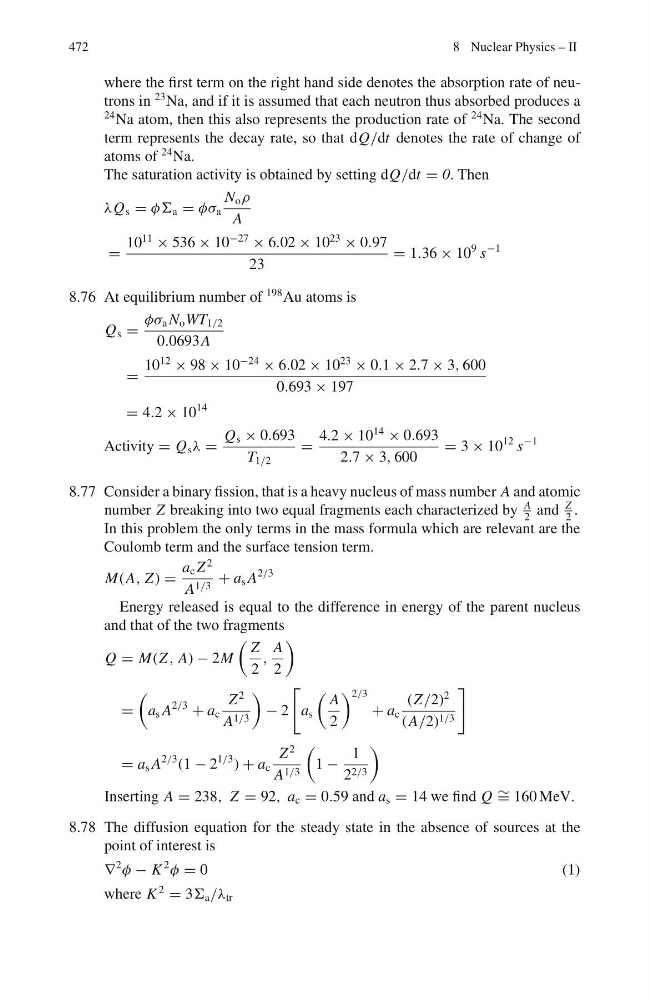
The saturation activity is obtained by setting dQ/dt = 0. Then
λQ s = φΣ a = φσ a
N o ρ
A
=
10
11
× 536 × 10
−27
× 6.02 × 10
23
× 0.97
23
= 1.36 × 10
9 s
−1
8.76 At equilibrium number of
198 Au atoms is
Q s =
φσ a N o WT 1/2
0.0693A
=
10
12
× 98 × 10
−24
× 6.02 × 10
23
× 0.1 × 2.7 × 3, 600
0.693 × 197
= 4.2 × 10
14
Activity = Q s λ =
Q s × 0.693
T 1/2
=
4.2 × 10
14
× 0.693
2.7 × 3, 600
= 3 × 10
12 s
−1
8.77 Consider a binary fission, that is a heavy nucleus of mass number A and atomic
number Z breaking into two equal fragments each characterized by
A
2
and
Z
2
.
In this problem the only terms in the mass formula which are relevant are the
Coulomb term and the surface tension term.
M( A, Z ) =
a c Z
2
A 1/3 + a s A
2/3
Energy released is equal to the difference in energy of the parent nucleus
and that of the two fragments
Q = M(Z , A) − 2M
Z
2
,
A
2
=
a s A
2/3
+ a c
Z
2
A 1/3
− 2
a s
A
2
2/3
+ a c
(Z /2)
2
( A/2) 1/3
= a s A
2/3 (1 − 2
1/3 ) + a c
Z
2
A 1/3
1 −
1
2 2/3
Inserting A = 238, Z = 92, a c = 0.59 and a s = 14 we find Q ∼ = 160 MeV.
8.78 The diffusion equation for the steady state in the absence of sources at the
point of interest is
∇
2
φ − K
2
φ = 0
( 1 )
where K
2
= 3Σ a /λ tr
8 Nuclear Physics – II
where the first term on the right hand side denotes the absorption rate of neutrons in
23 Na, and if it is assumed that each neutron thus absorbed produces a
24 Na atom, then this also represents the production rate of
24 Na. The second
term represents the decay rate, so that dQ/dt denotes the rate of change of
atoms of
24 Na.
The saturation activity is obtained by setting dQ/dt = 0. Then
λQ s = φΣ a = φσ a
N o ρ
A
=
10
11
× 536 × 10
−27
× 6.02 × 10
23
× 0.97
23
= 1.36 × 10
9 s
−1
8.76 At equilibrium number of
198 Au atoms is
Q s =
φσ a N o WT 1/2
0.0693A
=
10
12
× 98 × 10
−24
× 6.02 × 10
23
× 0.1 × 2.7 × 3, 600
0.693 × 197
= 4.2 × 10
14
Activity = Q s λ =
Q s × 0.693
T 1/2
=
4.2 × 10
14
× 0.693
2.7 × 3, 600
= 3 × 10
12 s
−1
8.77 Consider a binary fission, that is a heavy nucleus of mass number A and atomic
number Z breaking into two equal fragments each characterized by
A
2
and
Z
2
.
In this problem the only terms in the mass formula which are relevant are the
Coulomb term and the surface tension term.
M( A, Z ) =
a c Z
2
A 1/3 + a s A
2/3
Energy released is equal to the difference in energy of the parent nucleus
and that of the two fragments
Q = M(Z , A) − 2M
Z
2
,
A
2
=
a s A
2/3
+ a c
Z
2
A 1/3
− 2
a s
A
2
2/3
+ a c
(Z /2)
2
( A/2) 1/3
= a s A
2/3 (1 − 2
1/3 ) + a c
Z
2
A 1/3
1 −
1
2 2/3
Inserting A = 238, Z = 92, a c = 0.59 and a s = 14 we find Q ∼ = 160 MeV.
8.78 The diffusion equation for the steady state in the absence of sources at the
point of interest is
∇
2
φ − K
2
φ = 0
( 1 )
where K
2
= 3Σ a /λ tr