

8.3 Solutions
473
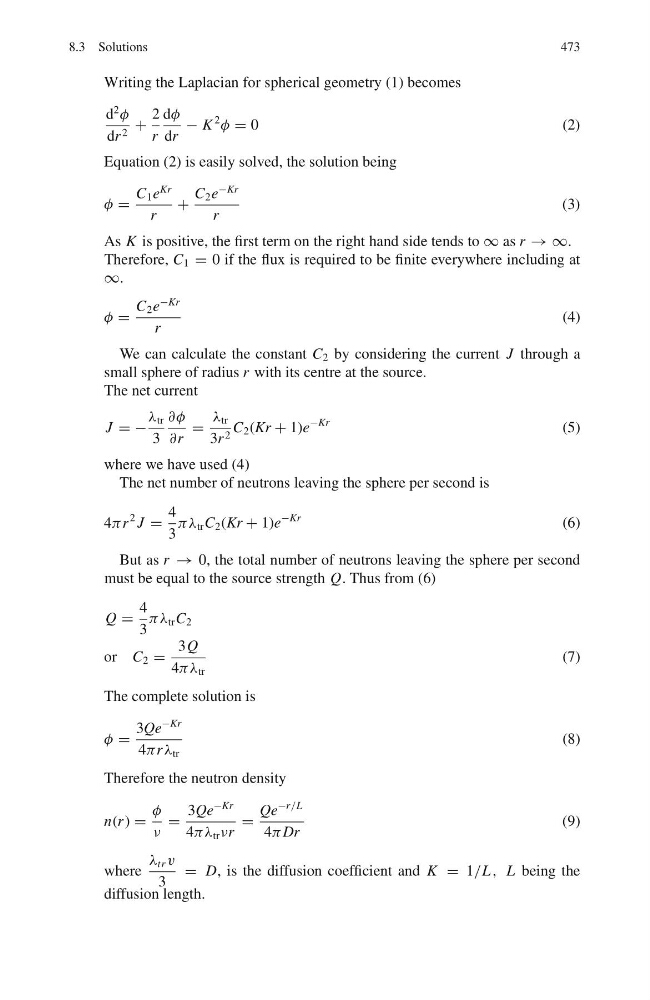
Writing the Laplacian for spherical geometry (1) becomes
d
2
φ
dr 2 +
2
r
dφ
dr
− K
2
φ = 0
( 2 )
Equation (2) is easily solved, the solution being
φ =
C 1 e
Kr
r
+
C 2 e
−Kr
r
(3)
As K is positive, the first term on the right hand side tends to ∞ as r → ∞.
Therefore, C 1 = 0 if the flux is required to be finite everywhere including at
∞.
φ =
C 2 e
−Kr
r
(4)
We can calculate the constant C 2 by considering the current J through a
small sphere of radius r with its centre at the source.
The net current
J = −
λ tr
3
∂φ
∂r
=
λ tr
3r 2 C 2 (Kr + 1)e
−Kr
(5)
where we have used (4)
The net number of neutrons leaving the sphere per second is
4πr
2 J =
4
3
πλ tr C 2 (Kr + 1)e
−Kr
(6)
But as r → 0, the total number of neutrons leaving the sphere per second
must be equal to the source strength Q. Thus from (6)
Q =
4
3
πλ tr C 2
or C 2 =
3Q
4πλ tr
(7)
The complete solution is
φ =
3Qe
−Kr
4πr λ tr
(8)
Therefore the neutron density
n(r ) =
φ
ν
=
3Qe
−Kr
4πλ tr νr
=
Qe
−r/L
4πDr
(9)
where
λ tr v
3
= D, is the diffusion coefficient and K = 1/L , L being the
diffusion length.
473
Writing the Laplacian for spherical geometry (1) becomes
d
2
φ
dr 2 +
2
r
dφ
dr
− K
2
φ = 0
( 2 )
Equation (2) is easily solved, the solution being
φ =
C 1 e
Kr
r
+
C 2 e
−Kr
r
(3)
As K is positive, the first term on the right hand side tends to ∞ as r → ∞.
Therefore, C 1 = 0 if the flux is required to be finite everywhere including at
∞.
φ =
C 2 e
−Kr
r
(4)
We can calculate the constant C 2 by considering the current J through a
small sphere of radius r with its centre at the source.
The net current
J = −
λ tr
3
∂φ
∂r
=
λ tr
3r 2 C 2 (Kr + 1)e
−Kr
(5)
where we have used (4)
The net number of neutrons leaving the sphere per second is
4πr
2 J =
4
3
πλ tr C 2 (Kr + 1)e
−Kr
(6)
But as r → 0, the total number of neutrons leaving the sphere per second
must be equal to the source strength Q. Thus from (6)
Q =
4
3
πλ tr C 2
or C 2 =
3Q
4πλ tr
(7)
The complete solution is
φ =
3Qe
−Kr
4πr λ tr
(8)
Therefore the neutron density
n(r ) =
φ
ν
=
3Qe
−Kr
4πλ tr νr
=
Qe
−r/L
4πDr
(9)
where
λ tr v
3
= D, is the diffusion coefficient and K = 1/L , L being the
diffusion length.