

8.3 Solutions
471
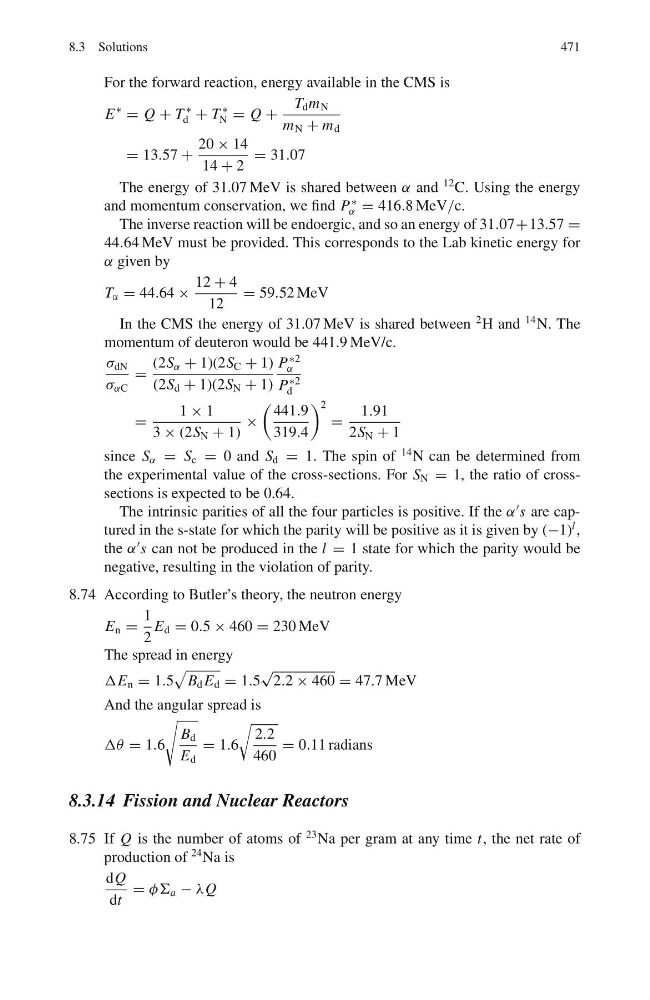
For the forward reaction, energy available in the CMS is
E
∗
= Q + T
∗
d + T
∗
N = Q +
T d m N
m N + m d
= 13.57 +
20 × 14
14 + 2
= 31.07
The energy of 31.07 MeV is shared between α and
12 C. Using the energy
and momentum conservation, we find P
∗
α = 416.8 MeV/c.
The inverse reaction will be endoergic, and so an energy of 31.07+13.57 =
44.64 MeV must be provided. This corresponds to the Lab kinetic energy for
α given by
T α = 44.64 ×
12 + 4
12
= 59.52 MeV
In the CMS the energy of 31.07 MeV is shared between
2 H and
14 N. The
momentum of deuteron would be 441.9 MeV/c.
σ dN
σ αC
=
(2S α + 1)(2S C + 1)
(2S d + 1)(2S N + 1)
P
∗2
α
P
∗2
d
=
1 × 1
3 × (2S N + 1)
×
441.9
319.4
2
=
1.91
2S N + 1
since S α = S c = 0 and S d = 1. The spin of
14 N can be determined from
the experimental value of the cross-sections. For S N = 1, the ratio of crosssections is expected to be 0.64.
The intrinsic parities of all the four particles is positive. If the α
s are captured in the s-state for which the parity will be positive as it is given by (−1)
l ,
the α
s can not be produced in the l = 1 state for which the parity would be
negative, resulting in the violation of parity.
8.74 According to Butler’s theory, the neutron energy
E n =
1
2
E d = 0.5 × 460 = 230 MeV
The spread in energy
ΔE n = 1.5
B d E d = 1.5
√
2.2 × 460 = 47.7 MeV
And the angular spread is
Δθ = 1.6
B d
E d
= 1.6
2.2
460
= 0.11 radians
8.3.14 Fission and Nuclear Reactors
8.75 If Q is the number of atoms of
23 Na per gram at any time t, the net rate of
production of
24 Na is
dQ
dt
= φΣ a − λQ
471
For the forward reaction, energy available in the CMS is
E
∗
= Q + T
∗
d + T
∗
N = Q +
T d m N
m N + m d
= 13.57 +
20 × 14
14 + 2
= 31.07
The energy of 31.07 MeV is shared between α and
12 C. Using the energy
and momentum conservation, we find P
∗
α = 416.8 MeV/c.
The inverse reaction will be endoergic, and so an energy of 31.07+13.57 =
44.64 MeV must be provided. This corresponds to the Lab kinetic energy for
α given by
T α = 44.64 ×
12 + 4
12
= 59.52 MeV
In the CMS the energy of 31.07 MeV is shared between
2 H and
14 N. The
momentum of deuteron would be 441.9 MeV/c.
σ dN
σ αC
=
(2S α + 1)(2S C + 1)
(2S d + 1)(2S N + 1)
P
∗2
α
P
∗2
d
=
1 × 1
3 × (2S N + 1)
×
441.9
319.4
2
=
1.91
2S N + 1
since S α = S c = 0 and S d = 1. The spin of
14 N can be determined from
the experimental value of the cross-sections. For S N = 1, the ratio of crosssections is expected to be 0.64.
The intrinsic parities of all the four particles is positive. If the α
s are captured in the s-state for which the parity will be positive as it is given by (−1)
l ,
the α
s can not be produced in the l = 1 state for which the parity would be
negative, resulting in the violation of parity.
8.74 According to Butler’s theory, the neutron energy
E n =
1
2
E d = 0.5 × 460 = 230 MeV
The spread in energy
ΔE n = 1.5
B d E d = 1.5
√
2.2 × 460 = 47.7 MeV
And the angular spread is
Δθ = 1.6
B d
E d
= 1.6
2.2
460
= 0.11 radians
8.3.14 Fission and Nuclear Reactors
8.75 If Q is the number of atoms of
23 Na per gram at any time t, the net rate of
production of
24 Na is
dQ
dt
= φΣ a − λQ