

398
7 Nuclear Physics – I
dΩ
∗
/dE p = 4π/E 0
(2)
And dσ p /dΩ
∗
= σ/4π
(3)
as the scattering is isotropic in the CMS.
Using (2) and (3) in (1) we get dσ p /dE p = σ/E 0
7.10 As the scattering is isotropic in the CMS the differential cross-section of the
recoiling nuclei is constant and is given by σ (ϕ
∗ ) = σ/4π = constant.
Now the differential cross-sections in the LS and CMS are related by
σ (ϕ) = (sin ϕ
∗ dϕ
∗
/ sin ϕ d ϕ). σ (ϕ
∗ )
But ϕ
∗
= 2 ϕ and dϕ
∗
= 2 dϕ
σ (ϕ) = (sin 2 ϕ.2 dϕ / sin ϕ dϕ)(σ/4 π) =
σ
π
cos ϕ
Thus, σ (ϕ) has cos ϕ dependence. It is of interest to note that
σ (ϕ) d Ω =
π/2
0
σ cos ϕ.2 π sin ϕ d ϕ/π = σ
as it should. The upper limit for the integration is confined to 90
◦ as the target
nucleus can not recoil in the backward sphere in the LS.
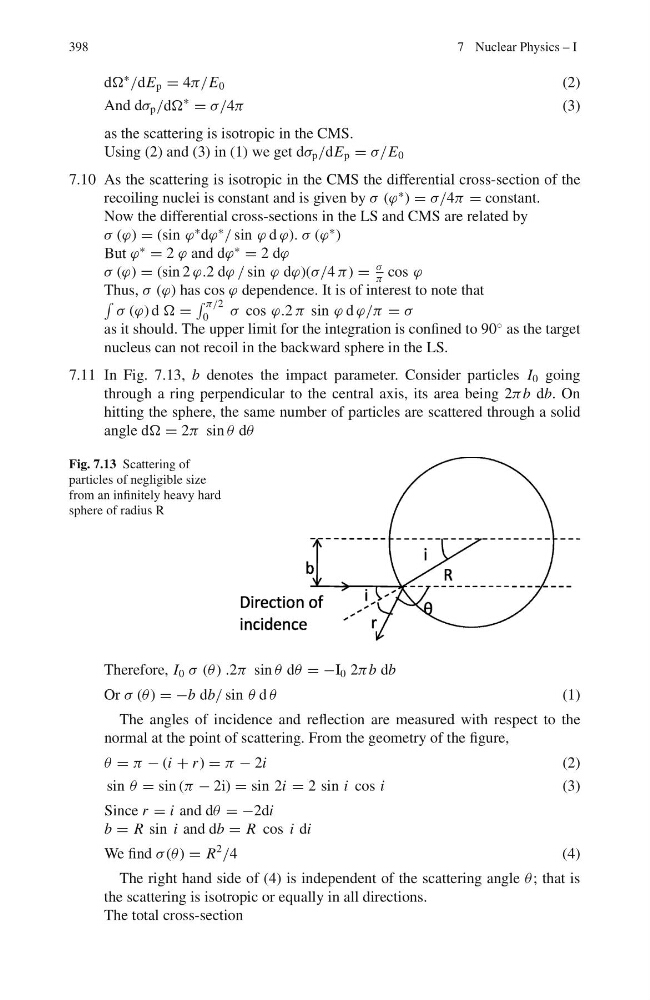
7.11 In Fig. 7.13, b denotes the impact parameter. Consider particles I 0 going
through a ring perpendicular to the central axis, its area being 2π b db. On
hitting the sphere, the same number of particles are scattered through a solid
angle dΩ = 2π sin θ dθ
Fig. 7.13 Scattering of
particles of negligible size
from an infinitely heavy hard
sphere of radius R
Therefore, I 0 σ (θ ) .2π sin θ dθ = −I 0 2πb db
Or σ (θ ) = −b db/ sin θ d θ
(1)
The angles of incidence and reflection are measured with respect to the
normal at the point of scattering. From the geometry of the figure,
θ = π − (i + r ) = π − 2i
(2)
sin θ = sin (π − 2i) = sin 2i = 2 sin i cos i
(3)
Since r = i and dθ = −2di
b = R sin i and db = R cos i di
We find σ (θ ) = R
2
/4
( 4 )
The right hand side of (4) is independent of the scattering angle θ; that is
the scattering is isotropic or equally in all directions.
The total cross-section
7 Nuclear Physics – I
dΩ
∗
/dE p = 4π/E 0
(2)
And dσ p /dΩ
∗
= σ/4π
(3)
as the scattering is isotropic in the CMS.
Using (2) and (3) in (1) we get dσ p /dE p = σ/E 0
7.10 As the scattering is isotropic in the CMS the differential cross-section of the
recoiling nuclei is constant and is given by σ (ϕ
∗ ) = σ/4π = constant.
Now the differential cross-sections in the LS and CMS are related by
σ (ϕ) = (sin ϕ
∗ dϕ
∗
/ sin ϕ d ϕ). σ (ϕ
∗ )
But ϕ
∗
= 2 ϕ and dϕ
∗
= 2 dϕ
σ (ϕ) = (sin 2 ϕ.2 dϕ / sin ϕ dϕ)(σ/4 π) =
σ
π
cos ϕ
Thus, σ (ϕ) has cos ϕ dependence. It is of interest to note that
σ (ϕ) d Ω =
π/2
0
σ cos ϕ.2 π sin ϕ d ϕ/π = σ
as it should. The upper limit for the integration is confined to 90
◦ as the target
nucleus can not recoil in the backward sphere in the LS.
7.11 In Fig. 7.13, b denotes the impact parameter. Consider particles I 0 going
through a ring perpendicular to the central axis, its area being 2π b db. On
hitting the sphere, the same number of particles are scattered through a solid
angle dΩ = 2π sin θ dθ
Fig. 7.13 Scattering of
particles of negligible size
from an infinitely heavy hard
sphere of radius R
Therefore, I 0 σ (θ ) .2π sin θ dθ = −I 0 2πb db
Or σ (θ ) = −b db/ sin θ d θ
(1)
The angles of incidence and reflection are measured with respect to the
normal at the point of scattering. From the geometry of the figure,
θ = π − (i + r ) = π − 2i
(2)
sin θ = sin (π − 2i) = sin 2i = 2 sin i cos i
(3)
Since r = i and dθ = −2di
b = R sin i and db = R cos i di
We find σ (θ ) = R
2
/4
( 4 )
The right hand side of (4) is independent of the scattering angle θ; that is
the scattering is isotropic or equally in all directions.
The total cross-section