

7.3 Solutions
399
σ =
σ (θ ) d Ω =
π
0
(R
2
/4). 2π sin θ d θ = π R
2
This is called geometric cross-section.
7.3.2 Rutherford Scattering
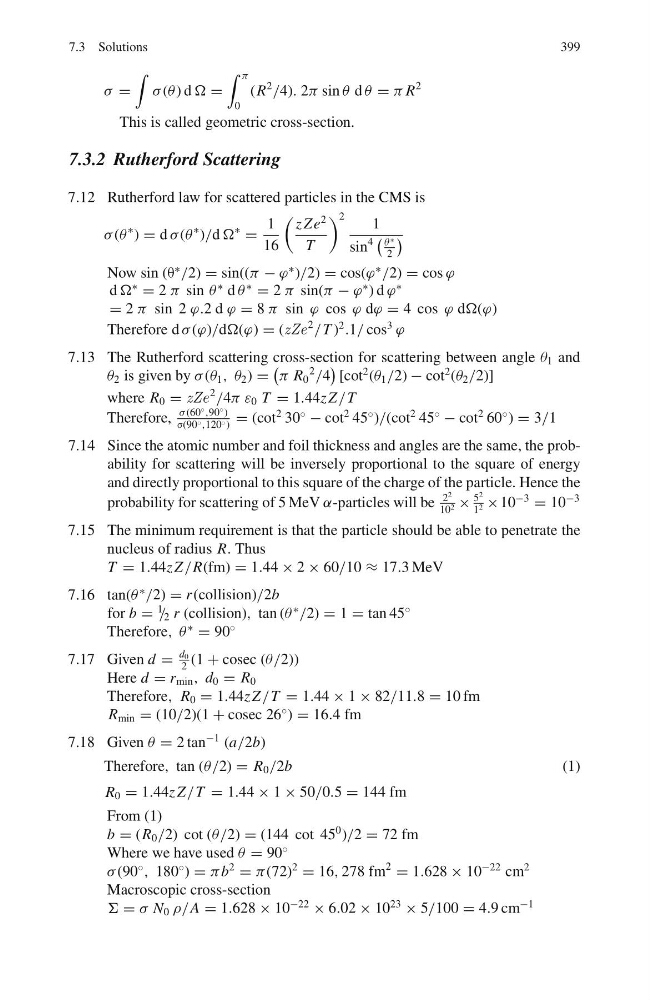
7.12 Rutherford law for scattered particles in the CMS is
σ (θ
∗ ) = d σ (θ
∗ )/d Ω
∗
=
1
16
z Ze
2
T
2
1
sin
4
θ ∗
2
Now sin (θ
∗
/2) = sin((π − ϕ
∗ )/2) = cos(ϕ
∗
/2) = cos ϕ
d Ω
∗
= 2 π sin θ
∗ d θ
∗
= 2 π sin(π − ϕ
∗ ) d ϕ
∗
= 2 π sin 2 ϕ.2 d ϕ = 8 π sin ϕ cos ϕ dϕ = 4 cos ϕ dΩ(ϕ)
Therefore d σ (ϕ)/dΩ(ϕ) = (zZe
2
/T )
2
.1/ cos
3
ϕ
7.13 The Rutherford scattering cross-section for scattering between angle θ 1 and
θ 2 is given by σ (θ 1 , θ 2 ) =
π R 0
2
/4
[cot
2 (θ 1 /2) − cot
2 (θ 2 /2)]
where R 0 = zZe
2
/4π ε 0 T = 1.44z Z/T
Therefore,
σ (60
◦ ,90
◦ )
σ(90 ◦ ,120 ◦ )
= (cot
2 30
◦
− cot
2 45
◦ )/(cot
2 45
◦
− cot
2 60
◦ ) = 3/1
7.14 Since the atomic number and foil thickness and angles are the same, the probability for scattering will be inversely proportional to the square of energy
and directly proportional to this square of the charge of the particle. Hence the
probability for scattering of 5 MeV α-particles will be
2
2
10 2 ×
5
2
1 2 ×10
−3
= 10
−3
7.15 The minimum requirement is that the particle should be able to penetrate the
nucleus of radius R. Thus
T = 1.44z Z/R(fm) = 1.44 × 2 × 60/10 ≈ 17.3 MeV
7.16 tan(θ
∗
/2) = r (collision)/2b
for b =
1
/ 2 r (collision), tan (θ
∗
/2) = 1 = tan 45
◦
Therefore, θ
∗
= 90
◦
7.17 Given d =
d0
2
(1 + cosec (θ/2))
Here d = r min , d 0 = R 0
Therefore, R 0 = 1.44z Z/T = 1.44 × 1 × 82/11.8 = 10 fm
R min = (10/2)(1 + cosec 26
◦ ) = 16.4 fm
7.18 Given θ = 2 tan
−1 (a/2b)
Therefore, tan (θ/2) = R 0 /2b
(1)
R 0 = 1.44z Z/T = 1.44 × 1 × 50/0.5 = 144 fm
From (1)
b = (R 0 /2) cot (θ/2) = (144 cot 45
0 )/2 = 72 fm
Where we have used θ = 90
◦
σ (90
◦
, 180
◦ ) = πb
2
= π (72)
2
= 16, 278 fm
2
= 1.628 × 10
−22 cm
2
Macroscopic cross-section
Σ = σ N 0 ρ/A = 1.628 × 10
−22
× 6.02 × 10
23
× 5/100 = 4.9 cm
−1
399
σ =
σ (θ ) d Ω =
π
0
(R
2
/4). 2π sin θ d θ = π R
2
This is called geometric cross-section.
7.3.2 Rutherford Scattering
7.12 Rutherford law for scattered particles in the CMS is
σ (θ
∗ ) = d σ (θ
∗ )/d Ω
∗
=
1
16
z Ze
2
T
2
1
sin
4
θ ∗
2
Now sin (θ
∗
/2) = sin((π − ϕ
∗ )/2) = cos(ϕ
∗
/2) = cos ϕ
d Ω
∗
= 2 π sin θ
∗ d θ
∗
= 2 π sin(π − ϕ
∗ ) d ϕ
∗
= 2 π sin 2 ϕ.2 d ϕ = 8 π sin ϕ cos ϕ dϕ = 4 cos ϕ dΩ(ϕ)
Therefore d σ (ϕ)/dΩ(ϕ) = (zZe
2
/T )
2
.1/ cos
3
ϕ
7.13 The Rutherford scattering cross-section for scattering between angle θ 1 and
θ 2 is given by σ (θ 1 , θ 2 ) =
π R 0
2
/4
[cot
2 (θ 1 /2) − cot
2 (θ 2 /2)]
where R 0 = zZe
2
/4π ε 0 T = 1.44z Z/T
Therefore,
σ (60
◦ ,90
◦ )
σ(90 ◦ ,120 ◦ )
= (cot
2 30
◦
− cot
2 45
◦ )/(cot
2 45
◦
− cot
2 60
◦ ) = 3/1
7.14 Since the atomic number and foil thickness and angles are the same, the probability for scattering will be inversely proportional to the square of energy
and directly proportional to this square of the charge of the particle. Hence the
probability for scattering of 5 MeV α-particles will be
2
2
10 2 ×
5
2
1 2 ×10
−3
= 10
−3
7.15 The minimum requirement is that the particle should be able to penetrate the
nucleus of radius R. Thus
T = 1.44z Z/R(fm) = 1.44 × 2 × 60/10 ≈ 17.3 MeV
7.16 tan(θ
∗
/2) = r (collision)/2b
for b =
1
/ 2 r (collision), tan (θ
∗
/2) = 1 = tan 45
◦
Therefore, θ
∗
= 90
◦
7.17 Given d =
d0
2
(1 + cosec (θ/2))
Here d = r min , d 0 = R 0
Therefore, R 0 = 1.44z Z/T = 1.44 × 1 × 82/11.8 = 10 fm
R min = (10/2)(1 + cosec 26
◦ ) = 16.4 fm
7.18 Given θ = 2 tan
−1 (a/2b)
Therefore, tan (θ/2) = R 0 /2b
(1)
R 0 = 1.44z Z/T = 1.44 × 1 × 50/0.5 = 144 fm
From (1)
b = (R 0 /2) cot (θ/2) = (144 cot 45
0 )/2 = 72 fm
Where we have used θ = 90
◦
σ (90
◦
, 180
◦ ) = πb
2
= π (72)
2
= 16, 278 fm
2
= 1.628 × 10
−22 cm
2
Macroscopic cross-section
Σ = σ N 0 ρ/A = 1.628 × 10
−22
× 6.02 × 10
23
× 5/100 = 4.9 cm
−1