

7.3 Solutions
397
7.7 Let the alpha particle of mass m moving with velocity v 0 and momentum
p 0 collide with proton of mass m. After the collision the maximum velocity
v 2 and momentum p 2 will be acquired by proton when it is emitted in the
incident direction. Since the alpha particle is heavier than proton, it must also
proceed in the same direction as the proton with velocity v 1 and momentum
p 1 . Assuming that the collision is elastic,
P 0
2
/2m 1 = p 1
2
/2m 1 + p 2
2
/2m 2
(energy conservation)
(1)
P 0 = p 1 + p 2
(momentum conservation)
(2)
Noting m 1 = 4m 2 , p 1 can be eliminated between (1) and (2) to yield
p 2 = 0.4 p 0
or m 2 v 2 = 0.4m 1 v 0 = 0.4 × 4m 2 v 0
v 2 = 1.6v 0
7.8 Use the transformation equation for the differential cross-sections in the CMS
and LS.
σ (θ ) = (1 + γ
2
+ 2γ cos θ
∗ )
3/2
σ (θ
∗ )/|1 + γ cos θ
∗
|
where γ = m 1 /m 2 = m/m = 1. Then the equation simplifies to
σ (θ ) = 4 cos(θ
∗
/2) σ (θ
∗ )
7.9 We can write by chain rule
d σ p /dE p = (d σ p /d Ω
∗ ).(dΩ
∗
/dE p )
( 1 )
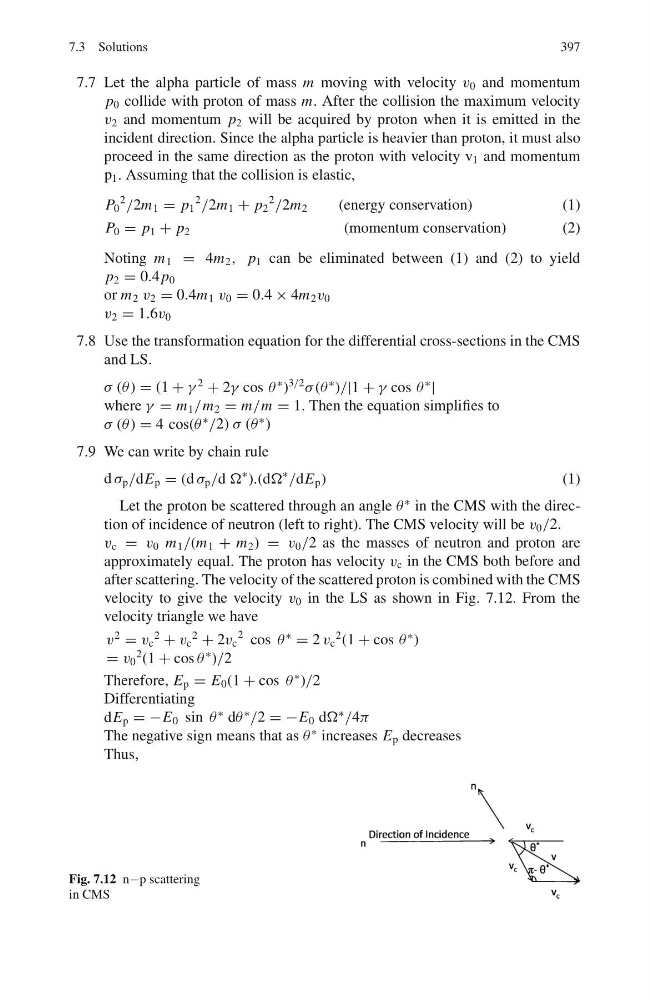
Let the proton be scattered through an angle θ
∗ in the CMS with the direction of incidence of neutron (left to right). The CMS velocity will be v 0 /2.
v c = v 0 m 1 /(m 1 + m 2 ) = v 0 /2 as the masses of neutron and proton are
approximately equal. The proton has velocity v c in the CMS both before and
after scattering. The velocity of the scattered proton is combined with the CMS
velocity to give the velocity v 0 in the LS as shown in Fig. 7.12. From the
velocity triangle we have
v
2
= v c
2
+ v c
2
+ 2v c
2 cos θ
∗
= 2 v c
2 (1 + cos θ
∗ )
= v 0
2 (1 + cos θ
∗ )/2
Therefore, E p = E 0 (1 + cos θ
∗ )/2
Differentiating
dE p = −E 0 sin θ
∗ dθ
∗
/2 = −E 0 dΩ
∗
/4π
The negative sign means that as θ
∗ increases E p decreases
Thus,
Fig. 7.12 n−p scattering
in CMS
397
7.7 Let the alpha particle of mass m moving with velocity v 0 and momentum
p 0 collide with proton of mass m. After the collision the maximum velocity
v 2 and momentum p 2 will be acquired by proton when it is emitted in the
incident direction. Since the alpha particle is heavier than proton, it must also
proceed in the same direction as the proton with velocity v 1 and momentum
p 1 . Assuming that the collision is elastic,
P 0
2
/2m 1 = p 1
2
/2m 1 + p 2
2
/2m 2
(energy conservation)
(1)
P 0 = p 1 + p 2
(momentum conservation)
(2)
Noting m 1 = 4m 2 , p 1 can be eliminated between (1) and (2) to yield
p 2 = 0.4 p 0
or m 2 v 2 = 0.4m 1 v 0 = 0.4 × 4m 2 v 0
v 2 = 1.6v 0
7.8 Use the transformation equation for the differential cross-sections in the CMS
and LS.
σ (θ ) = (1 + γ
2
+ 2γ cos θ
∗ )
3/2
σ (θ
∗ )/|1 + γ cos θ
∗
|
where γ = m 1 /m 2 = m/m = 1. Then the equation simplifies to
σ (θ ) = 4 cos(θ
∗
/2) σ (θ
∗ )
7.9 We can write by chain rule
d σ p /dE p = (d σ p /d Ω
∗ ).(dΩ
∗
/dE p )
( 1 )
Let the proton be scattered through an angle θ
∗ in the CMS with the direction of incidence of neutron (left to right). The CMS velocity will be v 0 /2.
v c = v 0 m 1 /(m 1 + m 2 ) = v 0 /2 as the masses of neutron and proton are
approximately equal. The proton has velocity v c in the CMS both before and
after scattering. The velocity of the scattered proton is combined with the CMS
velocity to give the velocity v 0 in the LS as shown in Fig. 7.12. From the
velocity triangle we have
v
2
= v c
2
+ v c
2
+ 2v c
2 cos θ
∗
= 2 v c
2 (1 + cos θ
∗ )
= v 0
2 (1 + cos θ
∗ )/2
Therefore, E p = E 0 (1 + cos θ
∗ )/2
Differentiating
dE p = −E 0 sin θ
∗ dθ
∗
/2 = −E 0 dΩ
∗
/4π
The negative sign means that as θ
∗ increases E p decreases
Thus,
Fig. 7.12 n−p scattering
in CMS