

396
7 Nuclear Physics – I
As triton will be emitted in the opposite direction in the CMS
θ t
∗
= 111
◦
Using formula (1) again, with the substitution.
θ t
∗
= 111
◦
, v c = u/2 and v t
∗
= u/2
√
3, we can solve for θ , and obtain
θ t = 34
◦ in the LS.
Finally, we can use the inverse transformation
tan θ
∗
=
sin θ
cos θ−vc/v
And substitute θ
∗
= 111
◦
, θ = 34
◦ and v c = u/2 to find v = 0.48 u.
7.4 Use the result of Problem 7.1,
M/m = sin (θ + 2ϕ)/ sin θ
M = 4.004, m = 1.008, θ = 10
0
.
Substituting these values in the above equation and solving for ϕ, we find
ϕ = 16.8
◦ which is the recoil angle of proton
7.5 Alphas of 20 MeV energy means that we are dealing with non-relativistic particles. From the results of Problem 7.2, the maximum scattering angle θ max for
m 1 > m 2 , is given by
sin θ m = m 2 /m 1
sin 30
0
= 0.5 = m 2 /4 or m 2 = 2
The gas is deuterium. The limiting angle θ max is independent of the incident
energy.
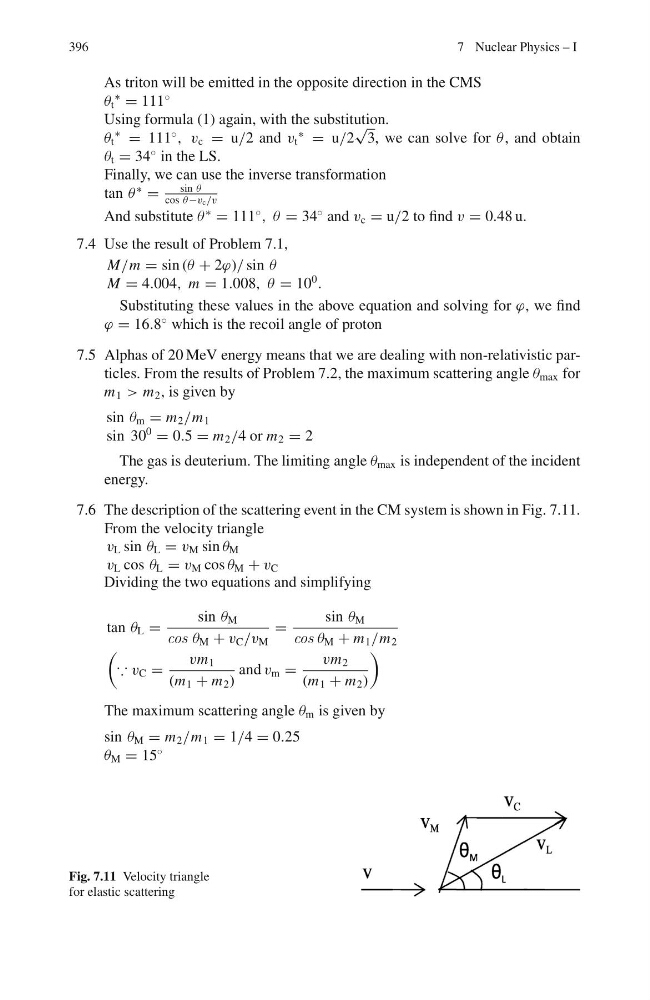
7.6 The description of the scattering event in the CM system is shown in Fig. 7.11.
From the velocity triangle
v L sin θ L = v M sin θ M
v L cos θ L = v M cos θ M + v C
Dividing the two equations and simplifying
tan θ L =
sin θ M
cos θ M + v C /v M
=
sin θ M
cos θ M + m 1 /m 2
∵ v C =
vm 1
(m 1 + m 2 )
and v m =
vm 2
(m 1 + m 2 )
The maximum scattering angle θ m is given by
sin θ M = m 2 /m 1 = 1/4 = 0.25
θ M = 15
◦
Fig. 7.11 Velocity triangle
for elastic scattering
7 Nuclear Physics – I
As triton will be emitted in the opposite direction in the CMS
θ t
∗
= 111
◦
Using formula (1) again, with the substitution.
θ t
∗
= 111
◦
, v c = u/2 and v t
∗
= u/2
√
3, we can solve for θ , and obtain
θ t = 34
◦ in the LS.
Finally, we can use the inverse transformation
tan θ
∗
=
sin θ
cos θ−vc/v
And substitute θ
∗
= 111
◦
, θ = 34
◦ and v c = u/2 to find v = 0.48 u.
7.4 Use the result of Problem 7.1,
M/m = sin (θ + 2ϕ)/ sin θ
M = 4.004, m = 1.008, θ = 10
0
.
Substituting these values in the above equation and solving for ϕ, we find
ϕ = 16.8
◦ which is the recoil angle of proton
7.5 Alphas of 20 MeV energy means that we are dealing with non-relativistic particles. From the results of Problem 7.2, the maximum scattering angle θ max for
m 1 > m 2 , is given by
sin θ m = m 2 /m 1
sin 30
0
= 0.5 = m 2 /4 or m 2 = 2
The gas is deuterium. The limiting angle θ max is independent of the incident
energy.
7.6 The description of the scattering event in the CM system is shown in Fig. 7.11.
From the velocity triangle
v L sin θ L = v M sin θ M
v L cos θ L = v M cos θ M + v C
Dividing the two equations and simplifying
tan θ L =
sin θ M
cos θ M + v C /v M
=
sin θ M
cos θ M + m 1 /m 2
∵ v C =
vm 1
(m 1 + m 2 )
and v m =
vm 2
(m 1 + m 2 )
The maximum scattering angle θ m is given by
sin θ M = m 2 /m 1 = 1/4 = 0.25
θ M = 15
◦
Fig. 7.11 Velocity triangle
for elastic scattering