

7.3 Solutions
395
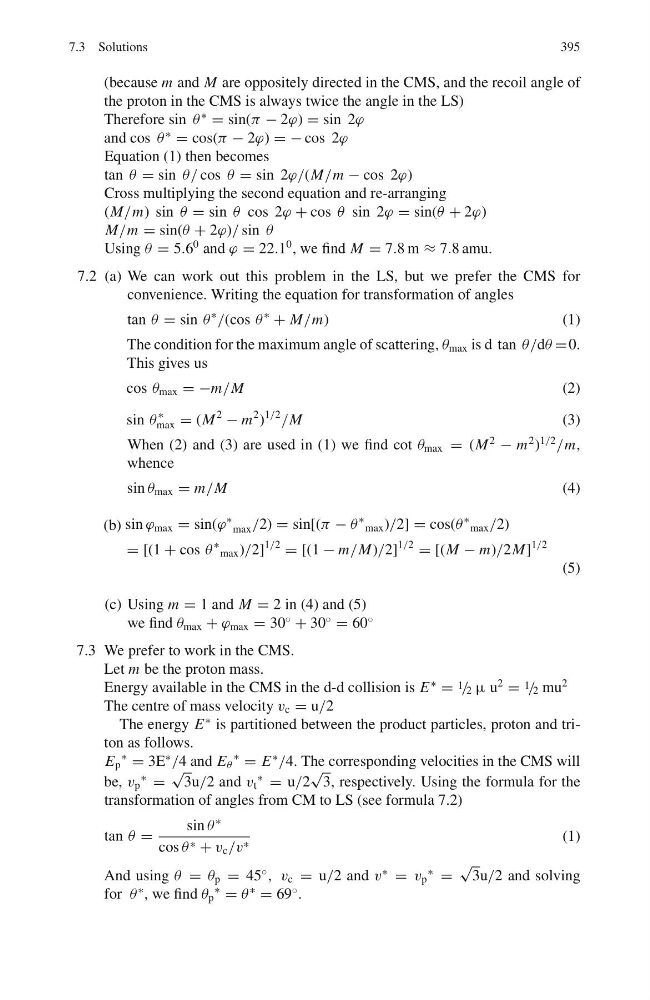
(because m and M are oppositely directed in the CMS, and the recoil angle of
the proton in the CMS is always twice the angle in the LS)
Therefore sin θ
∗
= sin(π − 2ϕ) = sin 2ϕ
and cos θ
∗
= cos(π − 2ϕ) = − cos 2ϕ
Equation (1) then becomes
tan θ = sin θ/ cos θ = sin 2ϕ/(M/m − cos 2ϕ)
Cross multiplying the second equation and re-arranging
(M/m) sin θ = sin θ cos 2ϕ + cos θ sin 2ϕ = sin(θ + 2ϕ)
M/m = sin(θ + 2ϕ)/ sin θ
Using θ = 5.6
0 and ϕ = 22.1
0 , we find M = 7.8 m ≈ 7.8 amu.
7.2 (a) We can work out this problem in the LS, but we prefer the CMS for
convenience. Writing the equation for transformation of angles
tan θ = sin θ
∗
/(cos θ
∗
+ M/m)
( 1 )
The condition for the maximum angle of scattering, θ max is d tan θ/dθ = 0.
This gives us
cos θ max = −m/M
(2)
sin θ
∗
max = (M
2
− m
2 )
1/2
/M
(3)
When (2) and (3) are used in (1) we find cot θ max = (M
2
− m
2 )
1/2
/m,
whence
sin θ max = m/M
(4)
(b) sin ϕ max = sin(ϕ
∗
max /2) = sin[(π − θ
∗
max )/2] = cos(θ
∗
max /2)
= [(1 + cos θ
∗
max )/2]
1/2
= [(1 − m/M)/2]
1/2
= [(M − m)/2M]
1/2
(5)
(c) Using m = 1 and M = 2 in (4) and (5)
we find θ max + ϕ max = 30
◦
+ 30
◦
= 60
◦
7.3 We prefer to work in the CMS.
Let m be the proton mass.
Energy available in the CMS in the d-d collision is E
∗
= 1 / 2 μ u
2
= 1 / 2 mu
2
The centre of mass velocity v c = u/2
The energy E
∗ is partitioned between the product particles, proton and triton as follows.
E p
∗
= 3E
∗
/4 and E θ
∗
= E
∗
/4. The corresponding velocities in the CMS will
be, v p
∗
=
√
3u/2 and v t
∗
= u/2
√
3, respectively. Using the formula for the
transformation of angles from CM to LS (see formula 7.2)
tan θ =
sin θ
∗
cos θ ∗ + v c /v ∗
(1)
And using θ = θ p = 45
◦
, v c = u/2 and v
∗
= v p
∗
=
√
3u/2 and solving
for θ
∗ , we find θ p
∗
= θ
∗
= 69
◦ .
395
(because m and M are oppositely directed in the CMS, and the recoil angle of
the proton in the CMS is always twice the angle in the LS)
Therefore sin θ
∗
= sin(π − 2ϕ) = sin 2ϕ
and cos θ
∗
= cos(π − 2ϕ) = − cos 2ϕ
Equation (1) then becomes
tan θ = sin θ/ cos θ = sin 2ϕ/(M/m − cos 2ϕ)
Cross multiplying the second equation and re-arranging
(M/m) sin θ = sin θ cos 2ϕ + cos θ sin 2ϕ = sin(θ + 2ϕ)
M/m = sin(θ + 2ϕ)/ sin θ
Using θ = 5.6
0 and ϕ = 22.1
0 , we find M = 7.8 m ≈ 7.8 amu.
7.2 (a) We can work out this problem in the LS, but we prefer the CMS for
convenience. Writing the equation for transformation of angles
tan θ = sin θ
∗
/(cos θ
∗
+ M/m)
( 1 )
The condition for the maximum angle of scattering, θ max is d tan θ/dθ = 0.
This gives us
cos θ max = −m/M
(2)
sin θ
∗
max = (M
2
− m
2 )
1/2
/M
(3)
When (2) and (3) are used in (1) we find cot θ max = (M
2
− m
2 )
1/2
/m,
whence
sin θ max = m/M
(4)
(b) sin ϕ max = sin(ϕ
∗
max /2) = sin[(π − θ
∗
max )/2] = cos(θ
∗
max /2)
= [(1 + cos θ
∗
max )/2]
1/2
= [(1 − m/M)/2]
1/2
= [(M − m)/2M]
1/2
(5)
(c) Using m = 1 and M = 2 in (4) and (5)
we find θ max + ϕ max = 30
◦
+ 30
◦
= 60
◦
7.3 We prefer to work in the CMS.
Let m be the proton mass.
Energy available in the CMS in the d-d collision is E
∗
= 1 / 2 μ u
2
= 1 / 2 mu
2
The centre of mass velocity v c = u/2
The energy E
∗ is partitioned between the product particles, proton and triton as follows.
E p
∗
= 3E
∗
/4 and E θ
∗
= E
∗
/4. The corresponding velocities in the CMS will
be, v p
∗
=
√
3u/2 and v t
∗
= u/2
√
3, respectively. Using the formula for the
transformation of angles from CM to LS (see formula 7.2)
tan θ =
sin θ
∗
cos θ ∗ + v c /v ∗
(1)
And using θ = θ p = 45
◦
, v c = u/2 and v
∗
= v p
∗
=
√
3u/2 and solving
for θ
∗ , we find θ p
∗
= θ
∗
= 69
◦ .