

374
7 Nuclear Physics – I
Ionization
Bethe’s quantum mechanical formula
− dE/dx = (4π z
2 e
4 n/mv
2 )[ln (2mv
2
/I ) − ln(1 − β
2 ) − β
2 ]
(7.22)
where n =number of electrons/cm
3 , I =ionization potential, v = β c is the particle
velocity and ze is its charge, m is the mass of electron
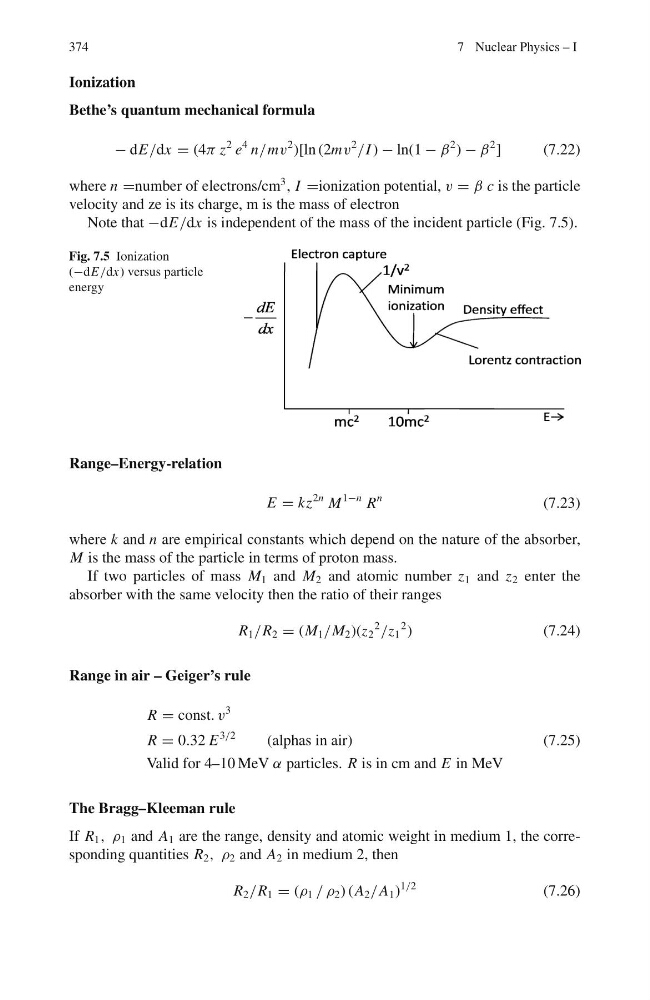
Note that −dE/dx is independent of the mass of the incident particle (Fig. 7.5).
Fig. 7.5 Ionization
(−dE/dx) versus particle
energy
Range–Energy-relation
E = kz
2n M
1−n R
n
(7.23)
where k and n are empirical constants which depend on the nature of the absorber,
M is the mass of the particle in terms of proton mass.
If two particles of mass M 1 and M 2 and atomic number z 1 and z 2 enter the
absorber with the same velocity then the ratio of their ranges
R 1 /R 2 = (M 1 /M 2 )(z 2
2
/z 1
2 )
(7.24)
Range in air – Geiger’s rule
R = const. v
3
R = 0.32 E
3/2
(alphas in air)
(7.25)
Valid for 4–10 MeV α particles. R is in cm and E in MeV
The Bragg–Kleeman rule
If R 1 , ρ 1 and A 1 are the range, density and atomic weight in medium 1, the corresponding quantities R 2 , ρ 2 and A 2 in medium 2, then
R 2 /R 1 = (ρ 1 / ρ 2 ) (A 2 /A 1 )
1/2
(7.26)
7 Nuclear Physics – I
Ionization
Bethe’s quantum mechanical formula
− dE/dx = (4π z
2 e
4 n/mv
2 )[ln (2mv
2
/I ) − ln(1 − β
2 ) − β
2 ]
(7.22)
where n =number of electrons/cm
3 , I =ionization potential, v = β c is the particle
velocity and ze is its charge, m is the mass of electron
Note that −dE/dx is independent of the mass of the incident particle (Fig. 7.5).
Fig. 7.5 Ionization
(−dE/dx) versus particle
energy
Range–Energy-relation
E = kz
2n M
1−n R
n
(7.23)
where k and n are empirical constants which depend on the nature of the absorber,
M is the mass of the particle in terms of proton mass.
If two particles of mass M 1 and M 2 and atomic number z 1 and z 2 enter the
absorber with the same velocity then the ratio of their ranges
R 1 /R 2 = (M 1 /M 2 )(z 2
2
/z 1
2 )
(7.24)
Range in air – Geiger’s rule
R = const. v
3
R = 0.32 E
3/2
(alphas in air)
(7.25)
Valid for 4–10 MeV α particles. R is in cm and E in MeV
The Bragg–Kleeman rule
If R 1 , ρ 1 and A 1 are the range, density and atomic weight in medium 1, the corresponding quantities R 2 , ρ 2 and A 2 in medium 2, then
R 2 /R 1 = (ρ 1 / ρ 2 ) (A 2 /A 1 )
1/2
(7.26)