

7.1 Basic Concepts and Formulae
373
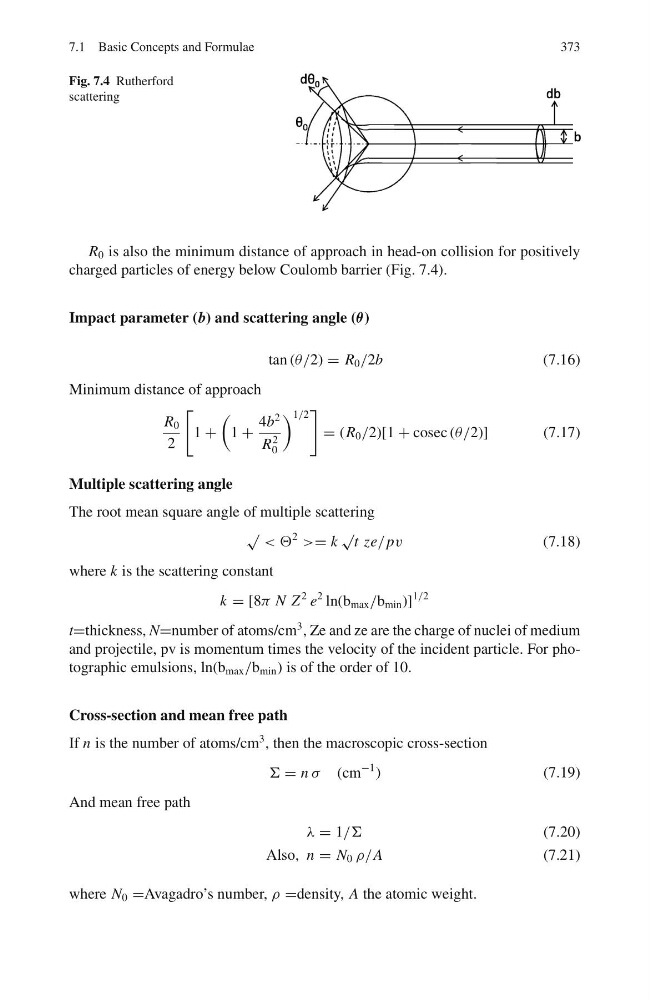
Fig. 7.4 Rutherford
scattering
R 0 is also the minimum distance of approach in head-on collision for positively
charged particles of energy below Coulomb barrier (Fig. 7.4).
Impact parameter (b) and scattering angle (θ)
tan (θ/2) = R 0 /2b
(7.16)
Minimum distance of approach
R 0
2
1 +
1 +
4b
2
R
2
0
1/2
= (R 0 /2)[1 + cosec (θ/2)]
(7.17)
Multiple scattering angle
The root mean square angle of multiple scattering
√ < Θ
2
>= k
√
t ze/ pv
(7.18)
where k is the scattering constant
k = [8π N Z
2 e
2 ln(b max /b min )]
1/2
t=thickness, N=number of atoms/cm
3 , Ze and ze are the charge of nuclei of medium
and projectile, pv is momentum times the velocity of the incident particle. For photographic emulsions, ln(b max /b min ) is of the order of 10.
Cross-section and mean free path
If n is the number of atoms/cm
3 , then the macroscopic cross-section
Σ = n σ (cm
−1 )
(7.19)
And mean free path
λ = 1/Σ
(7.20)
Also, n = N 0 ρ/A
(7.21)
where N 0 =Avagadro’s number, ρ =density, A the atomic weight.
373
Fig. 7.4 Rutherford
scattering
R 0 is also the minimum distance of approach in head-on collision for positively
charged particles of energy below Coulomb barrier (Fig. 7.4).
Impact parameter (b) and scattering angle (θ)
tan (θ/2) = R 0 /2b
(7.16)
Minimum distance of approach
R 0
2
1 +
1 +
4b
2
R
2
0
1/2
= (R 0 /2)[1 + cosec (θ/2)]
(7.17)
Multiple scattering angle
The root mean square angle of multiple scattering
√ < Θ
2
>= k
√
t ze/ pv
(7.18)
where k is the scattering constant
k = [8π N Z
2 e
2 ln(b max /b min )]
1/2
t=thickness, N=number of atoms/cm
3 , Ze and ze are the charge of nuclei of medium
and projectile, pv is momentum times the velocity of the incident particle. For photographic emulsions, ln(b max /b min ) is of the order of 10.
Cross-section and mean free path
If n is the number of atoms/cm
3 , then the macroscopic cross-section
Σ = n σ (cm
−1 )
(7.19)
And mean free path
λ = 1/Σ
(7.20)
Also, n = N 0 ρ/A
(7.21)
where N 0 =Avagadro’s number, ρ =density, A the atomic weight.