

7.1 Basic Concepts and Formulae
375
Straggling
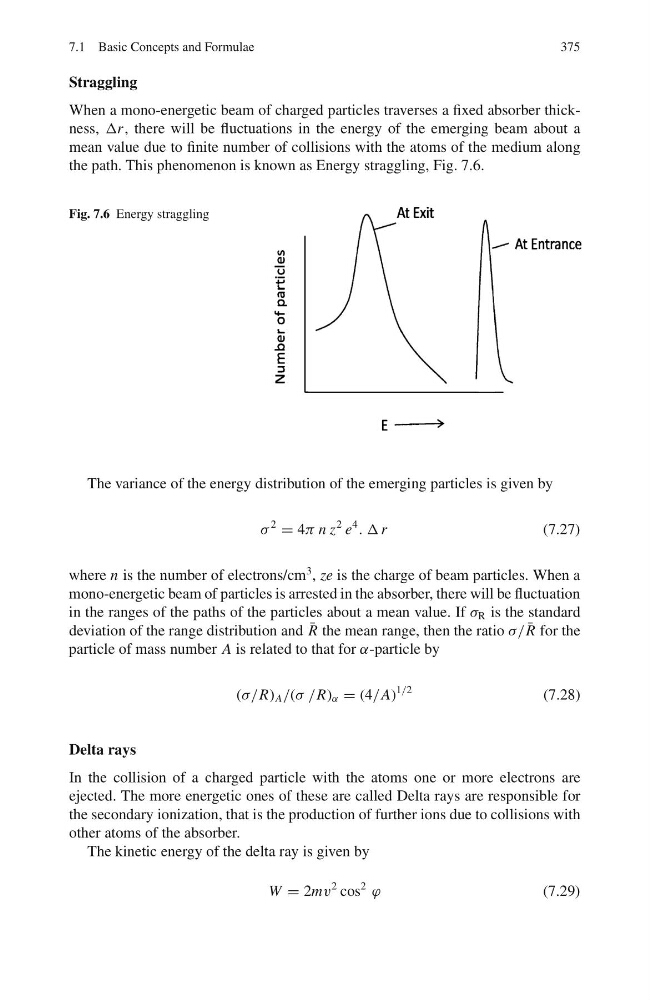
When a mono-energetic beam of charged particles traverses a fixed absorber thickness, Δr , there will be fluctuations in the energy of the emerging beam about a
mean value due to finite number of collisions with the atoms of the medium along
the path. This phenomenon is known as Energy straggling, Fig. 7.6.
Fig. 7.6 Energy straggling
The variance of the energy distribution of the emerging particles is given by
σ
2
= 4π n z
2 e
4
. Δ r
(7.27)
where n is the number of electrons/cm
3 , ze is the charge of beam particles. When a
mono-energetic beam of particles is arrested in the absorber, there will be fluctuation
in the ranges of the paths of the particles about a mean value. If σ R is the standard
deviation of the range distribution and ¯
R the mean range, then the ratio σ/ ¯
R for the
particle of mass number A is related to that for α-particle by
(σ/R) A /(σ /R) α = (4/A)
1/2
(7.28)
Delta rays
In the collision of a charged particle with the atoms one or more electrons are
ejected. The more energetic ones of these are called Delta rays are responsible for
the secondary ionization, that is the production of further ions due to collisions with
other atoms of the absorber.
The kinetic energy of the delta ray is given by
W = 2mv
2 cos
2
ϕ
(7.29)
375
Straggling
When a mono-energetic beam of charged particles traverses a fixed absorber thickness, Δr , there will be fluctuations in the energy of the emerging beam about a
mean value due to finite number of collisions with the atoms of the medium along
the path. This phenomenon is known as Energy straggling, Fig. 7.6.
Fig. 7.6 Energy straggling
The variance of the energy distribution of the emerging particles is given by
σ
2
= 4π n z
2 e
4
. Δ r
(7.27)
where n is the number of electrons/cm
3 , ze is the charge of beam particles. When a
mono-energetic beam of particles is arrested in the absorber, there will be fluctuation
in the ranges of the paths of the particles about a mean value. If σ R is the standard
deviation of the range distribution and ¯
R the mean range, then the ratio σ/ ¯
R for the
particle of mass number A is related to that for α-particle by
(σ/R) A /(σ /R) α = (4/A)
1/2
(7.28)
Delta rays
In the collision of a charged particle with the atoms one or more electrons are
ejected. The more energetic ones of these are called Delta rays are responsible for
the secondary ionization, that is the production of further ions due to collisions with
other atoms of the absorber.
The kinetic energy of the delta ray is given by
W = 2mv
2 cos
2
ϕ
(7.29)