

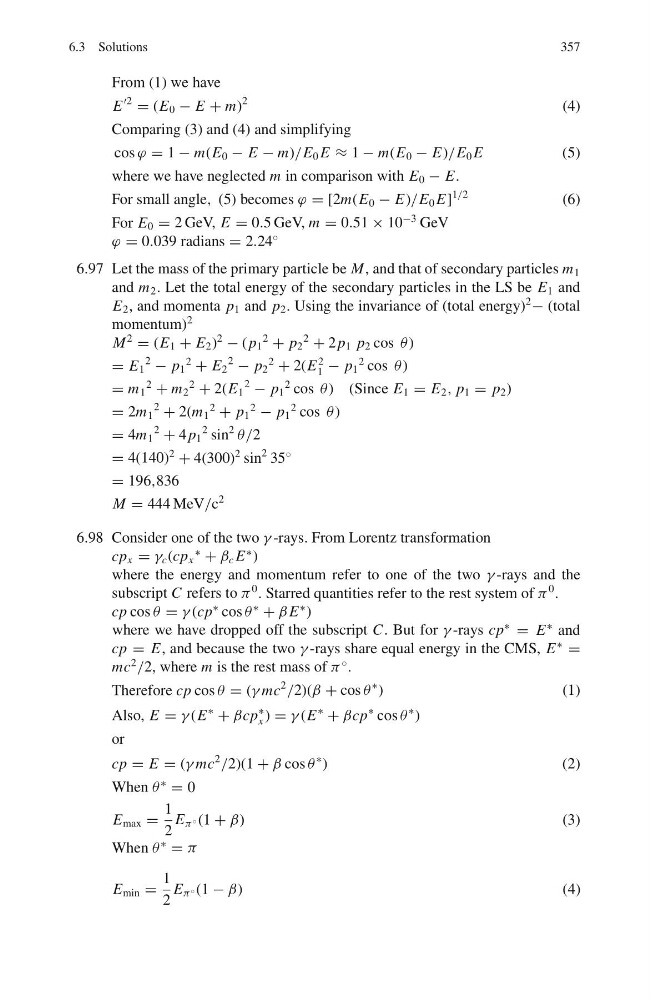
6.3 Solutions
357
From (1) we have
E
2
= (E 0 − E + m)
2
(4)
Comparing (3) and (4) and simplifying
cos ϕ = 1 − m(E 0 − E − m)/E 0 E ≈ 1 − m(E 0 − E)/E 0 E
(5)
where we have neglected m in comparison with E 0 − E.
For small angle, (5) becomes ϕ = [2m(E 0 − E)/E 0 E]
1/2
(6)
For E 0 = 2 GeV, E = 0.5 GeV, m = 0.51 × 10
−3 GeV
ϕ = 0.039 radians = 2.24
◦
6.97 Let the mass of the primary particle be M, and that of secondary particles m 1
and m 2 . Let the total energy of the secondary particles in the LS be E 1 and
E 2 , and momenta p 1 and p 2 . Using the invariance of (total energy)
2
− (total
momentum)
2
M
2
= (E 1 + E 2 )
2
− ( p 1
2
+ p 2
2
+ 2 p 1 p 2 cos θ )
= E 1
2
− p 1
2
+ E 2
2
− p 2
2
+ 2(E
2
1 − p 1
2 cos θ )
= m 1
2
+ m 2
2
+ 2(E 1
2
− p 1
2 cos θ) (Since E 1 = E 2 , p 1 = p 2 )
= 2m 1
2
+ 2(m 1
2
+ p 1
2
− p 1
2 cos θ)
= 4m 1
2
+ 4 p 1
2 sin
2
θ/2
= 4(140)
2
+ 4(300)
2 sin
2 35
◦
= 196,836
M = 444 MeV/c
2
6.98 Consider one of the two γ -rays. From Lorentz transformation
cp x = γ c (cp x
∗
+ β c E
∗ )
where the energy and momentum refer to one of the two γ -rays and the
subscript C refers to π
0 . Starred quantities refer to the rest system of π
0 .
cp cos θ = γ (cp
∗ cos θ
∗
+ β E
∗ )
where we have dropped off the subscript C. But for γ -rays cp
∗
= E
∗ and
cp = E, and because the two γ -rays share equal energy in the CMS, E
∗
=
mc
2
/2, where m is the rest mass of π
◦ .
Therefore cp cos θ = (γ mc
2
/2)(β + cos θ
∗ )
( 1 )
Also, E = γ (E
∗
+ βcp
∗
x ) = γ (E
∗
+ βcp
∗ cos θ
∗ )
or
cp = E = (γ mc
2
/2)(1 + β cos θ
∗ )
( 2 )
When θ
∗
= 0
E max =
1
2
E π ◦ (1 + β)
( 3 )
When θ
∗
= π
E min =
1
2
E π ◦ (1 − β)
( 4 )
357
From (1) we have
E
2
= (E 0 − E + m)
2
(4)
Comparing (3) and (4) and simplifying
cos ϕ = 1 − m(E 0 − E − m)/E 0 E ≈ 1 − m(E 0 − E)/E 0 E
(5)
where we have neglected m in comparison with E 0 − E.
For small angle, (5) becomes ϕ = [2m(E 0 − E)/E 0 E]
1/2
(6)
For E 0 = 2 GeV, E = 0.5 GeV, m = 0.51 × 10
−3 GeV
ϕ = 0.039 radians = 2.24
◦
6.97 Let the mass of the primary particle be M, and that of secondary particles m 1
and m 2 . Let the total energy of the secondary particles in the LS be E 1 and
E 2 , and momenta p 1 and p 2 . Using the invariance of (total energy)
2
− (total
momentum)
2
M
2
= (E 1 + E 2 )
2
− ( p 1
2
+ p 2
2
+ 2 p 1 p 2 cos θ )
= E 1
2
− p 1
2
+ E 2
2
− p 2
2
+ 2(E
2
1 − p 1
2 cos θ )
= m 1
2
+ m 2
2
+ 2(E 1
2
− p 1
2 cos θ) (Since E 1 = E 2 , p 1 = p 2 )
= 2m 1
2
+ 2(m 1
2
+ p 1
2
− p 1
2 cos θ)
= 4m 1
2
+ 4 p 1
2 sin
2
θ/2
= 4(140)
2
+ 4(300)
2 sin
2 35
◦
= 196,836
M = 444 MeV/c
2
6.98 Consider one of the two γ -rays. From Lorentz transformation
cp x = γ c (cp x
∗
+ β c E
∗ )
where the energy and momentum refer to one of the two γ -rays and the
subscript C refers to π
0 . Starred quantities refer to the rest system of π
0 .
cp cos θ = γ (cp
∗ cos θ
∗
+ β E
∗ )
where we have dropped off the subscript C. But for γ -rays cp
∗
= E
∗ and
cp = E, and because the two γ -rays share equal energy in the CMS, E
∗
=
mc
2
/2, where m is the rest mass of π
◦ .
Therefore cp cos θ = (γ mc
2
/2)(β + cos θ
∗ )
( 1 )
Also, E = γ (E
∗
+ βcp
∗
x ) = γ (E
∗
+ βcp
∗ cos θ
∗ )
or
cp = E = (γ mc
2
/2)(1 + β cos θ
∗ )
( 2 )
When θ
∗
= 0
E max =
1
2
E π ◦ (1 + β)
( 3 )
When θ
∗
= π
E min =
1
2
E π ◦ (1 − β)
( 4 )