

356
6 Special Theory of Relativity
6.91 (a) λ/λ
= [(1 + β)/(1 − β)]
1/2
= 656/434 = 1.5115
v = βc = 1.17 × 10
8 ms
−1
(b) the nebula is receding
6.92 λ/λ
= [(1 + β)/(1 − β)]
1/2
= (1 + β)
1/2 (1 − β)
−1/2
≈ (1 + β/2 + . . .)(1 + β/2 − . . .)
= 1 + β + . . . (neglecting higher order terms)
Δλ/λ
= (λ/λ
) − 1 = β = v/c
6.93 λ/λ
= [(1 + β)/(1 − β)]
1/2
= 670/525
β = 0.239
v = βc = 0.239 × 3 × 10
8
= 7.17 × 10
7 ms
−1
= 7.17 × 10
4 kms
−1
This speed exceeds the escape velocity. Hence the explanation is not valid.
6.94 λ
= λ[(1 − β)/(1 + β)]
1/2
= 589.3[(1 − 0.21)/(1 + 0.21)]
1/2
= 476.2 nm
The color is blue
6.95 The source velocity is perpendicular to the line of sight. θ = 90
◦ ,
ν
= νγ
λ = γ λ
γ = 1/(1 − β
2 )
1/2
= 1/(1 − 0.05
2 )
1/2
= 1.00125
Δλ = λ − λ
= λ
(γ − 1) = 589(1.00125 − 1)
= 0.736 nm = 7.36 ˚
A
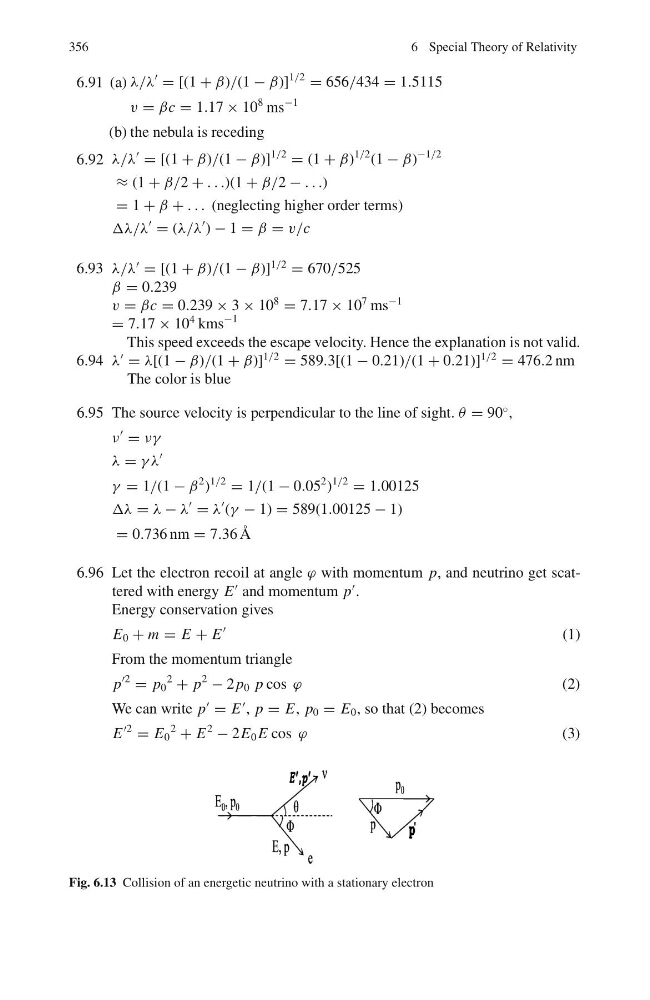
6.96 Let the electron recoil at angle ϕ with momentum p, and neutrino get scattered with energy E
and momentum p
.
Energy conservation gives
E 0 + m = E + E
(1)
From the momentum triangle
p
2
= p 0
2
+ p
2
− 2 p 0 p cos ϕ
(2)
We can write p
= E
, p = E, p 0 = E 0 , so that (2) becomes
E
2
= E 0
2
+ E
2
− 2E 0 E cos ϕ
(3)
Fig. 6.13 Collision of an energetic neutrino with a stationary electron
6 Special Theory of Relativity
6.91 (a) λ/λ
= [(1 + β)/(1 − β)]
1/2
= 656/434 = 1.5115
v = βc = 1.17 × 10
8 ms
−1
(b) the nebula is receding
6.92 λ/λ
= [(1 + β)/(1 − β)]
1/2
= (1 + β)
1/2 (1 − β)
−1/2
≈ (1 + β/2 + . . .)(1 + β/2 − . . .)
= 1 + β + . . . (neglecting higher order terms)
Δλ/λ
= (λ/λ
) − 1 = β = v/c
6.93 λ/λ
= [(1 + β)/(1 − β)]
1/2
= 670/525
β = 0.239
v = βc = 0.239 × 3 × 10
8
= 7.17 × 10
7 ms
−1
= 7.17 × 10
4 kms
−1
This speed exceeds the escape velocity. Hence the explanation is not valid.
6.94 λ
= λ[(1 − β)/(1 + β)]
1/2
= 589.3[(1 − 0.21)/(1 + 0.21)]
1/2
= 476.2 nm
The color is blue
6.95 The source velocity is perpendicular to the line of sight. θ = 90
◦ ,
ν
= νγ
λ = γ λ
γ = 1/(1 − β
2 )
1/2
= 1/(1 − 0.05
2 )
1/2
= 1.00125
Δλ = λ − λ
= λ
(γ − 1) = 589(1.00125 − 1)
= 0.736 nm = 7.36 ˚
A
6.96 Let the electron recoil at angle ϕ with momentum p, and neutrino get scattered with energy E
and momentum p
.
Energy conservation gives
E 0 + m = E + E
(1)
From the momentum triangle
p
2
= p 0
2
+ p
2
− 2 p 0 p cos ϕ
(2)
We can write p
= E
, p = E, p 0 = E 0 , so that (2) becomes
E
2
= E 0
2
+ E
2
− 2E 0 E cos ϕ
(3)
Fig. 6.13 Collision of an energetic neutrino with a stationary electron